|
|
| Tallinn, Estonia |
Copenhagen, Denmark: Denmark’s capital and oldest town is sophisticated, saucy and friendly. When Denmark ruled Norway and Sweden during the 15th century, Copenhagen was the capital of all three countries. Stroll the fairy-tale world of Tivoli Gardens, aglow with thousands of tiny twinkling lights. This cozy metropolis is a walking city. The ancient heart of the city is intersected by two walking streets known collectively as Stroget – and around them curls a maze of cobbled streets packed with tiny boutiques, cafes and restaurants. The Sofiero Slott is a majestic castle built in 1865 by Crown Prince Oscar and his wife Sophia, whose magnificent grounds include an extensive rhododendron collection. Rosenborg Palace houses the Danish crown jewels. The Stroget is a lively pedestrian section full of shops and interesting street scenes.
St. Petersburg, Russia: (Three Days) St Petersburg was built on a grand scale. The city sprawls across and around the mouth of the Neva River, at the end of the easternmost arm of the Baltic Sea. The Neva splits the city into northern, eastern and southern sectors. The area spreading back from the Winter Palace and the Admiralty on the south bank is the city's heart, and Nevsky prospect is its main artery.
For 200 years the vast Russian empire was ruled from this half-kilometer block at St Petersburg's heart. This is one of Europe's great squares, lined with colorful yet elegant edifices and dotted with monuments commemorating Russia's victory over Napoleon. It witnessed Bloody Sunday in 1905, the Bolshevik's grab for power in 1917, and all-night vigils in the name of democracy during the 1991 coup.
The square is dominated by the green, white and gold rococo fantasy of the Winter Palace, residence of tsars from 1762 to 1917 and the largest part of the famous State Hermitage Museum. The complex of buildings is the size of a small town. Four linked riverside buildings - the Winter Palace, the Little and Large Hermitage buildings and the Hermitage Theatre - hold a vast collection of Western European art, with enough chandeliers, over-the-top interior encrustations and tsarist jewels and treasures to have you seeing stars for days. The collection largely dates from the culturally heightened days of Catherine the Great, and many works were gained when Napoleon's power began to wane. Put together throughout two centuries and a half, the Hermitage collections of works of art present the development of the world culture and art from the Stone Age to the 20th century. The centerpiece of our cruise will be two unforgettable days in St. Petersburg. The Hermitage's three million exhibits with 200 Impressionist and Post- Impressionist master works, 25 Rembrandts and a Czarist collection of Matisses and Picassos is said to surpass anything in France.
Peter & Paul Fortress Built in 1703, the Peter & Paul Fortress is the oldest building in town. Its original purpose was to defend the land newly acquired from the Swedes. However, its main use up to 1917 was as a political prison and the first inmate was Peter's own son Alexey (Peter supervised his son's torture), who was followed by other notables such as Dostoevsky, Gorky, Trotsky and Lenin's older brother, Alexander.
The cathedral, though plain on the outside, has a magnificent baroque interior. Most of Russia's Romanov rulers are buried here. Between the cathedral and the Senior Officer's Barracks is a strangely proportioned statue of Peter the Great - rubbing his right forefinger apparently brings good luck.
Nevsky Prospect St Petersburg's 'Champs Élysées' is the famous Nevsky Prospect, which runs west from the Admiralty 4km (2mi) to the Alexandr Nevsky Monastery on the banks of the Neva. It's lined with fine buildings. Its residents include: Tchaikovsky, Nijinsky, Rimsky-Korsakov and Dostoevsky.
Sir Isaac's Cathedral The 21.8m-high golden dome dominating the St Petersburg skyline is Sir Isaac's Cathedral, the last neo-classical structure to be built in the city. French designer Ricard de Montferrand kick-started proceedings in 1818, but construction took so long (the cathedral wasn't finished until 1858) that Nicholas I was able to extend the original designs to include even more extravagance. The granite was ordered from Finland (and delivered in specially built ships and railways), 100kg of gold leaf were used for the dome and the end result - a lavish interior of marble and mosaic - along with the two largest solid lapis lazuli pillars ever mined in single pieces is a must-see. You can climb up the 43m-high colonnade for breathtaking views of the city.
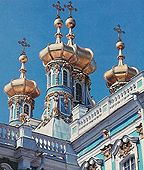 Pushkin Palace is the magnificent palace and former home of Czarina Catherine the Great. Looted and largely destroyed by the Nazis during World War II, the palace and gardens have been restored over the past 40 years to their original splendor. Your fully guided tour will begin with the main staircase, designed by Ippolito Monighetti in 1861. The palace ceilings were decorated with paintings by Italian artists in the 17th and 18th centuries. Be prepared to marvel at the magnificent Grand Hall or Throne Room, a gilded wonder with a spectacular painted ceiling and mirrored walls that are breathtakingly beautiful. The Cavalier’s Dining Room was designed by Bartolomeo Tastrelli and you will see Alexander I’s State Study with its splendid marble fireplace. The Picture Gallery contains more than 130 paintings by Dutch, Flemish, French and Italian masters of the 17th & 18th centuries.
Peterhof - "the Russian Versailles" ~ "the Capital of Russian Fountains." Peterhof is an immensely luxurious royal estate, lying on the shore of the Gulf of Finland (Baltic Sea), a combination of several palaces and parks, the "capital of Russian fountains" and "the Russian Versailles." The estate was founded by Peter the Great and shortly after 1710 the tsar had a beautiful park with several palaces built.
The focal point of both the Lower Park and the Upper Garden is the magnificent Grand Palace (Bolshoi Dvorets) with the Grand Cascade (Bolshoi Kaskad) in front of it. The original palace was built for Peter the Great in 1714-25 and in 1745-55 was remodeled to its present baroque glory by Bartolomeo Rastrelli, the architect of the Winter Palace in downtown St. Petersburg. Despite all the damage done to the Grand Palace during WW II, its interiors have been carefully restored and are truly breathtaking.
The Grand Cascade, which goes downhill from the palace towards the Baltic Sea, is one of the largest fountain ensembles in the world. The 64 fountains-built in 1721 use almost 8,000 gallons of water per minute without the use of pumping stations. Most of them were damaged during World War II, but have now been restored to their original beauty. From the Grand Cascade's largest fountain, the Samson, a channel goes through the park to the pier, where hydrofoils and boats from St. Petersburg arrive. Multiple fountains and pavilions (the Monplaizir Palace, Marly, the Hermitage-not to be confused with the Hermitage museum) are scattered all over the park. In a quiet part of the Alexandria Park there is the Cottage palace of Nicholas I, which unlike many other palaces has the royal living quarters carefully preserved.
The Upper Garden is a pretty baroque "formal garden" which separates the Grand Palace from the St. Petersburg-bound highway. Beyond the limits of the seemingly endless royal parks lies the town of Peterhof. It has a population of 82 thousand and is renowned throughout Russia for the "Raketa" wristwatches, which are produced there.
Peterhof is original name of the estate and the town is Peterhof is the German for "Peter's yard," "Peter's home." Note, that between 1944 and the early 1990’s the town was called Petrodvorets, and some guide books might still list it under that name.
A Word About Architecture. For most of its history, Russian architecture has been predominantly religious. Churches were for centuries the only buildings to be constructed of stone, and today they are almost the only buildings that remain from its ancient past. The basic elements of Russian church design emerged fairly early, around the eleventh century. The plan is generally that of a Greek cross (all four arms are equal), and the walls are high and relatively free of openings. Sharply-sloped roofs (tent roofs) and a multitude of domes cover the structure. The characteristic onion dome first appeared in Novgorod on the Cathedral of Sancta Sophia, in the eleventh century. On the interior, the primary feature is the iconostasis, an altar screen on which the church's icons are mounted in a hierarchical fashion.
The cathedral is actually a remarkable synthesis of traditional Russian architectural styles, though its classical proportions mark it as a work of the Italian Renaissance. The Russian tradition experienced a brief period of renewed influence under Ivan IV (the Terrible), under whose reign the legendary Cathedral of St. Basil's was built. In general, however, the Tsars began to align themselves increasingly with European architectural styles. The great example of this shift was Peter the Great, who designed St. Petersburg in accordance with prevailing European design. His successors continued the pattern, hiring the Italian architect Rastrelli to produce the rococo Winter Palace and Smolny Cathedral. Under Catherine the Great, the rococo was set aside for neoclassicism, completing St. Petersburg's thoroughly European topography.
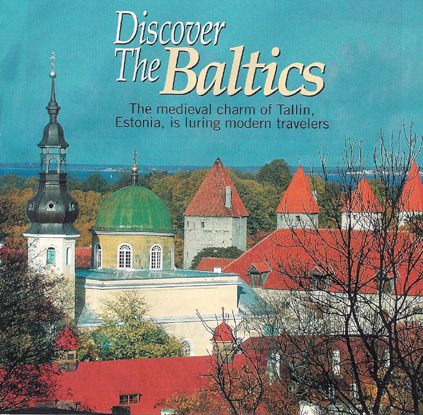
Tallinn, Estonia:
Medieval walls and towers still stand tall in Old Town. Stroll and shop along cobbleston streets, drop in at Alexander Nevsky Cathedral and find inspiration in the gleaming mosaics and icons. Tallinn is the amber capital of the world.
Visby, Gotland, Sweden:
In this delightful island town, stroll along the wide sandy beaches and cobbled streets lined with fairy-tale cottages and roses. Known as the town of ruins and roses, enjoy walking the medieval city walls, and visit Bronze Age burial sites.
To step inside one of the portals in the Visby town wall is like taking a step back into a forgotten time. The walled city of Visby is a piece of living Swedish & European medieval history. It is said that the center of Visby, with its ring-wall from the 13th century is an historic and unparalleled picture book of the history of Northern Europe.
Visby is not only the “City Of Roses And Ruins,” it is a city of walnut trees surrounded by myths and legends.
There are differing opinions as to how the town was established. Long before the time of Christ, there was a large Stone Age dwelling place here, the largest ever found in Sweden. It was so large that it could have been a Stone Age city, which re-established itself as an important trading center during the medieval period.
Visby was opened as a free port for international traders in 1161, -a medieval Gibraltar.
Visby’s famous ring-wall is three kilometers long and was constructed in several stages, primarily during the 13th century. The wall is adorned with 44 towers. Don’t miss the Kruttornet (Powder Tower) from the latter half of the 12th century. The tower is the only one of its kind in Sweden.
During the 13th century, conflicts between the rest of the island’s Gotlanders and the “Visby Germans” escalated. As a result, the city dwellers were forced to complement the protective wall facing the sea with another wall facing inland. In the spring of 1288, war broke out between the farmers and the citizens of Visby. The Swedish King interceded and the “Visby Germans” were forced to recognize King Magnus of the Swedish mainland as their rightful master. By that time, Visby’s days of greatness were over. New trading routs had developed further south in Europe and Visby’s importance as a free port diminished.
Today’s Visby has much left of its medieval charms. 650,000 tourists visit Gotland every year to view the town’s 17 preserved churches, the more than 200 structures with medieval masonry or just to enjoy some of the islands long, sandy beaches. Visby and Gotland are considered to be the sunniest places in Sweden. Visby has nearly 22,000 inhabitants. Approximately 3,000 live in the converted houses inside the ring-wall.
Cruise the Stockholm Archipelago:
The Stockholm archipelago has over 24.000 islands and it is a unique natural experience. It stretches 90 miles from Landsort in the south to Väddö in the north. Only 150 of the islands are inhabited year around. In the archipelago you will experience beautiful nature, wildlife, fjords, narrow channels and straits.
Stockholm, Sweden: Sleek marble buildings and old cobblestoned streets mingle here in what many regard as the world’s most beautiful city. Sprawled on 18 islands, Stockholm is the “Venice of the North.” The water is so clean you can fish and swim in it. You are seldom more than a five-minute walk from twisting, medieval streets and magnificent water views. Shop in medieval Gamla Stan, (Old Town), a labyrinth of narrow medieval streets, alleyways and quiet squares on the island just south of the city center. Watch the snappy changing of the guard at the Royal Palace. If only visited by taxi, don’t miss the world famous Vasamuseet, (Vasa Museum). The 17th-century warship Vasa (largest ship of its time), sank in Stockholm Harbor on its maiden voyage in 1628 because it was not carrying sufficient ballast. Forgotten for 333 years, the perfectly preserved vessel was recovered from the sea in 1961 and now stands sentinel over the harbor in her own striking museum.
=