|
|
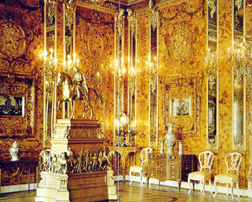
| The Amber Room at Saint Catherine's Palace |
What do you get from a 50 million year old pine tree? If it's seeped great globs of aromatic sticky resin, hardened and then fossilized into a soft (1-3) golden "gem" you have Amber.
Amber
Coral
Ivory
Pearls
Geologists and Paleontologists for fossils and prehistoric life
Archeologists for trade/movement of amber
Organic chemists for physical/chemical properties
Botanists and Entomologists for botanical and insects
Gemologists for jewelry
2) When heated, amber gives off a sweet pine smell with white smoke. Plastics, when heated smell like camphor or carbolic acid and have a disinfectant smell.
3) With a specific gravity of 1 -1.2, amber is buoyant in sea water. The more transparent the amber the higher its density and lower its buoyancy. Float it in salt water (2.5 tablespoons of salt per cup ). Amber will always float whereas thermoplastics or glass will sink.
4) Scrape the back with a knife. If it flakes, it's fake. If it is powdery, it's real.
5) If you rub amber vigorously on wool, the static charge will attract tissue paper.
Amber dates from 30 to 50 million years ago. Often confused with amber are "copal resins" which date back only a few hundred to a few million years.
The most valuable specimens contain inclusions such as insects, seeds, leaves and debris. Because amber dates back as far as 90 million years ago, it is unlikely you will find modern day insects. If you suspect the amber is real, but the insect, crustacean or barnacle has been added to increase its value, check very carefully for a small drill hole which was used to insert the insect and then filled with a modern resin. Often you will find tiny air bubbles coming out of the mouth of the insect as it died.
More than half the inclusions found in amber are flies. Then come: ants, beetles, moths, spiders, centipedes, termites, gnats, bees, cockroaches, grasshoppers and fleas. Fine Baltic amber from Estonia, for example will have only one inclusion in every thousand pieces found.
Amber is organic and not inorganic with an ordered crystalline structure, so it is NOT a mineral. Amber's color can vary depending on the source of the hardened tree resin. For example, the most common golden yellow, white, and ivory colored amber comes from pine trees. Cherry and plum trees produce an amber with more red, orange and brown tones.
Although the rarest colors are red and green, Americans tend to prefer the transparent, warmer colors. Amber will gradually darken over the years as it is exposed to air.
Other colors include:
Butterscotch (milky white to caramel)
Cognac or Honey
Cherry, (deep red) coming from pine and redwood trees (very rare)
Lemon, (translucent) is the most pure
Green (green overtones)
Antique (has been exposed to air for over 10,000 years
|
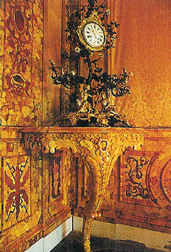
Cloudy amber or semi-transparent to opaque can be described as…
(a) "Fatty" Has tiny bubbles, suspended dust particles and is usually translucent and is yellowish in color resembling goose fat.
(b) "bony" or "foamy" ("frothy") is whitish yellow or brown and is opaque resembling ivory or bone. This type of amber is extremely soft and not easily polished.
For a being so soft, (1-3) amber is remarkably tough compared to other soft gem stones and yet, the amber from Estonia and other Baltic Sea countries is the toughest and least brittle of all ambers.
Like pearls, do not expose amber to harsh chemicals, jewelry cleaner, hair spray or perfume. Clean amber with warm water and a soft cloth.
The original source of amber is the Baltic Sea region consisting of: Norway, Denmark, Sweden, Germany, Poland, Latvia, Estonia and can be traced back to Prehistoric times and was used by our Stone Age predecessors. Baltic amber has even been found in Egyptian tombs dating back to 3200 B.C. Most Baltic Sea amber (Estonia and Latvia) comes from 25-40 meters beneath the ground.
Cretaceous amber can be found in California, and Poland (along the northwest side of Gdansk Bay, Bay of Danzig and Baltic coastline, amber can still be found), and in Siberia as well.
Tertiary amber can be found in California, (Simi Valley and Ventura County) , Poland, Sweden, (collected off the beaches in the southwest and in her Baltic islands), Germany, (found along the northern portion of Germany/Baltic coastline and inland along the Elbe river), Denmark, found along the west coast of Jutland from Germany to Skagen, Lithuania, (Lithuania has one of the largest amber museums in the world). Latvia in Liepaja is the School of Applied Arts, specializing in artistic uses of amber, Estonia, [Estonian use of amber in pottery dates back to the Stone Age) Russia, (Kaliningrad supplies over two-thirds of the world's amber) and The Netherlands. Although the oldest amber comes from The Baltic, amber has also been found in Mexico and The Dominican Republic.
Quaternary Amber can be found in Tanzania. This unique amber is older than copal resin, but younger than Baltic amber, Madagascar, Alaska (derived from cypress trees), Sweden, Germany and Poland.
Amber, from a metaphysical perspective ---
--- brings romantic love, purification, wisdom, energy and balance. It enhances patience, altruism, strength, calmness, healing, remembrance of past lives and ancient knowledge. This gentle stone draws out negative energy from the body and purifies the spirit and heart as well. Amber also helps us discover ancient wisdom and knowledge.