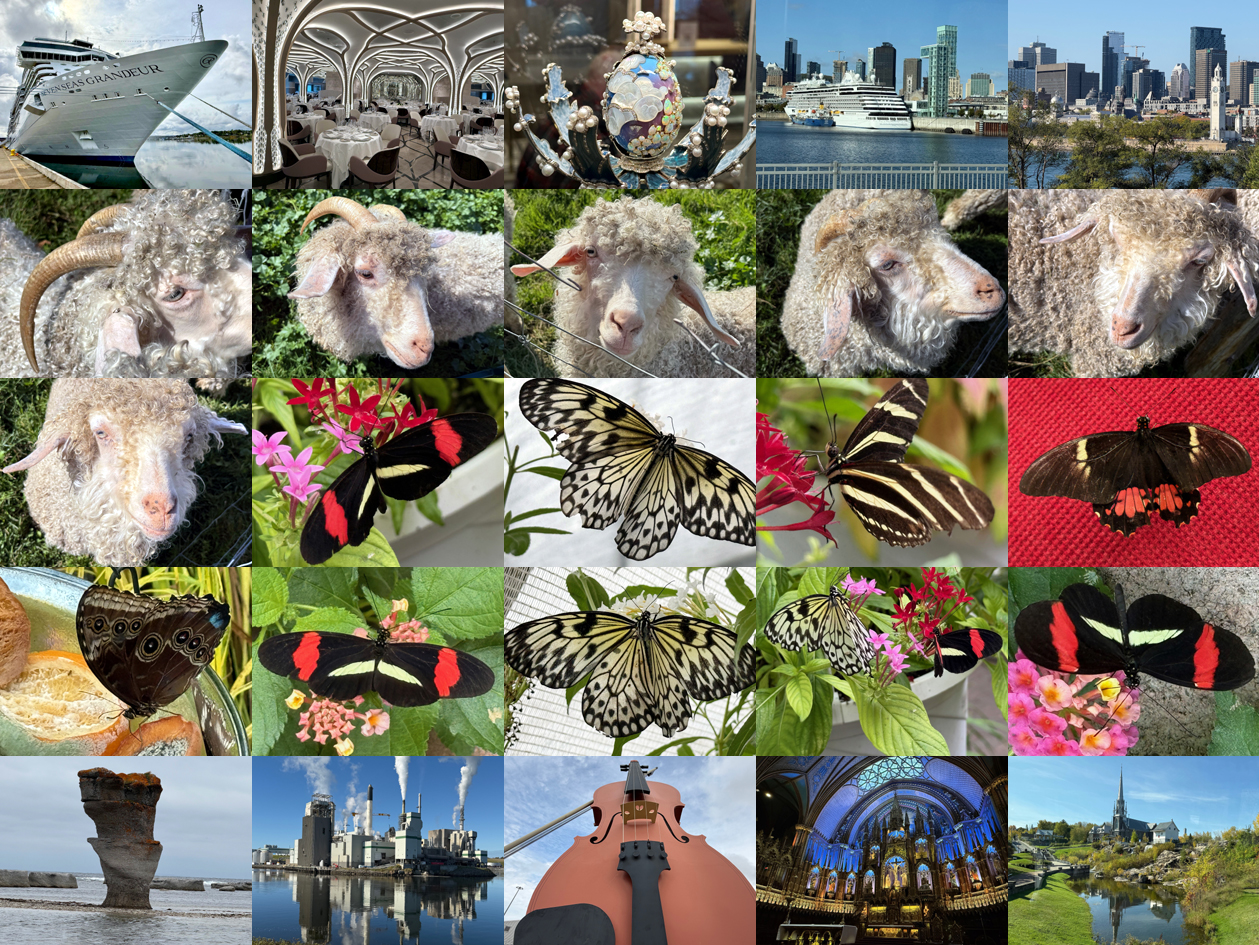
October 1 to 12, 2024 "Grandeur" Itinerary:
BOSTON ~ ~ ~ ~ ~ ~ ~ ~ ~ ~ ~ ~ ~ ~ ~ 10/1/24
PORTLAND, Maine ~ ~ ~ ~ ~ ~ ~ ~ ~ 10/2/24
SAINT JOHN, NEW BRUNSWICK~10/3/24
GULF OF ST. LAWRENCE ~ ~ ~ ~ ~ 10/4/24
SYDNEY (NOVA SCOTIA)~ ~ ~ ~ ~ ~10/5/24
CORNER BROOK ~ ~ ~ ~ ~ ~ ~ ~ ~ ~ 10/6/24
HAVRE-SAINT-PIERRE~ ~ ~ ~ ~ ~ ~ 10/7/24
SEPT-ILES~ ~ ~ ~ ~ ~ ~ ~ ~ ~ ~ ~ ~ ~ ~10/8/24
SAGUENAY ~ ~ ~ ~ ~ ~ ~ ~ ~ ~ ~ ~ ~ ~10/9/24
QUEBEC CITY~ ~ ~ ~ ~ ~ ~ ~ ~ ~ ~ ~10/10/24
MONTREAL ~ ~ ~ ~ ~ ~ ~ ~ ~ ~ ~ ~ ~ 10/11/24
MONTREAL ~ ~ ~ ~ ~ ~ ~ ~ ~ ~ ~ ~ ~ 10/12/24
The Angora or Ankara is a Turkish breed of domesticated goat. It produces the lustrous fiber known as mohair. It is widespread in many countries of the world. Many breeds derive from it, among them the Indian Mohair, the Soviet Mohair, the Angora-Don of the Russian Federation and the Pygora in the United States.
The goats are reared either for mohair or for their goat's meat. Mohair is not as fine as cashmere, but yields are much higher. Unlike cashmere, which is obtained by combing the coat of the goat, mohair is obtained by shearing; this is commonly done twice per year. In 2010 approximately half of all mohair production was in South Africa; Argentina, followed by the United States, Turkey, Australia and New Zealand. In some other countries the Angora is reared for its meat, which is succulent and tender, and which in the early twentieth century was described as the best of its kind in the world.
Other names: Angora goat, Ankara Kecisi, Mohair goat
Average weight: Male is 99 lbs. Female is 77 lbs.
Wool color is usually white; but can also be black, brown or grey
~ ~ ~ ~ ~ <> ~ ~ ~ ~ ~
Newfoundland Insectarium & Butterfly Pavilion
. . . . is located in the "UTC" Canadian Time Zone; (Coordinated Universal Time Zone), known for being one of the few 30-minute time zones of the world. Newfoundland insectarium and butterfly pavilion is situated in Reidville, (Deer Lake), Newfoundland, Canada about 40 minutes from Corner Brook. The butterfly pavilion features, hundreds of tropical butterflies, including the beautiful "Blue Morpho."
The insectarium and butterfly pavilion is housed in a beautifully restored historical barn, built in the 1940’s by its director and founder Lloyd Hollett.
www.nfinsectarium.com
NFinsectarium@gmail.com
Tel: 866.635.5454
The Irving Paper Mill in Saint John, New Brunswick, Canada - where Kimberly Clark made Kleenex Tissues
The Reversing Falls Rapids - Nature's Tug of War . . . . . A reversing rushing torrent
In Saint John, New Brunswick, Canada, you will find nature's phenomenon - where the Bay of Fundy's tides collide daily with the mighty Saint John River.
To learn more about the highest tides in the world, visit The You Tube Channel: "Reversing Falls Rapids" - "Nature's Tug of War."
Transcription: (Please excuse any typos).
At the Reversing Falls Rapids in St. John, New Brunswick, Canada, the mighty Bay of Fundy meets the Saint John River, creating the unique phenomenon that is the reversing falls.
At low tide, the St. John River runs down and empties into the bay. But what's different is the Bay of Fundy has the highest tides in the world here in St. John, New Brunswick.
The tides come up about 28 vertical feet - and further up the bay they come up as high as 50 feet - which is higher than a four story building. At low tide, the St. John River rushes down and empties out into the bay. As the tides start to rise they push on the river and cause the river to slow down and come to a complete stop. That's called a slack tide and during that time the water is completely still and looks like a lake - lasting for about 20 minutes.
It's only during that 20 minute period that boats can pass back-and-forth. The Bay of Fundy tides don't stop there. They continue to rise and push on the river, causing the river to reverse on itself. So it's flowing backwards and the effect of the current going backwards can be felt for 80 miles up the river. Then the Bay of Fundy tides start to go out - and it comes to another point where the bay and river are completely even. There's another slack tide for another 20 minutes and then the Bay of Fundy tides go all the way out and the river rushes down and empties out into the bay in a fantastic series of rapids and whirlpools. It takes about 12-1/2 hours to go from low tide to low tide.
Rivers everywhere feed the world's oceans. What's unusual is that twice each day the Saint John Harbor pushes back, overcoming the river current and making the waterfall 5 meters in the opposite direction. The abnormality is caused by The Bay of Fundy, a dynamic marine eco-system known for producing the world's most extreme tides. During the time between these contrary events, the water's surface rests placidly at half-tide, allowing vessels to come and go through the 150-meter-wide gorge in relative safety. While the reversing falls are exciting to watch the havoc created by Fundy's tidal flow through the gorge has brought peril to many.
The worst recorded disaster in the history of the reversing falls occurred on August 2, 1838 when 19 of 25 people perished after their vessel had a brush with the rocks and capsized.
About 20,000 years ago, the last continental glaciation reached its maximum. Before the last glaciation, the St. John River flowed to the sea through St. John. Retreating glaciers, left piles of sand and gravel, (called marines), that damned the river outlet. When the river found its new route about 14,000 years ago, it flowed over the rock ridges at Reversing Falls Rapids to create the gorge.
Thousands of years ago, a waterfall existed here, but as sea levels rose and the river bed eroded the waterfall was drowned. The phenomenon of the reversing falls rapids is only about 3000 years old. A profile of the river bed shows a series of waterfalls must have existed here starting near the islands at Fallsview Park and ending near the bridges just passed the islands. The river bottom drops to about 25 meters below low water level. Then it drops two more times to more than 40 meters below the water level.
The Big Fiddle ~ Cape Breton, (Sydney) ~ Nova Scotia
The World's Largest Fiddle located on the Sydney waterfront next to the Joan Harriss Cruise Pavilion greets visitors as they arrive via cruise ship. The fiddle and bow reach a height of 60 feet!
The Big Fiddle was designed and constructed by Cyril Hearn in 2005. It is a tribute to the folk music and traditions of the province's Celtic community.
Made of solid steel, the giant fiddle was dubbed FIDHEAL MHOR A' CEILIDH or the "Big Fiddle of the Ceilidh." Ceilidh is a Gaelic word which translates in to "visit. "
It is a must-see attraction when visiting Sydney.
The Ile Quarry is a pristine (limestone) monolith-dotted island. Havre-Saint-Pierre is located on the north shore of the Gulf of St. Lawrence, Quebec, Canada ~ east of Montreal ~ northeast of Quebec City.
~ ~ ~ ~ ~ <> ~ ~ ~ ~ ~
Montreal, Quebec, Canada
"Habitat 67" is a housing complex at Cite du Havre, on the Saint Lawrence River, Montreal, Quebec, Canada. It was built for Expo 67, a World's Fair held from April to October 1967.
The original plans called for 1,200 homes at a cost of $45 million. However, Safdie could only secure funding for a much reduced construction. This smaller development (about $22 million) was financed by the federal government, but is now owned by its tenants, who formed a limited partnership that purchased the building in 1985.
Habitat 67's interlocking forms, connected walkways and landscaped terraces were key in achieving Safdie's goal of a private and natural environment within the limits of a dense urban space.
Habitat 67 comprises 354 identical, prefabricated concrete forms (38 ft. x 17 ft. x 10 ft.) arranged in various combinations, divided into three pyramids, reaching up to 12 residential stories, with a parking level, and a building services level. Together these units created 146 residences of varying sizes and configurations, each formed from one to eight linked concrete units. Each unit is connected to at least one private landscaped garden terrace, built on the roof of the level below, which can range from approximately 225 to 1,000 sq ft in size. The apartments each have a molded plastic bathroom and a modular kitchen.
The development was designed to integrate the benefits of suburban homes - namely gardens, fresh air, privacy, and multilevel environments - with the economics and density of a modern urban apartment building. It was believed to illustrate the new lifestyle people would live in increasingly crowded cities around the world. Safdie's goal for the project to be affordable housing largely failed: demand for the building's units has made them more expensive than originally envisioned. In addition, the existing structure was originally meant to only be the first phase of a much larger complex, but the high per-unit cost of approximately $140,000 ($22,120,000 for all 158) prevented that possibility.
The theme of Expo 67 was "Man and His World," taken from Antoine de Saint-Exupery's memoir Terre des hommes (literally, 'world of man', though it was published under the title Wind, Sand and Stars). Housing was also one of the main themes of Expo 67. Habitat 67 then became a thematic pavilion visited by thousands of visitors who came from around the world, and during the expo also served as the temporary residence of the many dignitaries visiting Montreal.
Habitat 67 appears in: the background matte painting of the Scalosian City, from the remastered 1968 episode "Wink of an Eye" of Star Trek: The Original Series. The music video for Leonard Cohen's song "In My Secret Life" was filmed at Habitat 67.
The building's covered walkways and exterior appear in several scenes in 1977's The Disappearance, starring Donald Sutherland, where the main character shares an apartment in the building with his wife.
Habitat 67 appears as a constructible building in the video game Forge of Empires. It appears on the album cover of Landslide's Drum & Bossa / Buddah, his debut single from 1999 that was released on Hospital Records. It also appears on the covers of the 2003 album Velocity : Design : Comfort by American electronic/experimental rock act Sweet Trip and the 2012 album The North by Canadian indie pop band Stars. It also appeared in the 2007 movie Blades of Glory.
Alexander Graham Bell was born on March 3, 1847 in Edinburgh, Scotland and died on August 2, 1922 at his estate in Baddeck, Nova Scotia.
Belk's mother was deaf as was his wife Mabel, and he spent much of his life working with deaf people, including Helen Keller.
On March 7, 1876 Bell's patent for the telephone - No. 174465 was approved by the US patent office.
"Mr. Watson, come here. I want to see you," were the first words spoken over the telephone.
He spent his career experimenting in the fields of medicine, marine engineering, aerodynamics sound, transmission, and projects to assist the hearing impaired. Both he and his wife, Mabel dedicated their lives to scientific inquiry and bettering the lives of others.
During the last 30 years of his life, many of Alexander Graham Bell's experiments were conducted in Baddeck, Nova Scotia, where he had an extensive workshop and laboratory.
On February 23, 1909 more than 100 people witness the first successful powered flight in Canada as the "Silver Dart" lifted off the ice on Baddeck Bay, Nova Scotia, and flew 800 meters. More than 30 flights were conducted over the next month with the "Silver Dart!"
In case you were wondering why pirates don't take a shower before they walk the plank - it's because they just wash up on shore!