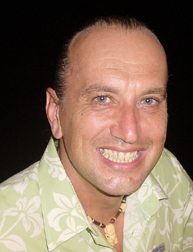
Dr. Mark Eddowes, Lecturer
Dr. Mark Eddowes, Lecturer |
He learned French and Tahitian, the latter giving him access to numerous communities with whom he has worked and given him a better knowledge of Tahitian society, past and present as a result. He is a student of Professor Roger Green (University of Harvard US-Auckland NZ), a founding father of Polynesian archaeology and the world authority on the “Lapita people” ancestors of the Polynesians. He also began the first systematic studies of marae or Tahitian temple architecture, which Mark has continued.
Mark has excavated with, and is a persona1 friend of another esteemed archaeologist Professor Bob Suggs, whose excavations in the 1950's created the model for the settlement of East Polynesia via the Marquesas Islands. As such he is an acknowledged expert and researcher in his field among Professors and students alike in Polynesian anthropology.
He was resident archaeologist from 1989 to 1999 at the Musee de Tahiti et des iles in Tahiti during which he undertook fieldwork and lived upon numerous islands in French Polynesia.
Mark will be sailing with us and lecturing on board the m/s Paul Gauguin.
 It is necessary to go right back to the dawn of Maohi civilization to trace the beginnings of tattooing in the Polynesian archipelago. The practice was originally widespread in the Society Islands, where it reached the greatest heights of artistic perfection and was also favored by the inhabitants of the Marquesas Islands and the Maoris.
The practice of tattooing in Tahiti has a divine source and has been passed down uncontaminated from one generation to the next – for now outside influence has been able to alter the methods used or the way in which designs are applied to the skin.
Traditionally, tattooing has always been a privilege of the more eminent social classes. The main purposes of decoration were to enhance sexual attraction, to exalt the life force and to give the wearer a godlike appearance. Social ranking was signaled by tattoos that corresponded to the wearer’s position in the community under the supervision of the Ari’i. When initiates acquired greater prestige, they would get new tattoos.
Women had fewer tattoos than men, and only their hands, arms, hips, thighs and feet underwent the operation. Designs for women, being purely ornamental, were more elegant and better drawn. Men often had tattoos all over their body, including on the neck and ears. Only the face was left untattooed. For men, tattoos were often a kind of medal, awarded for daring in war or to mark a special event, and were always an affirmation of cultural identity.
There are many different tattoos and they were applied to many parts of the body. Each design had its own special name for the back of the body, the ear lobes and buttocks. Some were stylized patterns of stars circles, diamonds- while others reflected the sway of like of a community; battles and weapons for the Uru, human sacrifices for the Marae. Tattooers also drew inspiration from dogs, other animals and fish. The tattooer priest who carried out this delicate operation was generously rewarded and enjoyed great standing in society.
The tools of the tattooer priest (Tahu’a Tatau), which are still used today, were two comb-like instruments, a punch and a stick. The punch had a wooden handle into which a bird bone, or shard of mother-of-pearl, or a tooth from a fish, pig, shark, whale, or even a human being had been carefully attached and sharpened. Some combs had as many as 26 such points. To help this first tool penetrate beneath the skin, the tattooer priest had a second instrument at his disposal. This was a stick that was used as a hammer on the punch.
The extremely black dye used came from the burns and dried fruit of the “bancoule Tiairi.” The resulting powder was mixed with water or “monoi.” The dye was injected under the skin and took on an absolutely indelible bluish coloration.