Golden Facts
Researched by Tom Taffel
San Francisco Gem and Mineral Society
Member Since 1975
eagles
- Atomic Symbol: AU
- Atomic Number: 79
- Atomic Weight: 196.967
- Specific Gravity: 19.300
- Melting Point 1,945 degrees F
- Boiling Point: 5,371 degrees F
- MOH's Scale of Hardness: 2.5
* Gold was formed with the earth's crust, generally in quartz veins, millions of years
ago.
* Gold makes up .001 p.p.m. of the earth's crust. In the sea it is approximately .004
p.p.m.
* Iron meteorites have been found to contain gold in concentrations as high as 0.7
p.p.m.
* Gold is very dense. 1.5 times more dense than lead, 19.3 times more dense than
water.
* Gold is malleable. An ounce of gold can be hammered to a thin sheet of at least 100
square feet.
* In a thin leaf, gold transmits green light.
* An ounce of gold can be stretched into a thin wire more than 5 miles long.
* A thread drawn from one ton of gold would stretch to the moon and back.
* Gold is used in computers, weaponry, spacecraft and in the treatment of chronic ulcers and
surgery to patch damaged nerves, blood vessels and bones.
* Electrical conductivity is 71 times that of copper.
* Various industries use 1,750 tons of gold a year. Dentists use 3 tons a year.
* 10 carat gold is 40% pure. Black Hills gold is alloyed with copper.
* 14 carat gold is 58% pure. And 42% alloy, generally silver.
* 18 carat gold is 75% pure.
* 24 carat gold is 100% pure and is attainable only through processing and refining.
* 21-23 carat gold is natural placer gold. 80-92% pure.
* 77% of all gold recovered is by lode mining and is crushed, processed and
refined.
* 20% of all gold recovered is byproduct of other base metal mining and must be
refined.
* Only 3% of the gold recovered is from natural placer deposits.
* Less than 1/10 of 1% of gold is found in nugget form. Of this, 10% is selected for
jewelry.
* An average of 80 cubic yards of gravel must be “sluiced” to find one ounce of placer
gold.
* A one ounce nugget is as rare a find as a 5 carat diamond.
* Like snowflakes, no two nuggets are alike.
* The largest gold nugget ever found in Alaska was discovered near Nome.
It weighed
155 ounces, was 7" long, 4" wide and 2" thick.
* According to Alaska's Mineral Industry 1990, major operators produced
231,000
ounces of gold in 1990, down from 297,900 ounces in 1989.
* Gold was first discovered in Alaska on the Kenai Peninsula in 1848.
* Laboratory Pure Gold is 1.000 Fine. Commercially Fine Gold is .999 Fine
* U.S. Gold Coins are .9166 Fine (22 Karat)
* Annual world production of gold approaches 50 million ounces. Of that,
30 million ounces comes from South Africa
5 million ounces comes from Russia
3.3 million ounces comes from Canada
1.8 million ounces comes from The United States
.9 million ounces comes from Australia
Gold is 19 times heaver than water. Gold will fall quickly to that bottom of a water course and then tend to stay in that place. Where it falls and how far down stream it will travel is the deciding factor in where to look for gold.
Gold being heaver than any other material in the stream will be moving very reluctantly. In doing so it will generally move in a straight line following the path of least resistance. When gold does encounter resistance--like a large boulder, it will stop and of course fall to the bottom of the river, or get stuck in a crevice of the boulder as it is falling. The first place to look for gold is out in the middle of the river around boulders. However if that boulder is in fast part of the river, unless the gold piece was big, the gold may have been washed right over or around and on down stream. The ideal spot for a boulder area that would produce gold would be in part of the river where the water slows to almost a stop A pool of water on either side of the boulder would be a good spot to start a search.
|
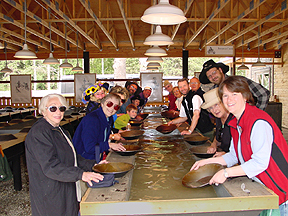
Panning For Gold In Skagway
True and False … Jade
Although Serpentine is often sold as jade, Jadeite and Nephrite are the only two-forms of true jade.
The more expensive and rarer of the two is Jadeite, the highest quality being imperial jade. With a hardness of 7, it can be green, black, white, red, yellow, lilac, orange, pink, blue and brown.
Nephrite jade is the more common of the two and is often used in Chinese carvings and comes in many tones of green, predominantly olive, and has a hardness of 6.5.
Misleading "False" Terms For Jade:
"Amazon jade" and "Colorado Jade" is amazonite or green feldspar
"American jade" is Californite, a green variety of idocrase
"Mexican jade” and “Imperial Mexican jade" are green-dyed calcite
"Indian jade" is aventurine
"Korean jade" and "new jade" are serpentine