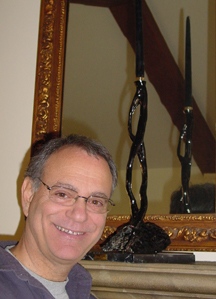
“Black Coral”
by Tom Taffel
San Francisco Gem & Mineral Society
member since 1975
|
by Tom Taffel
member since 1975 |
Actually there are more than 500 species of coral, (antipatharians), but only 150 species of black corals. From Hawaii alone, come 14 species of black coral. But the most rare of all black corals comes from the Western Caribbean off Grand Cayman Island from depths of over 200 feet.
The growth rate of this rare black coral is ¼ to ½ inch diameter ~ every 100 years ~ which is why it's a protected species by international law and divers are only allowed to retrieve pieces which have broken off a reef naturally (in spite of its firm attachment to the sea floor).
Black corals are carnivores and have a hardness ranging from 4.0 - 5.5 and a density of 2.43 - 2.70 and are found in all oceans, most commonly in deep water habitats of tropical and subtropical seas. Of the 150 species of black coral, some can be found on reef slopes in water as shallow as 3 feet and as deep as 300 feet. Black coral has actually been found growing in depths of up to 20,000 feet. But coral larvae living in shallow waters will always be found in shaded areas were light is extremely limited. Black corals are colonial animals related to sea anemones. Colonies of black coral require swift currents which feed the corals animal plankton over their polyps. Black coral colonies thrive in deep, and therefore dark waters, usually near drop-offs and ledges.
It is the skeleton of the coral we see in jewelry and not the living coral that produces it. “A thin veneer of animal tissue, called the cenosarc, secretes the tightly-layered central skeleton of horn-like protein. Depending upon the species, the living tissue may be black, red, orange, brown, green, yellow or white. The gelatinous polyps located in this living "bark" are short and cylindrical, their six, non-retractable tentacles are armed with stinging cells.”
“Relatively little is known about the life cycle and reproduction of black corals. Like other cnidarians, black corals have life cycles that include both asexual and sexual reproduction. Asexual reproduction (budding) builds the colony by adding more living tissue that in turn secrets more skeleton. Regular growth rings laid down as the skeleton thickens can be used to estimate the age of the colony. Sexual reproduction involves the production of eggs and sperm to create young that can disperse and settle new areas. Polyps are either male or female, but a single colony may be hermaphroditic, with both male and female polyps. The larval stage, called a planula, can drift with currents until a suitable surface is found. Once the larva settles, it metamorphoses into a polyp form and secretes skeletal material that attaches it to the sea floor. Then it begins budding, creating more polyps that will for a young colony. Asexual reproduction can also occur naturally by fragmentation of branch ends.”
“Black coral has been harvested for centuries as a charm and a medicine. Early peoples of many cultures believed that black coral had the power to ward off evil and injury. The name, 'antipathies,' means 'against suffering.’”
Hawaii’s state gem is black coral as of 1987.
Renowned American designer and master sculptor Bernard Passman has turned black coral into a popular art medium and created works of art for Princess Diana, the Queen of England, President Nixon and Pope John Paul II. For Charles and Diana’s royal wedding Bernard Passman created a 97-piece black coral and sterling silver tableware service followed by an 11-piece set (in miniature) for Prince William.
The tools used in cutting and carving black coral are similar to those used by dentists.
Bernard K. Passman galleries are located in Georgetown, Grand Cayman Island; St. Thomas, U.S. Virgin Islands; Las Vegas, Nevada; New Orleans, Louisiana; and Ketchikan, Alaska. Bernard Passman has been granted a special permit to work with rare and precious material known as the “black gold of the Caribbean.” Speaking of gold, his beautiful rings sell for $20,000 and his famous “Ziegfeld Girl” has a value of $135,000. Other objets d’art, sculpture and jewelry of Bernard K. Passman can be seen at: www.passman.com.
Other species of black coral are found in the same South Pacific waters famous for black Tahitian pearls.
If you’ve always wanted to visit and explore the South Pacific, specifically Bora Bora, “the most beautiful island in the world” - James Michener - please join San Francisco Gem and Mineral Society Members (26 years), Tom Taffel and Bill Repp as they host their sixth annual group cruise to Tahiti and her islands: Bora Bora, Moorea, Raiatea, Tahaa, Tahiti and for the first time, The Marquesas Islands. We will be sailing July 12-July 23, 2005 aboard one of the world’s highest rated six-star ships: Radisson Seven Seas m/s Paul Gauguin. This small ultra-luxury cruise ship carries a maximum of 320 passengers and offers unlimited complimentary gourmet wines with both lunch and dinner. Airfare from San Francisco and Los Angeles, transfers, hotel, two island tours, gratuities and watersports plus a $100 per person shipboard credit are included. You will be able to study, learn about, and purchase (tax and duty free) black pearls right at the pearl farms -- at a fraction of U.S. prices. Raiatea, the vanilla island is famous for producing plump hand-pollinated vanilla beans…again, at a fraction of the price we pay in the United States.
Whether it’s the abundance of (bargain) black pearls, (starting at $10), beautiful corals, spectacular topography, the gourmet vanilla of the Society Islands of French Polynesia or just a luxurious, relaxing, (bargain), six-star cruise with six-star cuisine, this is a dream vacation to paradise!
(Tahiti) Tom Taffel