The Magical Islands of Venice
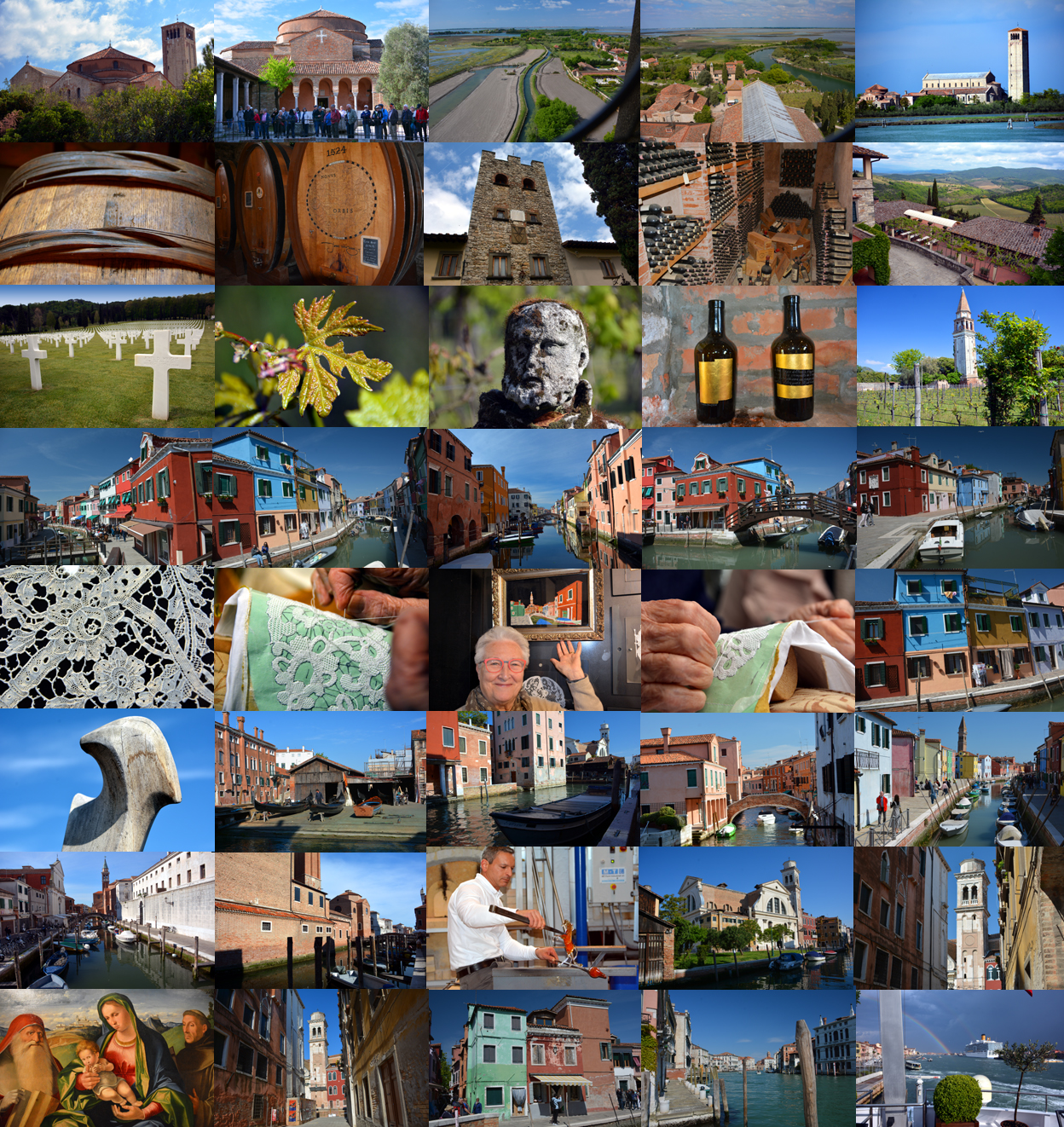
Colorful Burano with its lace making, Torcello's great Cathedral, and peaceful Mazzorbo's exclusive wine vineyard.
Burano, known for its colorful houses and lace making tradition, and Mazzorbo, famous for its exclusive wine made from golden-hued Dorona grapes, a time-honored and historic variety that dates back for centuries. The 500ml bottles with their 24-karat gold leaf designs sell for 80 Euros…empty!
Torcello
Torcello is home to spectacular Byzantine mosaics depicting the Last Judgment in the seventh-century Cathedral of Santa Maria Dell’Assunta.
Before there was a "Venice," there was semi-deserted Torcello – with its glittering Byzantine mosaics in a cathedral is stranded in the middle of a desolate, largely abandoned mud island in the Venetian Northern lagoon. Torcello was Venice 1.0, the first of the lagoon islands to be called home by a mainland population fleeing the Barbarian hordes that overran the Italian peninsula during the Dark Ages.
Its marshy badlands give you the best feeling for what Venice looked like when people first started settling there.
Torcello was a thriving center of some 20,000 inhabitants from the 7th to 11th centuries. It was from here that settlers first started moving to the area around the Rialto Bridge to build what we now know as Venice.
Starting in the 11th and 12th centuries, however, malaria and competition from the upstart community of La Serenissima set in and quickly depopulated the island.
Venice scavenged the ruins for building materials, so most of its buildings and palaces have now utterly vanished.
Torcello now runs on a skeleton crew of 75 inhabitants (though that's up from 20 just a few decades ago).
Today Torcello consists of little more than one long canal leading from the ferry landing past vineyards to a clump of buildings around a sun-bleached dirt-and-gravel square at its center.
Notice the wooden pilings hammered into the edges of the muddy bank. Atop such pilings all the stone palazzi of Venice itself are built. The anaerobic atmosphere down in the mud keeps the wood from rotting—but does nothing to keep the weight of all that stone from pressing them slowly farther into the mud while, simultaneously, the levels of the Adriatic Sea rise imperceptibly, sinking the city of Venice ever so slowly into the lagoon.
A bit farther along you'll pass a lithe, wafer-thin span of brick-and-stone without railings nicknamed "The Devil's Bridge." it was built in the 15th century (and restored in 2008), and its name—Ponte del Diavolo—is most likely merely a fun corruption of "Diavoli," the name of a local family.
The Cathedral of Torcello
On the main (only) square in town are two churches: the more elaborate-looking (but only on the outside) church of Santa Fosca, and the plain-jane brick facade of Venice's oldest monument and one of the prettiest churches in all of Greater Venice: the Cattedrale di Torcello (Basilica di Santa Maria Assunta), whose foundation dates to AD 639—though the current edition was built in 1008. The cathedral is famous for its outstanding 11th- to 12th-century Byzantine mosaics—a Madonna and Child in the apse and a Last Judgment on the west wall—glowing walls of gold-flecked art to rival those of Ravenna and of St. Mark's Basilica itself. It's no longer a cathedral since there's no bishop on Torcello.
The cathedral (tel. +39-041-730-119 or +39-041-296-0630) is open daily Mar-Oct 10:30am to 5:30pm; Nov-Feb 10am–5pm.
Next door to the cathedral is the simple, spare 11th-century Greek cross church dedicated to St. Fosca, a martyr from Ravenna who was buried here alongside her nurse and fellow martyr, St. Maura.
The octagonal columned portico and russet drum of its center look impressive, but the inside is nearly bare—though in a lovely way, with Byzantine capitals on the marble columns and a conical wooden ceiling.
Santa Fosca (tel. +39-041-730-084) is open daily 10am to 4:30pm. Admission is free.
Aside from a lone, tipsy campanile (bell tower) you can climb for great views of the rest of the island; given over to one scraggly vineyard and several swampy canals outlined by logs hammered into the muddy banks (again, a glimpse at how Venice looked before the stone palazzi were built).
Locanda Cipriani: A famous restaurant in the middle of nowhere Somewhat incongruously, the island is also home to a world-famous restaurant (famous because Hemingway loved it) called Locanda Cipriani (www.locandacipriani.com). Yes, that Cipriani, of various "Ciprianis" around the world—not to mention Harry's Bar in downtown Venice (the original Cipriani's first name was Arrigo, which is Italian for "Harry.")
Mazzorbo
Formerly called Maiurbium (from the latin Magna Urbs, Majour Town), the island of Mazzorbo had an important commercial function in the past. Founded as well at the moment of the Barbarian Invasions (640 A.C.), it took economical and social advantage from its proximity to Torcello, called at that time "Emporium Mega" (great emporium), main spot of the lagoon.
Mazzorbo is famous for a salt-water-tolerant heirloom grape, Dorona, which has been planted here to yield a luscious golden wine. A 500 ml bottle sells for 180 Euros. The empty bottle sells for 80 Euros!
Burano - the colorful island of lace
Many international magazines include Burano among the top 10 most colorful cities in the world.
Burano is an island in the Venetian Lagoon, northern Italy; like Venice itself, it could more correctly be called an archipelago of four islands linked by bridges.
The women of the island have been experts at lace since the 1400s, when Leonardo da Vinci himself visited to shop for cloth that he used on the altar at the Duomo di Milano.
Although in lacemaking in Burano is the main craftsmanship attraction, enchanting is also the "lume glass working": a technique born in the nearby island of Murano, but also widespread in the other islands of the Venetian Lagoon.
Although in lacemaking in Burano is the main craftsmanship attraction, enchanting is also the "lume glass working": a technique born in the nearby island of Murano, but also widespread in the other islands of the Venetian Lagoon.
The typical Burano's houses are mainly squared-shaped and are divided into two or three floors. On the ground floor is the kitchen, the breakfast nook and the toilet. Onthe next floor, there are the bedrooms.
Burano is an island in the Northern Venetian Lagoon, 11 Km northeastern far from Murano and Venice, to which it is connected by the Canale Bisatto - Canale Carbonera - Scomenzera San Giacomo's trail: this route from Venice to Burano takes 45 minutes by boat. This island is easily reachable also from Treporti (10 minutes) and Punta Sabbioni (30 minutes), two Cavallino-Treporti's resorts which overlook on the lagoon. Today in Burano there are around 3000 inhabitants, while the total number of people living in Venice and its islands is about 60000.
Chioggia
Chioggia is an unpretentious fishing town at the southern end of the Venetian lagoon. Like Venice it is built around canals and boats, but otherwise it is very different and makes an interesting excursion from Venice.
Chioggia market visit and boat ride on the Chioggia Lagoon
There’s no better place to indulge in Italy’s famed frutti di mare than Chioggia, a colorful fishing village on the Venice Lagoon. Stroll through the town’s bustling fish market with a guide. Or head via small boat to a casone (fisherman's hut on stilts in the middle of the lagoon) to experience how local fisherman harvest mussels.
Chioggia is in the Veneto region of Italy, a medium-sized fishing port just inside the Venetian lagoon with easy access to the Adriatic. It can be reached by public transport from Venice and makes an unusual day-trip destination. It has several picturesque spots and a slower, more ordinary, pace of life than Venice. The town's morning fish-market is a popular sight, and its seafood restaurants are highly-praised. Chioggia fancies itself as a 'little Venice', but apart from one or two imposing buildings and churches, it is more like an image of what Venice might be had it never discovered the splendid riches of trade.
Chioggia has ancient origins, being ideally placed for seagoing and defensive purposes. Etruscans settled here, and in Romans times the town was called Clodia. Chioggia grew in importance at the same time as the other Venetian lagoon settlements, when mainland-dwellers were seeking safer homes. The town's most famous moment came when it was part of the Venetian Republic, and Venice finally defeated Genoa here in the Battle of Chioggia. The town then subsided into a quiet fishing port, which is still pretty much its status today, although the seaside Sottomarina area has reinvented itself as a modern beach resort. Apart from the great sea-battle, one other historical event to which you'll see references around town is a local apparition of the Virgin Mary.