TASMANIAN DEVILS
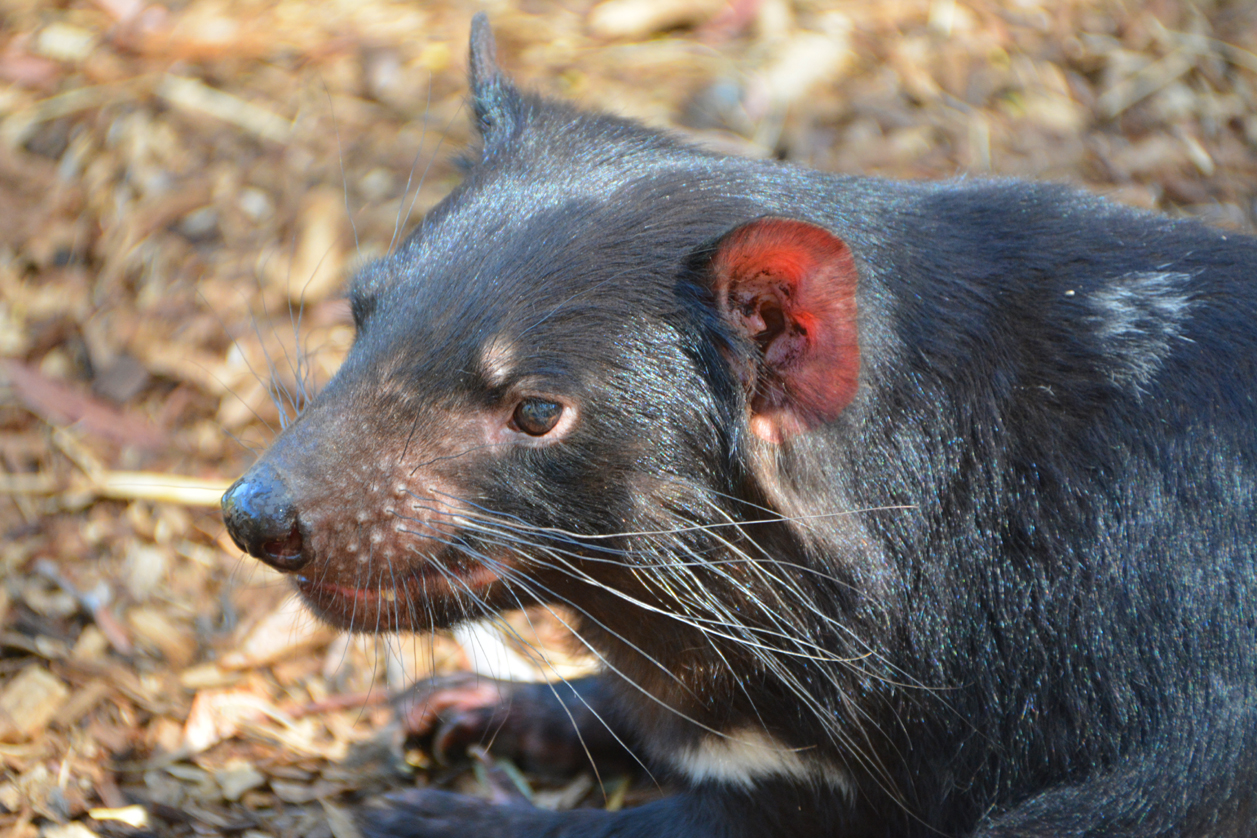
The Tasmanian Devil may look like a dog, skunk, badger, wolverine and rat, but it’s a marsupial. Like a kangaroo, they have a pouch. Although Tasmanian Devils are not good hunters, they eat meat. Like hyenas and wolverines, they are great scavengers. They live in dens and burrows.
PRISON - Port Arthur, Tasmania
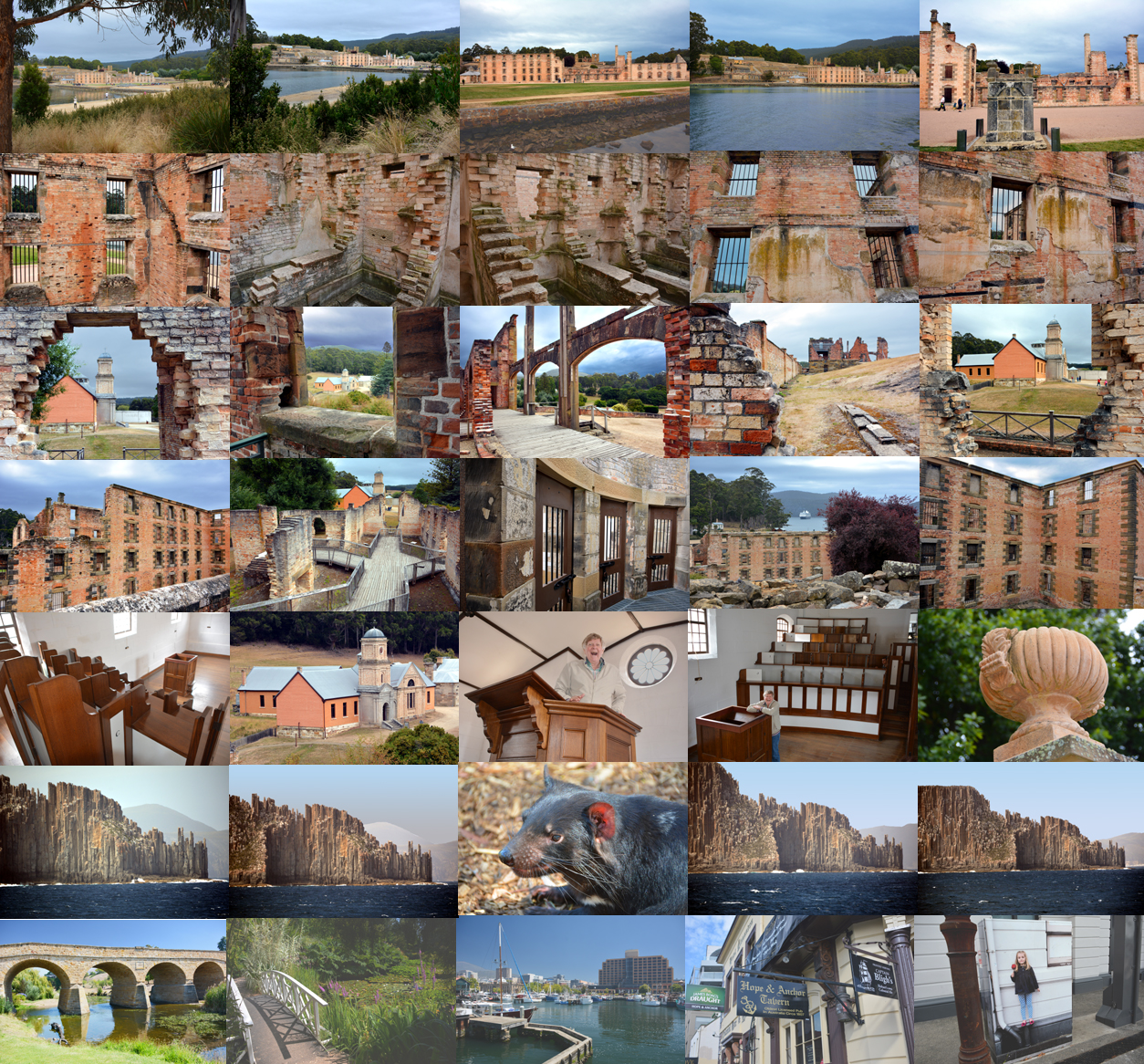
Port Arthur is a small town and former convict settlement on the Tasman Peninsula, in Tasmania, Australia. Port Arthur is one of Australia's most significant heritage areas and an open-air museum.
The site forms part of the Australian Convict Sites, a World Heritage property consisting of eleven remnant penal sites originally built within the British Empire during the 18th and 19th centuries on fertile Australian coastal strips. Collectively, these sites, including Port Arthur, now represent, "...the best surviving examples of large-scale convict transportation and the colonial expansion of European powers through the presence and labour of convicts."
Port Arthur is officially Tasmania's top tourist attraction. It is located approximately 37 miles south east of the state capital, Hobart. In 1996 it was the scene of the worst mass murder event in post-colonial Australian history.
Penal Station
Port Arthur was named after George Arthur, the Lieutenant Governor of Van Diemen's Land. The settlement started as a timber station in 1830, but it is best known for being a penal colony.
From 1833, until 1853, it was the destination for the hardest of convicted British criminals, those who were secondary offenders having re-offended after their arrival in Australia. Rebellious personalities from other convict stations were also sent here, a quite undesirable punishment. In addition, Port Arthur had some of the strictest security measures of the British penal system.
Port Arthur was one example of the "Separate Prison Typology" (sometimes known as the Model prison). The prison was completed in 1853 but then extended in 1855. The layout of the prison was fairly symmetrical. It was a cross shape with exercise yards at each corner. The prisoner wings were each connected to the surveillance core of the Prison as well as the Chapel, in the Centre Hall. From this surveillance hub each wing could be clearly seen, although individual cells could not.
The Separate Prison System also signaled a shift from physical punishment to psychological punishment. It was thought that the hard corporal punishment, such as whippings, used in other penal stations only served to harden criminals, and did nothing to turn them from their immoral ways. For example, food was used to reward well-behaved prisoners and as punishment for troublemakers. As a reward, a prisoner could receive larger amounts of food or even luxury items such as tea, sugar and tobacco. As punishment, the prisoners would receive the bare minimum of bread and water. Under this system of punishment the "Silent System" was implemented in the building. Here prisoners were hooded and made to stay silent, this was supposed to allow time for the prisoner to reflect upon the actions which had brought him there. Many of the prisoners in the Separate Prison developed mental illness from the lack of light and sound. This was an unintended outcome although the asylum was built right next to the Separate Prison. In many ways Port Arthur was the model for many of the penal reform movement, despite shipping, housing and slave-labor use of convicts being as harsh, or worse, than others stations around the nation.
The peninsula on which Port Arthur is located is a naturally secure site by being surrounded by water (rumored by the administration to be shark-infested). The 30m wide isthmus of Eaglehawk Neck that was the only connection to the mainland was fenced and guarded by soldiers, man traps and half-starved dogs.
Contact between visiting seamen and prisoners was barred. Ships had to check in their sails and oars upon landing to prevent any escapes. However, many attempts were made, and some were successful. Boats were seized and rowed or sailed long distances to freedom.
In 1836, a tramway was established between Taranna and a jetty in Long Bay, north of Port Arthur. The sole propulsion was convicts. One of the last remaining sections of the tramway can be viewed at the Federation Chocolate Factory at Taranna.
Port Arthur was sold as an inescapable prison, much like the later Alcatraz Island in the United States. Some prisoners were not discouraged by this, and tried to escape. One of the most infamous incidents, simply for its bizarreness, was the escape attempt of one George "Billy" Hunt. Hunt disguised himself using a kangaroo hide and tried to flee across the neck, but the half-starved guards on duty tried to shoot him to supplement their meager rations. When he noticed them sighting him up, Hunt threw off his disguise and surrendered, receiving 150 lashes.
Port Arthur was also the destination for juvenile convicts, receiving many boys, some as young as nine. The boys were separated from the main convict population and kept on Point Puer, the British Empire's second boys' prison. Like the adults, the boys were used in hard labor such as stone cutting and construction. One of the buildings constructed was one of Australia's first non-denominational churches, built in a gothic style. Attendance of the weekly Sunday service was compulsory for the prison population. Critics of the new system noted that this and other measures seemed to have negligible impact on reformation.
Despite its reputation as a pioneering institution for the new, enlightened view of imprisonment, Port Arthur was still in reality as harsh and brutal as other penal settlements. Some critics might even suggest that its use of psychological punishment, compounded with no hope of escape, made it one of the worst. Some tales suggest that prisoners committed murder (an offence punishable by death) just to escape the desolation of life at the camp. The Island of the Dead was the destination for all who died inside the prison camps. Of the 1646 graves recorded to exist there, only 180, those of prison staff and military personnel, are marked. The prison closed in 1877.
Port Arthur, Tasmania
<> <<>> <<<>>> <<>> >< <<>> <<<>>> <<>> <>
“RULES FOR PRISONERS”
This could be the longest run-on sentence ever written!
261 – The prisoners are cautioned against committing any of the undermentioned offences, for which they will be liable to punishment, via: communicating, or attempting to communicate with each other, either by words or signs; reading aloud; singing, dancing, or making any other noise whatever, except such as may be unavoidable in the performance of their allotted work; not rising when the first bell is rung; not keeping their persons, cells, and the various articles provided for their use at all times clean and neatly arranged; leaving their cells improperly dressed, or without their badges; not keeping their clothing in proper repair; not maintaining the proper interval from each other when proceeding to or from the Chapel or Exercise-yards; not behaving with due respect and decorum during Divine Service; stopping any of the ventilating apertures; making, defacing, or damaging in any way their books or utensils; wearing their caps in their cells; not remaining visible to the Officers on duty during Divine Service; not treating the Officers of the Establishment and all visitors with due respect; addressing any Officer or Constable, except for some necessary purpose; not immediately reporting any article in their possession being broken or damaged by accident or otherwise; having any unauthorized article whatever in their possession; using their copy-books or slates for any unauthorized purpose; unrolling their bedding before the bell has been rung for that purpose; not extinguishing their cell lights and retiring to rest at the appointed signal; taking down the lamps without permission; allowing their lights to burn above a moderate height.
262 – Any prisoner wishing to see the Governor, the Comptroller-General, the Civil Commandant, the Chaplain, Medical Officer or the Schoolmaster, will intimate his desire to the Officer on duty.
263 – Any complaint respecting the quantity of food must be made before the article is taken into the cell.
264 – Any other complaint is to be made to the Commandant, or the Officer in Charge.
265 – A Copy of these Rules to be suspended in each Cell.