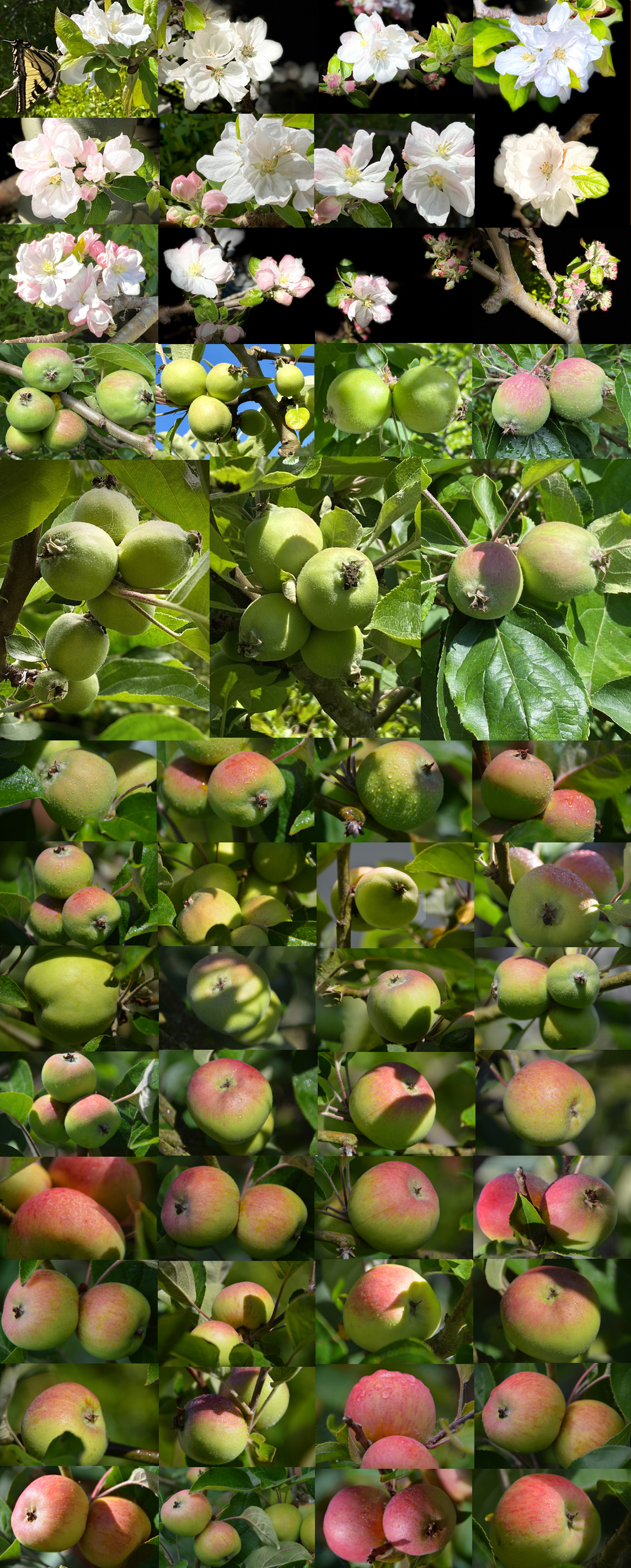
These may look Delicious, but they're Gravenstein
RED (GREEN) GRAVENSTEIN APPLES
Gravenstein apples are famous for apple sauce
apple pies, being eaten fresh and baked, because
they are flavorful, crisp, juicy, tart, and aromatic.
Apples, like pears & plums, belong to the rose family.
On the Endangered Species List - The Gravenstein Apple
https://northcoast.organic/endangered-species-list-gravenstein-apple/
Are the Gravenstein apples soon to disappear? The Gravenstein, a very special little heirloom apple, is grown only in Nova Scotia and Sonoma County, California, home of North Coast Organic. According to Slow Food USA, the Gravenstein is in danger of becoming broadly extinct because of many reasons, the most observable is its difficulty to harvest. Gravenstein apples have short stems, and their trees produce ripe apples at different times throughout the harvest season. They are also extremely delicate and perishable.
First planted in Sonoma County in 1811 by Russian trappers, the Gravenstein is known for its crisp, juicy texture and sweet, tart flavor. It's the first apple to ripen every season, usually mid-July, depending on the amount of rain received the preceding winter. It is squat, irregularly shaped and usually has a greenish yellow background, covered with broad red stripes.
Many orchards around Sonoma County that were once filled with Gravenstein apple trees have been converted to vineyards or rural estates. During the past six decades, Sonoma County's Gravenstein orchards have declined by almost 7,000 acres and are currently down to 960 acres. There are only six commercial Gravenstein apple growers remaining in Sonoma County. Together, their crop totals 15,000 tons of apples a year.
North Coast Organic is helping save the Gravenstein
As more consumers have come to appreciate the health benefits of organic apple products, North Coast Organic's need for local organic apples has grown. As a result, many Sonoma County growers are planting more organic apple orchards, including Gravenstein apples, rather than shifting their land to vineyards.
Apples ~ Apples ~ Apples
Apples originated in the mountains of Kazakhstan, in Central Asia and are members of the rose family along with pears, cherries, strawberries, raspberries, plums, and peaches. If well maintained, an apple tree can live up to 200 years.
Of the 7,500 cultivated apples, the most popular apples are: Golden, Pippin, Granny Smith, and Fuji but the number one apple, (until 2018), was Red Delicious, but now, the king of apples in the United States is the Gala apple. Let's not forget: Honeycrisp, McIntosh, Braeburn, Idared, Cosmic Crisp, and my personal favorite eating apple, the Pink Lady also known as Cripps Pink.
Although we're most familiar with the typical red, pink, yellow and green-skinned apples with white flesh, there are some exotic apples with purple or black skin and have pink or red flesh. If you find yourself in the remote parts of Tibet and you are prepared to pay $20 for one apple, you might try the dark purple Tibetan Black Diamond apple. Closer to home, (but not very plentiful), you will find the dark purple Arkansas Black apple, but like many apples, should not be eaten right off the tree, as the starches need plenty of time to convert to sugar.
What's so good about apples? Well, they are an excellent source of nutrients fiber, vitamin C, potassium, and antioxidants and phytochemicals such as quercetin, catechin, and chlorogenic acid.
Apples contain a lot of simple natural sugars like glucose, fructose, and sucrose. They have a low glycemic index (GI) - around 36 - (they won't spike your blood sugar much after you eat them). Their high fiber and polyphenol content prevent glucose spikes. A medium (3-inch diameter) apple contains: 95 calories, .5 grams protein, .3 grams fat, 25 grams total carbohydrates, 4.5 grams fiber, and 14% "Daily Value" vitamin C, 6% potassium, 5% vitamin K, 4% vitamin B6. Be sure to eat the skin for maximum nutrition . . . after washing them well with a produce brush to remove pesticide residue. You can also soak them in water and baking soda. . .or eat organic apples.
Apples are credited with such health benefits as: anticancer, reduces your risk of cardiovascular disease and heart attack, weight loss, improved bone, lung and brain health, blood sugar control. Apples may even stimulate hair growth and protect you from gastrointestinal issues as well as gastric ulcers.
Don't buy apples whose skin is damaged, discolored or have soft spots. Thin skin apples don't last as long. Apples give off ethylene gas which will speed up the ripening of other produce, so store them away from other produce, in your refrigerator crisper from 30-35 degrees F with 90-95% humidity in a plastic bag with holes, or cover them with a damp paper towel. Storing apples in an airtight container or sealed bag will release moisture and cause them to rot.
For a large quantity of apples, select a cool, dark humid place such as a basement or garage. If you wish to keep your apples for a prolonged period, individually wrap them in paper with their stem still intact. The paper helps keep the apples separate to prevent them from ripening each other. Wrapped apples should be put in a crate, ideally in a single layer, or in trays.
So, enjoy your apples...
Braeburn: The sweetness of this type mellows when heated, but the Braeburn apple keeps its shape. Braeburns work well in both sweet and savory dishes. Reddish-orange with
green and yellow streaks and a unique sweet-tart flavor. Best for cooking and baking.
Cortland: Crimson in color with a sweet flavor and crisp texture. Best for applesauce and apple butter.
Crispin: This variety is versatile and works well baked, in apple pies, or made into applesauce.
Fuji: This type is sturdy and can withstand baking and roasting, making it ideal for strudel or apple crisp. Crisp texture and dense flesh with a sugary-sweet flavor.
Best for eating raw.
Gala: This type is also heat-sensitive and works best raw or cut and tossed into fruit salads. Sweet, aromatic and crisp with a light-red color. Best for eating raw and applesauce.
Golden Delicious: Very sweet to the taste with a golden yellow color. Best for applesauce and apple butter.
Granny Smith: This tart, high-acidity variety is tasty raw or cooked into pies, tarts, pancakes, soups, or stuffing. Very tart and crisp with a bright green color. Best for baking.
Gravenstein: A juicy apple with a finely-grained texture and a light yellow or red skin. Best for applesauce and apple cider.
Honeycrisp: This apple remains sweet even when cooked, so it does well in dishes like crisps and pies, but also slaws and sandwiches.
McIntosh: These break down easily and are a good choice for homemade applesauce.
Pink Lady: Crisp in texture and bright pink with a tart-sweet flavor. Best for eating raw.
Red Delicious: These are sensitive to heat and are best enjoyed fresh and crisp, like sliced into salads or crunchy sandwiches and soft in texture with a mellow, not-too-sweet
flavor. Best for apple cider.
Idared:
Cosmic Crisp:
Health Benefits of Apples
If there's an iconic fruit, it's the apple. From the Big Apple to "American as apple pie" to your sweetheart being the "apple of your eye," this delicious fruit has captured our imaginations like no other. It's both revered for its health benefits (keeping the doctor away) and reviled for its contribution to original sin (although the fruit in the Garden of Eden is no longer thought to have been an apple.)
Apples fill not just our thoughts and religious traditions, but our shopping carts as well. The apple and its comical buddy, the banana, are the most consumed fruits in the United States. (Worldwide, the apple is hugely popular too. Although it loses ground to the tomato - if we're going to call tomatoes fruits, that is!)
And no wonder apples are popular. They're not only delicious but convenient as well. They're portable, pre-wrapped, long-lasting, relatively inexpensive, and widely available. And, as we've seen, they've been imbued by our collective imagination with both wholesome and health-giving properties. But there are some concerns, including their high sugar content, pesticide exposures, and more and more genetically modified varieties are coming out. So all in all, how good for you are apples? Do their benefits outweigh any downsides? Let's examine the apple facts.
Apple Facts
According to DNA analysis, apples originated in the mountains of Kazakhstan, in Central Asia. Apples are members of Rosaceae, the Rose family, along with pears, cherries, strawberries, raspberries, plums, and peaches. Apple trees reproduce sexually, meaning that both a male and female tree are required to produce a viable seed. And here's the crazy thing. Unlike most plants, baby apple trees can produce fruit completely differently from either parent - an evolutionary strategy known as "extreme heterozygosity." Pretty ironic, considering the meaning of the phrase, "The apple doesn't fall far from the tree!"
These qualities of huge variance and utter unpredictability in the propagation of apples are what made Johnny Appleseed so important to the history of the apple. By planting seeds everywhere, he went in Pennsylvania, Ohio, West Virginia, Ontario, and Illinois, he provided the seed stock for many of the varieties of apples we enjoy today. But because farmers can't count on new trees from seed to produce edible and marketable fruit, their only guarantee of reproducibility is grafting, which is how the modern apples we're used to eating come about. Grafting apples is a process by which buds are carefully removed from the current year's growth and inserted into the bark of trees used to grow the following year's apples. A well-cared-for apple tree can live from 100 to 200 years.
Types of Apples
When you go to the grocery store, chances are you're familiar with the most common types of apples to choose from - for instance, Golden, Pippin, Granny Smith, and Fuji. And don't forget Red Delicious, the most well-known of all, which reigned as the most popular apple in the United States for decades until 2018 when it was dethroned by the Gala apple. But did you know that worldwide there are over 7,500 cultivated apple types?
Rare Apples
Although most apples you see in the grocery store are red, pink, yellow, or green with a whitish interior, rarer apples may be black or purple on the outside, or have red or pink flesh. Some even taste like roses, lemon, or honey. What's even more interesting is that the sweeter apples most of us are used to weren't the original apples. Today's commercial apples were likely only introduced within the last two hundred years.
Rarer apples can be expensive as they're not often commercially grown. The Tibetan Black Diamond apple - which is a dark purple apple that grows in a very remote part of Tibet and resembles something from a fairy tale - can cost up to $20/apple. Most of these rare black apples never make it to the consumer marketplace, partially because apple farmers are uncertain how well they would sell internationally, and because they can take five to eight years to even bear fruit.
If you're not planning to travel to Tibet anytime soon, a similar dark purple apple grows in Arkansas and is called the Arkansas Black apple. Still, this one is too tart to eat when first picked. And it requires long-term storage to develop its flavor, which prevents it from being widely available to consumers.
Apple Nutrition
Nearly all apple varieties are a good source of important nutrients, especially fiber, vitamin C, and potassium, as well as various antioxidants and phytochemicals - such as quercetin, catechin, and chlorogenic acid.
Much of the fiber in apples is called pectin, which is a mixture of soluble and insoluble fibers. Soluble fiber helps feed good gut bacteria and lower high cholesterol. While insoluble fiber helps keep your intestines clean and healthy.
Apples contain simple natural sugars like glucose, fructose, and sucrose, but they have a low glycemic index (GI) - around 36 - which means they don't spike your blood sugar much after you eat them. While some people avoid apples because they are so sweet, their high fiber and polyphenol content actually help prevent glucose spikes by slowing down how fast your body breaks down carbohydrates.
One medium (3-inch diameter) apple offers the following nutritional profile:
Calories: 95
Protein: 0.5 grams
Total Fat: 0.3 grams
Total Carbohydrate: 25 grams
Fiber: 4.5 grams
Vitamin C: 14% of the Daily Value (DV)
Potassium: 6% of the DV
Vitamin K: 5% of the DV
Vitamin B6: 4% of the DV
Keep in mind that there are many nutritional components in the apple peel, so it's best to eat them washed and unpeeled.
Health Benefits of Apples
In addition to being packed with nutrients, apples offer a number of health benefits. Discover some of the benefits with the most research support below.
1. May have anticancer benefits.
Some of the phytonutrients in apples appear to have protective effects when it comes to cancer risk. A 2005 study published in the Annals of Oncology reviewed studies done between 1991 and 2002 in Italy, consistently finding that people who consumed at least one apple per day were at a 20% and 18% lower risk of colorectal and breast cancers, respectively. Other research suggests that polyphenolic compounds in apples have antioxidant, anti-inflammatory, anti-proliferative, and apoptosis-inducing characteristics when it comes to cancer.
2. May lower your risk for cardiovascular disease.
Human and animal studies have found that regularly eating apples can protect heart health. A 2008 study published in Molecular Nutrition & Food Research fed some very unfortunate hamsters a high cholesterol diet for 12 weeks. When these hamsters also received apples and apple juice, they experienced a reduction in cholesterol levels and a 48% reduction in arterial plaque buildup compared to a control group. The researchers attributed this effect partially to the antioxidant boost the hamsters received from the fruit.
But what about humans? A Finnish study from 1998 found that men and women who ate more than 54 grams of apples daily (about half a decent-sized apple) lowered their risk of dying from a heart attack by 19% and 43%, respectively. And more recently, a 2020 study published in the American Journal of Clinical Nutrition fed healthy, mildly hypercholesterolemic adults either two apples per day or a sugar- and energy-matched apple control beverage for eight weeks each. Researchers measured heart health biomarkers before and after each treatment. They found that eating two apples per day reduced total cholesterol, LDL "bad" cholesterol, and triglycerides compared to the control group.
3. May support healthy weight loss.
Apples are high in fiber and low in calories, which are two characteristics that make them an ideal weight-loss food. Their fiber content can contribute to satiety, preventing overeating during the day, and reducing overall caloric intake. In a 2003 study, overweight women between ages 30-50 years with high blood cholesterol levels were randomized to eat supplements of either apples, pears, or oat cookies for 12 weeks. The group who consumed one and a half apples (300 grams) per day lost three pounds during the course of the study. (To be fair, the pear group also lost weight, but hey, this article is about apples. Pears, wait your turn.) A 2018 review published in the Journal of the American College of Nutrition looked at current research around apple components and weight loss, finding that there is a consistent correlation between apple consumption and weight loss.
4. May improve lung health and asthma symptoms.
Consuming fruits and vegetables, in general, has been found to have a positive influence on lung health. In 2007, an in-depth analysis of the link between produce consumption and lung cancer, based on data collected from a prospective cohort of 478,590 participants from 10 European countries, was published. A significant inverse association occurred between daily intake of apples and pears and lung cancer incidence. In other words, the more apples (and pears - there they go trying to creep in again!) people ate, the less likely they were to get lung cancer.
5. May lower the risk of dementia and protect brain health.
A 2005 study in the Journal of Alzheimer's Disease found that mice fed apple juice concentrate after being fed a pro-oxidant diet (deficient in vitamin E and folate, but high in iron) had significantly improved cognition and reduced pro-oxidative status compared to the control group. The amount fed to the mice was the equivalent of two to three, eight-ounce glasses of apple juice per day for humans. Other research suggests that apple juice concentrate may intervene in mechanisms that promote production of amyloid peptide, a hallmark of Alzheimer's.
6. May support healthy blood sugar control.
It's counterintuitive, considering how sweet apples are, but a growing body of research suggests that eating apples may help lower high blood sugar and protect against type 2 diabetes. Furthermore, the fiber and polyphenols in apples are thought to slow carbohydrate digestion, preventing dramatic spikes in blood sugar after eating. In a 2005 study published in the Journal of the American College of Nutrition, researchers examined the association of dietary flavonoid intake and type 2 diabetes among 38,000 women, finding that eating one or more apples per day was linked to a 28% lower risk of developing type 2 diabetes.
7. May improve bone health.
Research shows that eating fruits and vegetables improves bone mineral density and other markers of bone strength. In a 2004 clinical trial, 15 healthy female adults ate a 500-calorie, macronutrient-matched test meal on three different occasions, which either included fresh peeled apples, unsweetened applesauce, or candy. Urine samples were taken after the meals, finding that eating fresh apples and applesauce each reduced net acid excretion from the body, and slowed calcium loss.
8. May help protect your gastrointestinal system.
Apples may not only protect your gut via their fiber composition; they may actually protect it from damage caused by medications. For instance, a 2005 study published in the journal Gut found that apple extract helped prevent damage to the gut known to be a risk factor from using non-steroidal anti-inflammatory drugs (NSAIDs). This attribution came from the polyphenols catechin and chlorogenic acid, which help prevent oxidative damage to cells in the body. Preliminary test-tube studies have also indicated that apple polyphenols may protect against gastric ulcers.
9. May stimulate hair growth.
It turns out that there may be some truth to the touted growth-promoting effects of certain apple-derived hair products. A 2002 study published in the British Journal of Dermatology observed the effects of apple-derived procyanidin B-2 on the growth of hair in rats, concluding that it has a hair growth-promoting mechanism and plays a role in the hair cycle progression. Ironic, considering how smooth and shiny apples are.
Five Common Apple Criticisms and Potential Health Risks
While apples offer undeniable health benefits, they've also received criticism for risks that may come with eating them. Are these concerns warranted or not? Let's examine some of them and separate apple facts from fiction.
1. Apples are high in cyanide.
While it's true that apple seeds contain amygdalin - a cyanide and sugar compound that degrades into hydrogen cyanide when metabolized - the human body can detoxify this in small doses. I don't know about you, but most people don't even eat the apple seeds - at least, not on purpose. And the number of apple seeds it would take for the cyanide content to become dangerous is so large that even apple seed lovers are unlikely to be at risk for issues. Plus, you'd have to chew them really well to release the amygdalin into your bloodstream. Creating a lethal apple seed concoction would probably require grinding the seeds from hundreds of apples and consuming them all at once. The good news: apple flesh and peel don't contain any cyanide.
2. Apples are high in sugar.
Like other fruits and vegetables, apples do contain their share of natural sugars. Sugars and carbohydrates often get a bad rap for people with prediabetes or diabetes. But apples don't actually contribute to this disease. The average apple contains 25 grams of carbohydrates, 19 grams of which are sugars. But apples are low on the glycemic index because of their fiber and polyphenolic content. Note, however, that this is referring to whole apples. Juiced apples are another matter as apple juice has had most - if not all - of its natural fiber filtered out and discarded, leaving you with a sugar-rich liquid that will likely affect your blood sugar differently.
3. Apples are often genetically modified.
One of the most common genetic modifications done to apples is to prevent them from browning. Arctic apples, for instance, have this modification. While it doesn't improve their flavor or nutritional value, the flesh of these apples won't turn brown when sliced and exposed to oxygen like other apples will. This is appealing to food service providers and some restaurants because they can leave sliced apples out for longer without them turning brown.
Arctic apples could lead to some degree of reduction in food waste. But they lead to no net improvement in flavor, nutritional value, or yield. And they don't help reduce water or pesticide consumption, either. And GMO apples that don't brown could lead to people unknowingly consuming apples that could be weeks or even months old or more. Are there risks? We don't know. And without proper labeling, we likely never will. Purchase organic or non-GMO labeled apples whenever possible to reduce pesticide exposure and opt-out of the GMO experiment.
4. Apples contain high amounts of pesticides.
Every year, the Environmental Working Group (EWG) releases their shopper's guide to pesticides in produce, called the Dirty Dozen. And every year, apples make the list. According to a 2019 article from EWG, apples contain at least four pesticide residues on average, including some at high concentrations. The use of some pesticides occurs after apples are harvested, like diphenylamine, which doesn't have enough long-term safety data available at this time. That's why you should buy organic apples whenever possible. And to help remove any pesticide residues, soak them in a mixture of water and baking soda, or at the very least scrub them thoroughly with a produce brush before eating.
5. Apples are a source of allergens.
Although rare, there is such a thing as an apple allergy. Specifically, it's an allergy to the protein in apples. What may be more common, however, is a reaction called oral allergy syndrome (OAS), which can appear suddenly after eating certain fresh produce like apples. Symptoms typically include itchy lips and tongue. But OAS isn't actually an allergy to apples themselves; it's an overly protective bodily response to pollen. In a sense, your immune system mistakes the apple for pollen that you’re allergic to. OAS is more common among people with seasonal allergies or hay fever who react to pollen in the environment. Cooking produce can remove the allergen, but an OAS response typically only lasts 15 minutes and isn't usually severe.
How to Choose Apples
Like other fresh produce, proper storage will help preserve apples in your home for as long as possible. Furthermore, knowing what to look for at the grocery store or farmers market will help you choose the best quality apples.
When purchasing apples, look for any damage or discoloration on the skin. When you feel apples in your hand, avoid any that have soft or mushy spots. And after you get your apples home, eat the ones that have any damage first as these will start to go bad faster the longer they sit. Remember what they say about "one bad apple."
Tips for Apple Storage
At home, consider how long you'll be storing your apples before eating them. Apples with thinner skins don't last as long. Furthermore, apples give off a compound called ethylene gas, which will speed up the ripening of other produce. Hence, apples should usually be stored away from other produce, in your fridge or on your countertop. The ideal temperature for longest storage is 30-35 degrees F with 90-95% relative humidity. If storing a small amount in the fridge, place the apples in a crisper drawer in a plastic bag with holes, or cover them with a damp paper towel. Putting apples in an airtight container or sealed bag right away will release moisture and make them rot quicker.
If you have a lot of apples to store, a cool, dark place with a little bit of humidity, like a basement or garage, may be a good choice. For very long-term storage, the most optimal method is to individually wrap apples in paper with their stem still intact. The paper helps keep the apples separate to prevent them from ripening each other. Wrapped apples should be put in a crate, ideally in a single layer, or in trays. Be sure to wash the apples well before eating them to remove any paper residue.
The Best Ways to Eat Apples
The best way to enjoy apples depends on the specific variety. Some types of apples are firmer, have thinner skin, or break down more easily than others.
Here are some suggested best uses for some of the most popular types of apples (all of which are also good eaten straight):
McIntosh: These break down easily and are a good choice for homemade applesauce.
Fuji: This type is sturdy and can withstand baking and roasting, making it ideal for strudel or apple crisp.
Red Delicious: These are sensitive to heat and are best enjoyed fresh and crisp, like sliced into salads or crunchy sandwiches.
Gala: This type is also heat-sensitive and works best raw or cut and tossed into fruit salads.
Crispin: This variety is versatile and works well baked, in apple pies, or made into applesauce.
Braeburn: The sweetness of this type mellows when heated. But the Braeburn apple keeps its shape. Braeburns work well in both sweet and savory dishes.
Honeycrisp: This apple remains sweet even when cooked, so it does well in dishes like crisps and pies, but also slaws and sandwiches.
Granny Smith: This tart, high-acidity variety is tasty raw or cooked into pies, tarts, pancakes, soups, or stuffing.
Enjoy Eating Apples
Regardless of the type, apples are one of the most versatile fruits. And there are many ways to enjoy them. Try adding chopped apples to cold cereal or hot oatmeal, in plant-based yogurt with other healthy toppings, on pancakes or waffles, sliced and stacked onto peanut butter sandwiches, or simply sliced and served with nut butter or a homemade chickpea-based "cookie dough" dip. You can boil apples, mash them into homemade cinnamon applesauce, grate them into coleslaw, grill, stuff, and bake them, or dice and mix them into cold salads. Apples are a healthy, delicious addition to just about any dish or snack. And, of course, you can also eat them raw, straight away, without any preparation (other than rinsing in clean water).
Healthy Apple Recipes
Let's take a moment to appreciate the versatility of apples. They can add a little sweetness and crunch to salads, add texture to and develop flavor in salad dressings, or you can bake them into a delicious dessert. It's time to step away from the traditional apple and peanut butter (though I think it's one of the most delicious snacks on the planet!) and experiment with all of the ways to use apples in recipes. To get you started, we've created three for you to make and enjoy.
1. Kale Pomegranate Salad with Chopped Walnuts and Apples
Apples can lend a subtle sweetness to savory dishes like this Kale Pomegranate Salad, where it pairs perfectly with the acidic dressing and earthy kale. The vitamin C in the apples can also increase the iron absorption from the kale. And you can enjoy this salad year-round, from a refreshing meal on a summer evening to a colorful dish for a winter holiday party.
2. Magical Applesauce Dressing
Who knew that apples could help emulsify a dressing? When you change the consistency from whole apple to applesauce, apples make for a perfect dressing ingredient by adding texture and natural sweetness.
3. Apple Crumble
Have a sweet tooth but don't want the overly processed sugar? This Apple Crumble might help to satisfy it naturally. Braising the apples helps to bring out their natural sugar. And adding a bit of date paste adds more natural sweetness, plus fiber and nutrition.
Fact: An Apple a Day is a Good Start
Apples are a fantastic addition to a healthy, whole foods, plant-based diet. It's no wonder they're so well-loved, considering they have many benefits and offer properties that can help prevent chronic disease. While there are some "bad apples" out there - like GMOs and pesticide-laden crops - the real apple facts show there's definitely some truth to the adage of "an apple a day keeps the doctor away."
Interesting Food Facts