Antarctic's Seals
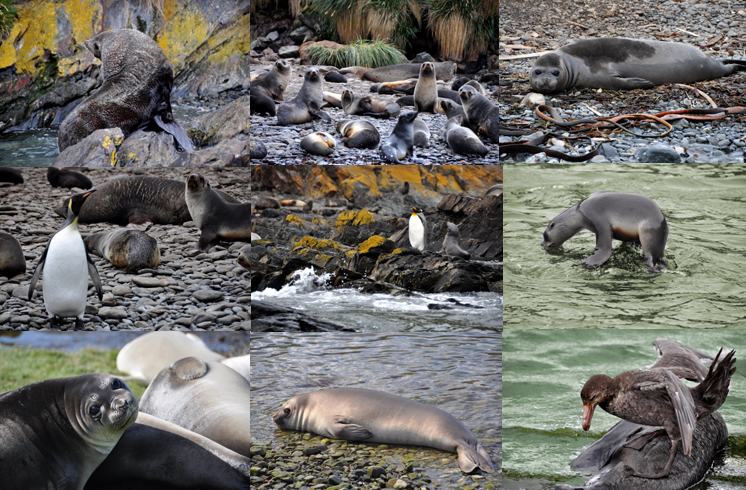
SEALS OF ANTARCTICA
Of the six species of seals living in the Antarctic, one is an eared seal and five are “true” seals belonging to the Phocidae family.
With small external ear-flaps, and using their fore flippers to swim, the Antarctic Fur Seal belongs to the family Otariidae. On land they walk on their fore and hind flippers – beware as they can outrun most people. Mature male Antarctic Fur Seals have a shaggy mane and weigh up to 200 Kgs. almost four times the weight of females.
Crabeater Seals are thought to be the most abundant seals in the world, with population estimates ranging anywhere between 10 and 50 million seals. Despite their name, these seals feed primarily on krill, using their tricusp teeth to sieve the krill from the water. Crabeater Seals spend most of their time in and around pack ice, and are often heavily scarred from Leopard Sea attacks.
Leopard Seals have “leopard” spots on their elongated body, powerful fore flippers and a large head with a menacing gape. The largest individuals are females, which may reach up to 4.5 meters in length and weight 600 kgs. Whilst widely known for hunting penguins and other species of seal, a significant proportion of the Leopard Seals diet is krill.
Weddell Seals are the most southerly occurring mammal in the world. Weddell Seals have a smart “cat-like” face with upturned mouths and short whiskers. These seals use their canine and incisor teeth to maintain breathing holes in the ice.
Southern Elephant Seals are the largest seals in the world, with males weighing over 4 tons and measuring 18 feet in length. They breed in the sub-Antarctic islands and in summer venture into the Antarctic. A male develops a large trunk-like proboscis, hence their name. Elephant Seals dive to depths in excess of 1700 meters in search of food and may stay submerged for 2 hours without breathing.
Little is known about the Ross Seal, a species confined to heavy pack ice. These seals have dark streaks on their coats, and have large eyes, thought to be an adaptation for dig in deep dark water. Along with Weddell Seals, these seals are known for their “singing.”
Fur seals were nearly hunted to extinction…are now protected and there are about 20,000 surrounding the Falkland Islands. The males grow to about 6.5 feet and weigh up to 350 pounds and can be very aggressive.