Ronne, Denmark


Osterlars Church

From Wikipedia, the free encyclopedia


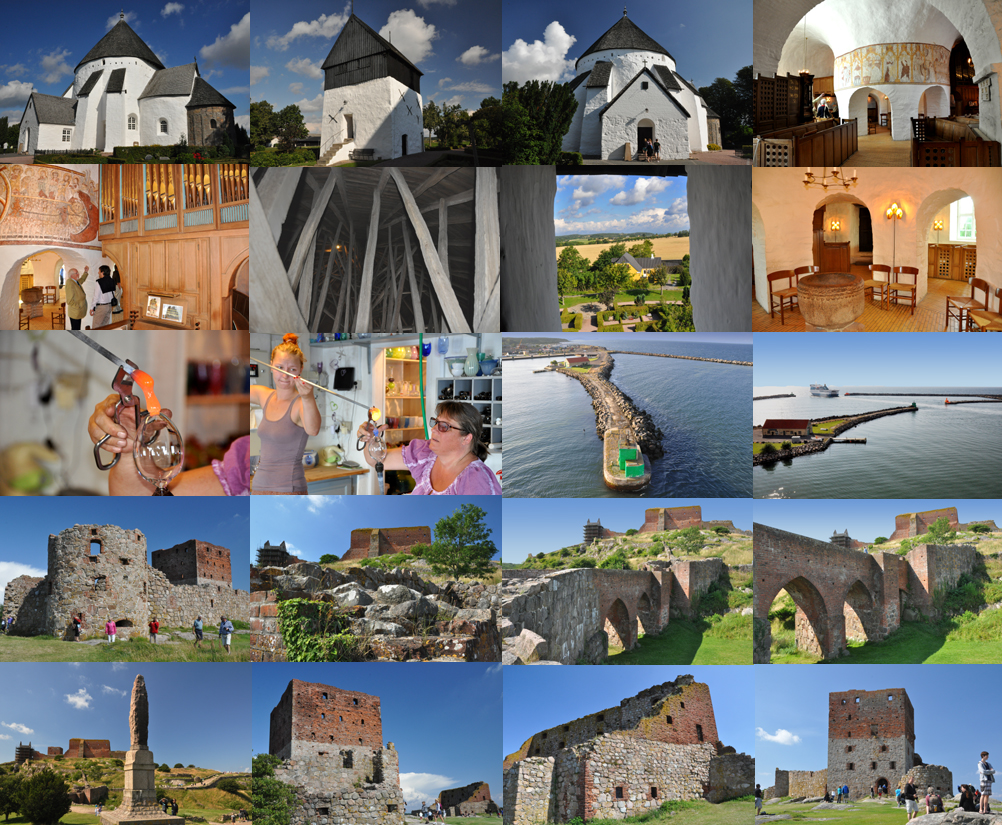
Osterlars Church is a historical building located 5 km south of Gudhjem on the Danish island of Bornholm.  It is the largest and, possibly, the oldest of the island's four round churches. Built in about 1160, it was dedicated to St. Lawrence.  It consists of an apse, an oval chancel, a large round nave and has three storeys.  There is evidence the church was once fortified, the top storey serving as an open shooting gallery.

The church is dedicated to St. Laurentius (St. Lawrence).  The Danish equivalent, Lars, was also the church's original name in the Middle Ages but around 1600, the prefex oster- (eastern) was added to avoid confusion with nearby Ny-Lars.


History and architecture

The building is one of Denmark's oldest Romanesque churches.  On the basis of coins dated 1157 found in the floor, the date of construction was probably around 1160.  The fieldstone wall stands on foundations of Bornholm limestone.

The bell tower stands separately from the church in the churchyard, and the bell tower was the original entrance and gate tower.

The church's central column is decorated with frescos or kalkmalerier from 1350 showing biblical scenes from the Annunciation through to the Passion, ending with Day of Judgment where Jesus judges mankind.  Many of the naked figures are sent to hell, symbolized by a huge dragon.  They were probably painted some 140 years after the church was built.

The frescos, which had been hidden with limewash since the Reformation, were uncovered in 1882.  They were first restored by Jacob Kornerup in 1889, then in 1960 by G.M. Lind.  In 2005, the National Museum of Denmark carried out further restoration work.

The pulpit is from 1595.  The carved altarpiece is from c. 1600.

Osterlars, and the other round churches, could have been used as supply stores for the crusades.


The Ruins of Hammershus

Hammershus is Northern Europe's largest medieval fortification, situated 74 metres (243 ft) above sea level on Hammeren, the northern tip of the Danish island of Bornholm in the Baltic Sea.  Erected in the 13th century, it was long believed that the castle was built as a private residence for the archbishop of Lund.  However, new evidence found at the ruins of the castle suggests it was constructed in the beginning of the century as a royal residence for Valdemar II of Denmark and a base for the Danish crusades.

The fortification consists of the base castle residence and accompanying Mantel Tower, and includes a great stonewall stretching 750 metres (2,460 ft) around the castle grounds.

During a number of successive struggles between the kings of Denmark versus the Archbishopric, the fortress, serving as a refuge for the Archbishops, e.g. Jens Grand, was conquered by the king's army on a number of occasions, e.g. 1259, 1265, 1319, and 1325. In 1521, it was taken by king Christian II who used it to imprison Bishop Jens Andersen Beldenak of Funen.  The fortress was conquered by forces of Lubeck the same year.

In 1658, Hammershus was occupied by Swedish forces but a rebellion on the island terminated the Swedish rule.  The rebels led by Jens Pedersen Kofoed shot the Swedish commandant Johan Printzenskiold and the Danish peasants traveled to Copenhagen to return the island to the king of Denmark.  Corfitz Ulfeldt and his wife Leonora Christina were imprisoned in Hammershus 1660 to 1661, and the fortress was used as a prison on several other occasions.

The fortress was partially demolished around 1750 and is now a ruin.  It was partially restored around 1900.