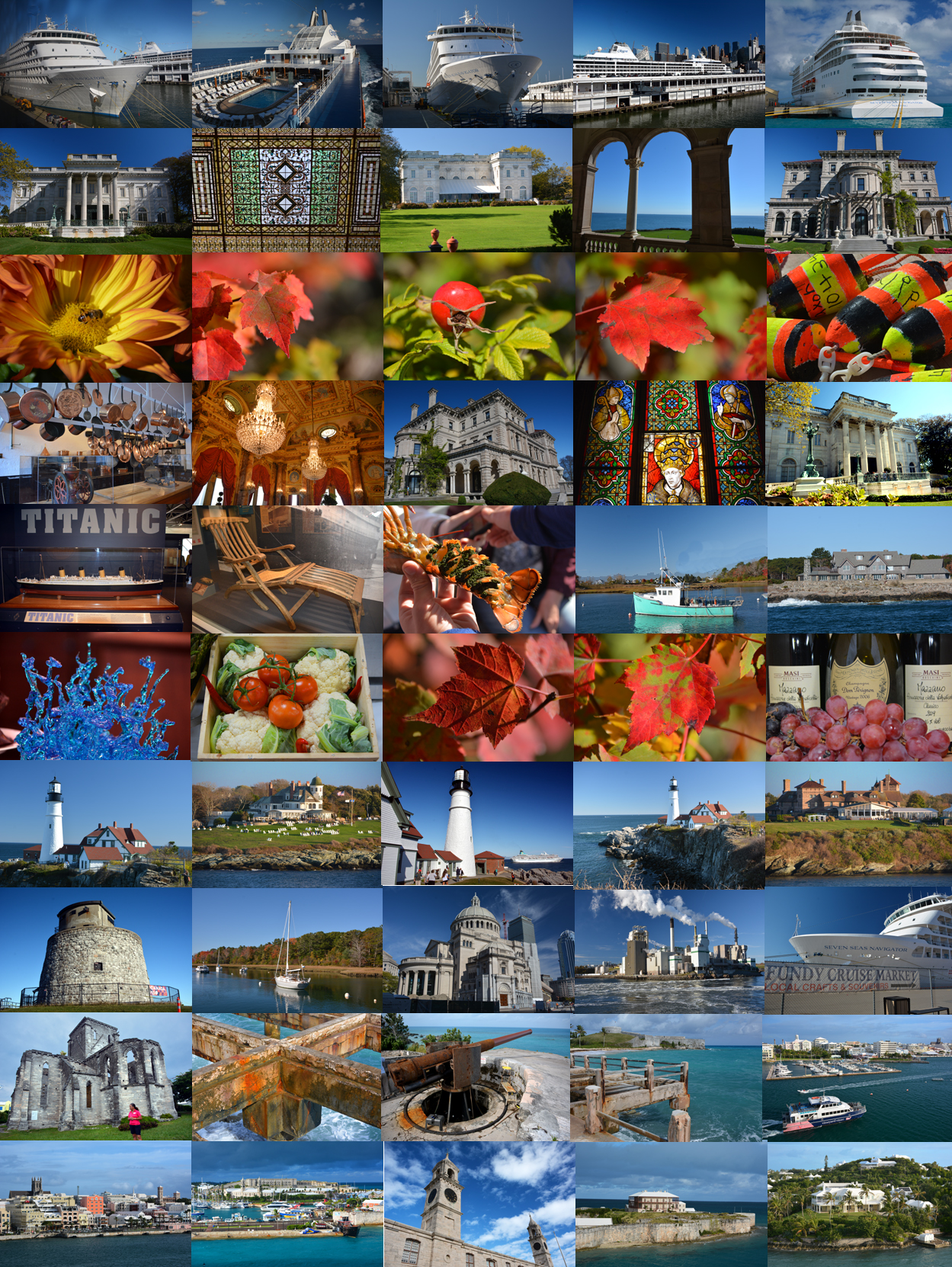
New England
Fort St. Catherine (The Jewel of the East)
St. Catherine was built in 1614 with five cannons weighing 18 tons each. The shells weighed 400 pounds and were capable of penetrating thick iron plates.
SAMBRO LIGHTHOUSE LENS
From 1906 to 1967, this lens was used in the Sambro Island lighthouse located northwest of the entrance to the Halifax Harbor.
Sambro is the oldest lighthouse in Canada and the oldest surviving lighthouse in both North and South America. It was built in 1758. Its light was visible for 17 nautical miles.
The Unfinished Church (St. Georges, Bermuda)
This Gothic ruin is all that is left of the building begun in 1874 to replace St. Peters Church. It was originally built to seat 650 people. Its simple, bold design was the work of architect William Hay. His plans called for a cruciform church, with walls regularly buttressed and perforated with tall, arched window. Two columns of brick pillars supported the roof internally and the building was crowned with a tower. The church was never finished, due to various complications. First, a split in congregation led to the Reformed Episcopal Church building its own place of worship nearby. Then, in 1884, the Cathedral in Hamilton burned down and money originally earmarked for St. Georges was diverted to rebuilding it. However, despite these difficulties, the new church had almost been completed by 1894 at a cost of 2,000 pounds. The roof was added in 1899 by private subscription.
The Congregation then elected to renovate old St. Peters Church, abandoning their new church on the verge of its completion. The western end of the church was badly damaged in the hurricane of 1926, and thereafter, the walls and floor suffered from neglect, storm damage and erosion. The rest of the roof has since vanished and one side of the internal supported pillars has toppled over. Today, the ruin is preserved as an historic monument as part of the St. Georges World Heritage Site.
Town of St. George, Bermuda
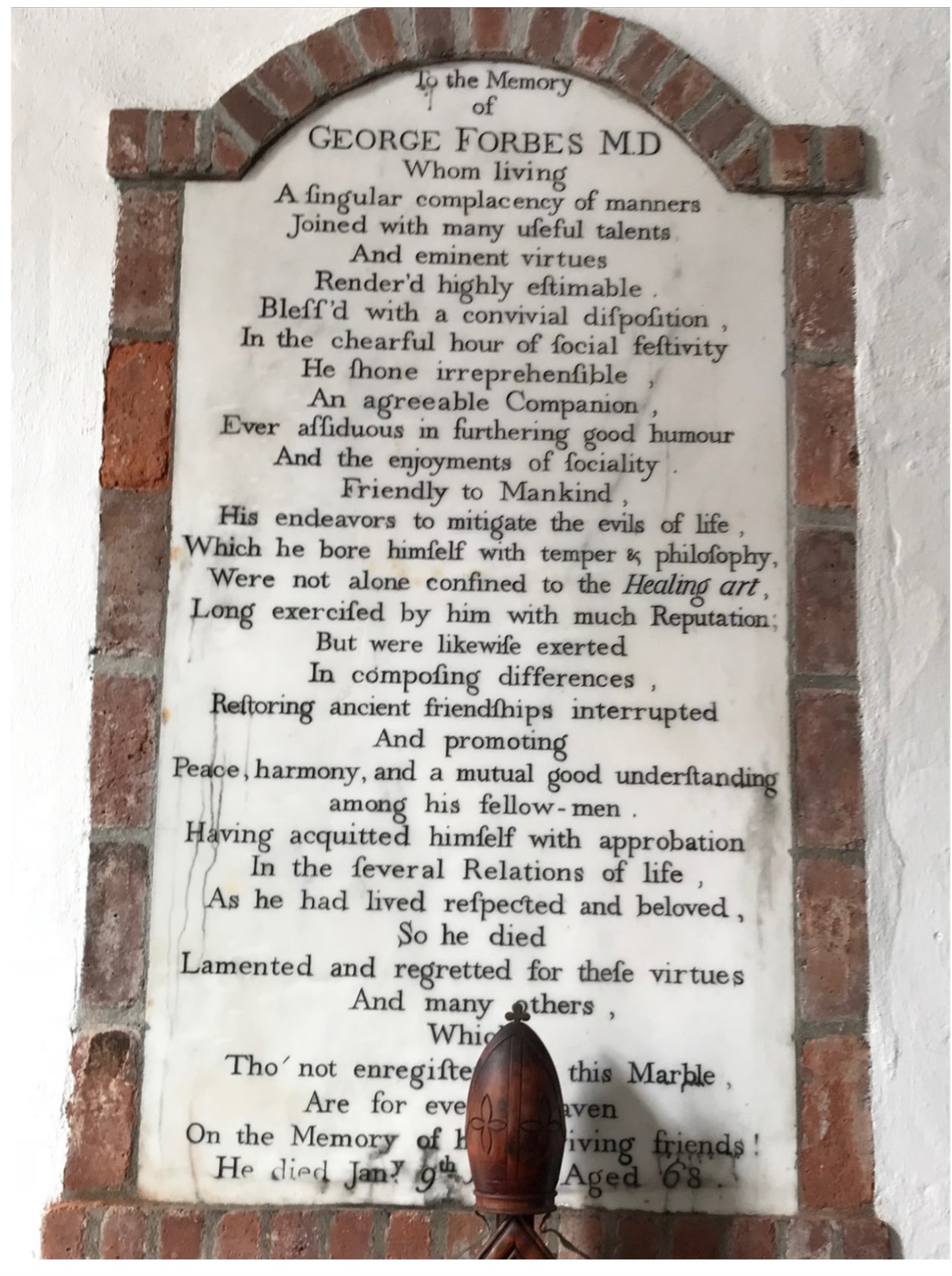
Note the use of the "f" for todays "s" and "ff" for "ss"
To the Memory
of
GEORGE FORBES M.D.
Whom living
A fingular complacency of manners
Joined with many ufeful talents
And eminent virtues
Renderd highly eftimable
Bleffd with a convivial difpofition,
In the chearful hour of focial feftivity
He thhone irreprehenifible,
An agreeable Companion,
Ever affiduous in furthering good humour
And the enjoyments of fociality.
Friendly to Mankind,
His endeavors to mitigate the evils of life,
Which he bore himfelf with temper & philofophy,
Were not alone confined to the Healing art,
Long exercifed by him with much Reputation;
But were likewife exerted
In compofing differences,
Reftoring ancient friendships interrupted
And promoting
Peace, harmony and a mutual good underftanding
Among his fellow-men.
Having acquitted himfelf with approbation
In the feveral Relations of life,
As he had lived refpected and beloved,
So he died
Lamented and regretted for thefe virtues
And many others,
Which
Tho not enregifterd on this Marble,
Are for ever engraven
On the memory of His furviving friends!
He died Jany 9th, 1778 Aged 68
"This is actually modern English. Old English, like in "Beowulf," was before the Norman Conquest (1066) and is pretty incomprehensible to us. Then came Middle English, (think Chaucer's "Canterbury Tales"), which is still tough for us to read. I would call this early modern to modern English - the language of Shakespeare. The long "S" (looks like an elongated "f") was used in modern English into the early 1800s. It was used at the beginning or in the middle of a word, or often for the first of two "S's" when there is double "S." Printers decided to standardize to one "S," the curvy one we use, around 1800. It is definitely not an "F." I kind of like it!"
Special footnote from Dr. John Freedman ~ Thank you John ~ (www.scholaratsea.com)
<<>> <<>> <<<>>> <<>> <<>>
PORTLAND HEAD LIGHT ~ ~ ~ (Cape Elizabeth)
Since its commission by George Washington in 1790 Portland headlight remains an enduring symbol of The rugged, solid characteristics of a magnificent Coastline and proud people weathering the Challenges of nature and time.
In observance of greater Portlands 350th Anniversary, we redidicate this unique landmark To the aspirations and achievements of those who Came before us and to present and future generations Who will continue its proud heritage.
George Bush ~ Vice President of the United States ~ July 1982
<<>> <<>> <<<>>> <<>> <<>>
A house on Bellevue Avenue was a symbol of social power during the Gilded Age, the years between 1865 and 1914 when America became the worlds greatest financial and industrial power. There were over 300 summer residences in Newport at its height of popularity as a seaside resort. The rich, famous, and fashionable came to Newport to see and be seen, acting out their social pageant against the backdrop of great Bellevue Avenue houses.
These houses have been celebrated as great works of architecture and as homes to famous families who shaped the nations economic, social and cultural life. They have also been criticized as examples of conspicuous consumption. Marble House (1888-1892)
Mable House was a birthday gift from William K. Vanderbilt to his wife Alva. Designed by the dean of American architecture, Richard Morris Hunt, the house reportedly cost an estimated 11 million dollars in 1892.
Two landmarks of western architecture inspired the design o Marble House: the Parthenon (5th Century B.C.), a temple to the goddess Athena in Athens, Greece, and the Petit Trianon (1764), a retreat in the gardens of Versailles.
In 1895, the Vanderbilts daughter, Consuelo, married the 9th Duke of Marlborough in one of the most celebrated weddings of the Gilded Age. In her later years, Mrs. Vanderbilt became an ardent supporter of the Votes for Women movement. She hosted the Conference of Great Women for suffragists at Marble House in 1914.
Mr. and Mrs. Frederick Prince purchased Marble House in 1933. The Preservation Society acquired the estate in 1963. Marble House is a National Historic Landmark.
<<<<>>>>
Carleton Martello Tower
Construction of this tower was begun by the British Army during the War of 1812 as one of a projected series of fortifications intended to block the western land approach of Saint john. Subsequent to its completion in 1815 the tower was largely neglected, seeing only occasional use in times of emergency, including service as a fire control headquarters in the second world war. The original structure typifies the English Martello tower design, a popular form of coastal defense in the British Isles during the Napoleonic period.
Lighthouse Lens
From 1906 until 1967, this lens was used in the Sambro Island lighthouse located Southwest of the entrance to Halifax Harbor.
Sambro is the oldest lighthouse in Canada and the oldest surviving lighthouse in both North and South America it was built in 1758 as the very first act of business of Nova Scotias first elected legislature, paid for a special tax on liquor imports. In 1906, an extra 22 feet was added to the tower and this lens was installed making the light visible for 17 nautical miles.
TITANIC a significant part o nova Scotias unique marine heritage On April 10, 1912, the TITANIC left on her maiden voyage with over 2,200 passengers and crew members aboard. Four days later, she struck an iceberg south of Newfoundland. She sank in two hours and forty minutes. Just over 700 survivors in lifeboats were rescued by the CARPATHIAand taken to New York. The White Star Line, which had offices located on Hollis Street in Halifax, commissioned our Canadian vessels to look for bodies in the area of the disaster. Two of these vessels, the MACKAY-BENNETT and the MINIA were cable ships based in Halifax. The four ships were able to recover 328 TITANIC victims. Many were buried at sea, but 209 bodies were brought to Halifax, the closest major port to the area of the sinking. All of the TITANIC victims thought to be Protestant were buried in Fairview Lawn Cemetery.