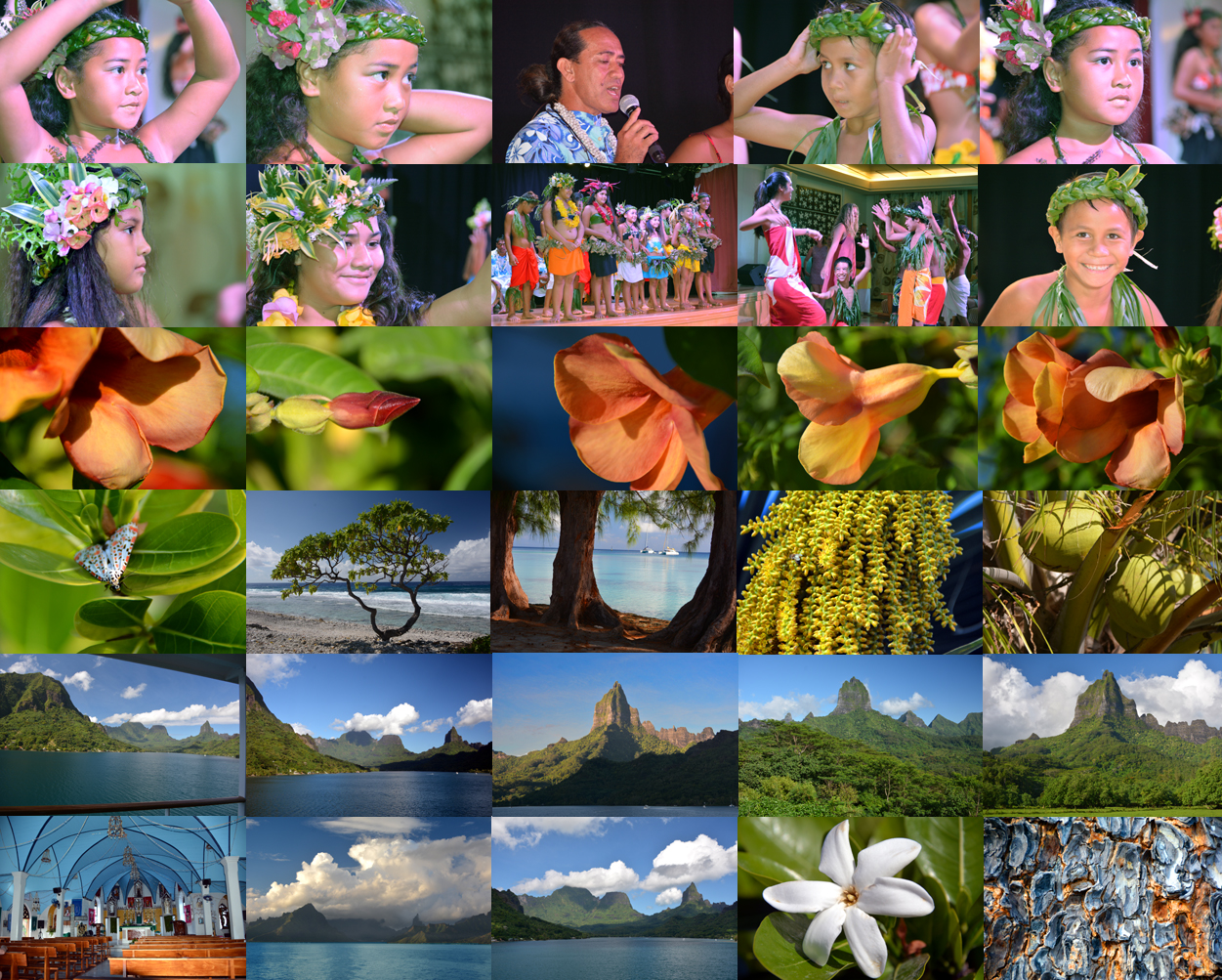
Huahine, Society Islands, French Polynesia
July 6, 2017
Huahine is located 175 km North-West of Tahiti within the Leeward Islands or better known as the “Society Islands.” The island is made up of two mountainous ranges of Huahine Nui (big) and Huahine Iti (small). The population of 6,000 people live among eight villages with the main town being Fare, settled in the 1830’s as a whaling port.
Huahine was a center for Polynesian culture making it one of the richest archeological sites. The village of Maeva contained nearly thirty restored Maraes, (ceremonial temples). Tahitian (sacred) blue-eyed eels range from 3 to 6 feet long and have fins along their side and are found only in Huahine, Moorea and Tahiti. The gentle, harmless eels are a tourist delight along with the Children of Huahine – who perform on each sailing of the m/s “Paul Gauguin.”
Fakarava, Tuamotu Islands, French Polynesia
July 10, 2017
The second largest atoll after Rangiroa and the ancient capital of the Tuamotu Archipelago, Fakarava is filled with numerous unexplored motus (islets). Protected by the UNESCO charts, Fakarava is proud of its biosphere and rare crustaceans such as squills or sea cicadas. The village of Tetamanu is home of the oldest Catholic church in Polynesia - built of coral - dating back to 1874.
The "Mecca" of diving: the northern pass of Garuda is a he largest in French Polynesia (800) meters wide, is excellent for drift diving and coral formations of exceptional quality.
Most Islanders live in Rotoava Village at the northeastern end, (4km east of the airport. Aside from Rangiroa’s Avatoru, this is the most developed and busy town in the Tuamotu.
Taha'a, Society Islands, French Polynesia
July 12, 2017
Enclosed within the same barrier reef as Raiatea is the small island of Taha'a, known as the "vanilla island" with its 4,470 inhabitants and numerous "black gold" plantations.
Moorea, Society Islands, French Polynesia
July 13 & 14, 2017
Moorea, (pronounced MO-oh-ray-ah), the heart of French Polynesia is known for its awesome, natural beauty, jagged peaks and lush greenery.
The early Polynesians named this island Tahiti-iti meaning the little fist of Tahiti. The name “Moorea” means yellow lizard. Moorea is a rugged mountainous island, roughly triangular in shape, measuring approximately 10 miles on each side. The lush tropical vegetation, white sandy beaches and small villages spread along the coast make the 37 mile drive along the island’s coastal road most pleasurable. The coral reef surrounding the island is approximately half to three quarters of a mile from shore.
Geographically, the island is an ancient volcano whose northern side has been down faulted by the sea. Cook’s Bay and Opunohu Bay on the north coast are old craters taken by the sea. Both Bays have been used by many filmmakers as backdrops for their productions.
Over millions of years, the island has eroded into cliffs and jagged peaks. Perhaps the most famous peak to be seen on the island is that of Mouaroa, better known to many as James Mitchener’s “Bali Hai.” The Belvedere vista point offers a spectacular view of the Opuhohu and Cook’s Bays as well as the magnificent peaks and valleys of the north side of this spectacular island.
The Tahitian Tatoo
The words: "tattow," "tatoo" and "tattoo" come from the Tahitian word "tatau" - translated "hitting repeatedly" - the practice of writing indelible marks on the skin......discovered by Captain Cook during his trip to the Marquesas Islands. However, the Missionaries converted the locals to Christianity and the art of tattooing was completely forbidden.
The Tahitian "Mahu" or "Rae Rae"
The term "mahu" originally referred to transvestites in pre-colonial Polynesia. Much like the native American cultures, throughout Polynesia, the mahu were not only accepted in their communities, but they were also regarded as gifted and divine, possessing the qualities of both the male and female gender.
Since the islands were colonized, mahu has broadened to include cross-dressers, drag queens, female impersonators, and transsexuals. The term has taken on a bit of a derogatory and negative connotation in recent years, which is why the local Tahitians prefer the term "rae rae."
"Rae rae" is the term that is most commonly used now to describe transvestites. The rae rae in the islands are pretty well respected in fact. They tend to have jobs in the service industry and you’ll definitely come across them in the hotels, restaurants, in dance performances, and on the airlines.
There have been many conflicting stories and articles that have been written about the rae raes and how this phenomenon occurred throughout Polynesia. The most common theory was that a family that did not have any girls would raise one of the boys as a girl. Over the years reports have noted that it was the first boy, or the second boy, or the last boy, or the forth boy. If you ask a rae rae that was raised this way, meaning it was not necessarily by choice to be raised as a girl, they will probably tell you that there was no rule as to which child it was in terms of order.
Today, although Tahitians are no longer choosing to raise one of their boys as a girl as their ancestors had, there is a new generation of rae rae – those who have chosen this path. Anthony Bourdain’s “No Reservations” French Polynesia included a segment with interviews of five rae raes.