Lucerne, (Luzern)
AmaCerto Itinerary
Amsterdam - Rhine River - Moselle River - Lucerne - Zurich
July 17, 2022 to August 3, 2022
July 30, 2022 Basel
Transfer to Lucerne
Lucerne Lucerne Walking Tour
Highlights tour of Basel. Once in Lucerne, discover the unrivaled beauty and charm of this pristine city on a walking tour.
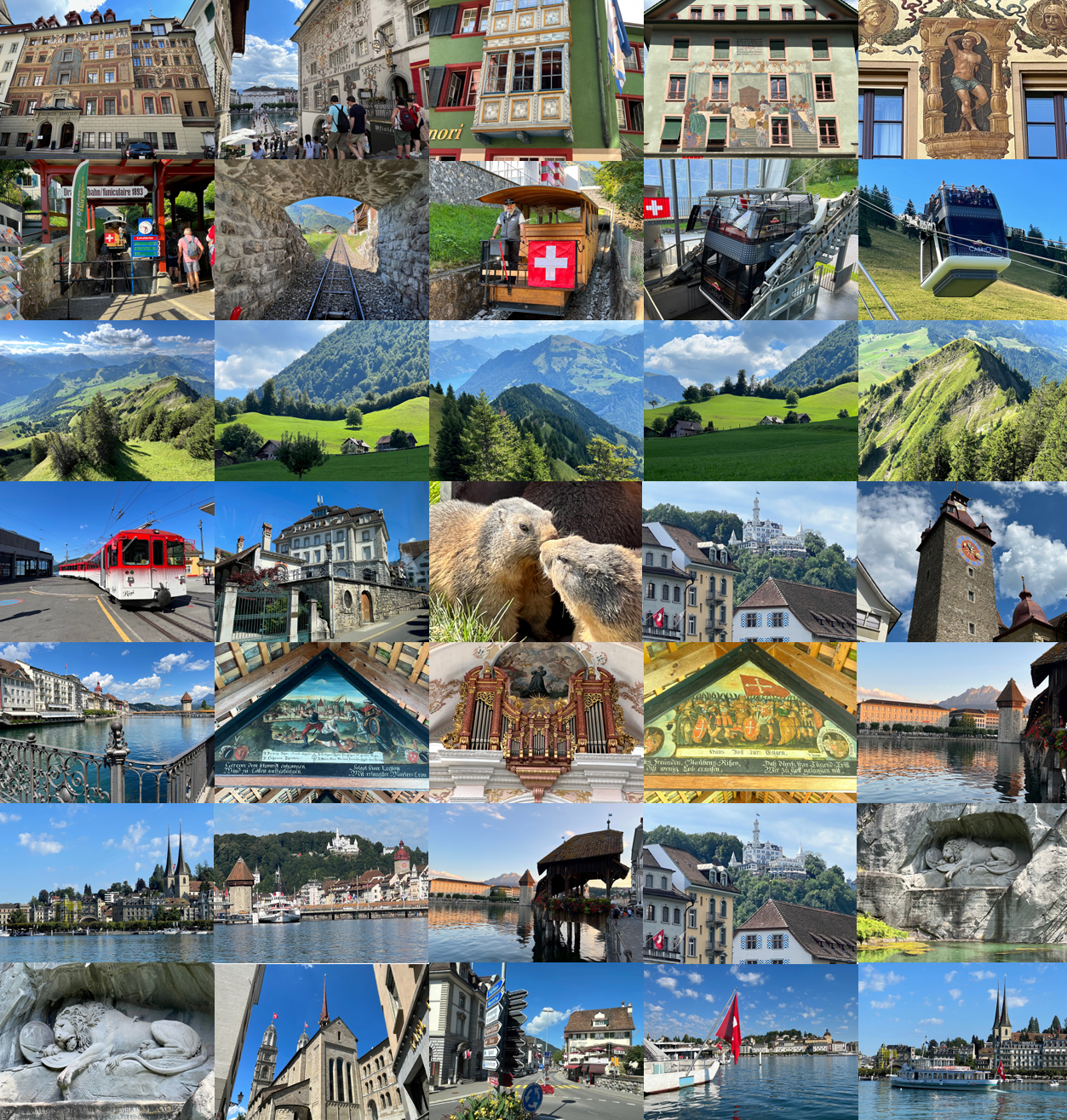
July 31, 2022 Lucerne Lucerne City Tour and medieval city walls
Today, stop at the iconic Luzern-Lion Monument, sculpted in memory of the Swiss Guards massacred during the French Revolution. You’ll also visit the spectacular medieval walls and towers, dating back to the 13th century.
RICHARD WAGNER . . . and his life at Lake Lucerne
When Richard Wagner signed the tenancy agreement with Lieutenant Colonel Walter am Rhyn in April 1866, he planned to spend only one year at the Tribschen mansion-house. However, he and his family finally lived at the shore of Lake Lucerne for six years. Wagner already knew Lucerne quite well, because he had spent six months at the Hotel, [our beautiful hotel], “Schweizerhof” in 1859.
During a boat trip with Cosima von Bulow, (the daughter of Franz Liszt), he discovered on the Tribschen peninsula the slightly neglected, but magnificent mansion-house, then owned by the patrician am Rhyn family. Soon afterwards, he was able to move into the completely furnished house.
Wagner’s years in Lucerne are said to be his happiest. On August 25, 1870, he married Cosima. The ceremony took place at St. Matthew’s Church in Lucerne. His son Siegfried, born on Tribschen, was baptized on September 4, 1870, and on December 25, 1870, the 1870 “Siegfried Idyll” was performed for the first time on the staircase of the house.
Chronology of Richard Wagner’s Life
1813. Richard Wagner was born in Leipzig on May 22, 1813.
1843. Begins music studies in Leipzig. 1834. Music Director in Lauchstadt. 1836. Music Director in Konigsberg.
1842. Moves from to Dresden, world premiere “Rienzi.”
1844. Lifelong appointment as Royal Court Music Director in Dresden.
1849. Participation in May revolution in Dresden - flees to Switzerland.
1859. Six months residence at the Hotel “Schweizerhof” in Lucerne and completes “Tristan und Isolde.”
1864. One-year stay in Vienna - danger of imprisonment for debts, (thoughts of suicide) - fateful encounter with King Ludwig II of Bavaria. Lives in Munich.
1865. Love for Cosima von Bulow, Isolde - Cosima and Richard’s first daughter is born in Munich.
1866. Wagner is forced to leave Munich, tenancy agreement for the mansion-house in Tribschen.
1867. Eva - Cosima and Richard’s second daughter is born in Tribschen and “Meistersinger” is completed.
1868. World premiere of “Meistersinger” in Munich.
1869. Seigfried, (Cosima and Richard’s son), is born in Tribschen. World premiere of “Rheingold” in Munich.
1870. Hans von Bulow agrees to divorce his wife, Cosima. Richard marries Cosima at St. Matthew’s Church. World premiere of “Siegfried Idyll” on the staircase of the hoisin Tribschen. Wagner brought in a small orchestra to celebrate Cosima’s 33rd birthday. Cosima was so moved she couldn’t talk.
1871. Decision to build the “Festspielhaus” in Bayreuth.
1872. Move to Bayreuth - laying the corner stone for the “Festspielhaus.”
1876. Grand Opening of the “Festspielhaus” with “The Ring of the Nibelungen.”
1882. Second season of the Bayreuth Festival.
1883. Richard Wagner dies in Venice on February 13, 1883. His remains are sent to Bayreuth. The End.
Alpine Marmot