|
|
by Terry Breen
www.terryslog.com
Make the most of your Alaskan cruise with www.terryslog.com where you'll find everything to enjoy your days at sea and in port!
• Current Weather
• Port maps and information
• Updated port events and activities
• Points of interest, shopping and dining
• Fun Facts and Figures on "Alaska: the Great Land!"
Rain Capital of the United States; Salmon Capital of the World; Gateway City; First City; Native American Capital of Alaska – whatever you chose to call it, welcome to Ketchikan!
Ketchikan means Eagle Wing River in the native Tlingit language. The Tlingits knew that the streams surrounding their village were teaming with salmon. Today Ketchikan is still all about salmon, eagles, Tlingits and the breathtaking beauty of Misty Fjords. Even the free shuttle is painted with salmon. To make the most of your time in port know your options; here in Ketchikan they are fishing, flight-seeing to Misty Fjords, Native art and culture, and bear viewing (in season). During a well-planned day you can fit in one or two of these activities as well as time to browse the many galleries and shops along Front Street.
Ketchikan 2012 population 14,070
Like many towns in Southeast Alaska, Ketchikan is located on an island, Revillagigedo Island, which is locally-known as "Revilla" for short. Situated at the southernmost extent of the Tongass National Forest, timber, fishing and mining has been the mainstay of the community since its incorporation in 1900. As you begin your exploration from the ship notice that many of the buildings along Front Street still retain a turn-of-the-century feel. As you stroll along the boardwalk, you are actually walking over water as Front Street is built upon pilings!
One of the most historic and colorful areas of town is Creek Street. Don't miss the view from the Cape Fox Hotel as well as its exquisite Native America art collection. The Northwest Coast Native Americans of Ketchikan form an important part of the community and include not just Tlingit but also Haida and Tsimshian. In addition to the shops and galleries of Creek Street, enjoy the nearby Totem Heritage Center which contains the oldest totem poles in the state. For totem poles enthusiasts head north to Totem Bight State Park for the largest collection of totem poles (many of them authentic reproductions); or south to Saxman Village, a working Tlingit community with some of the most interesting totem poles in the state.
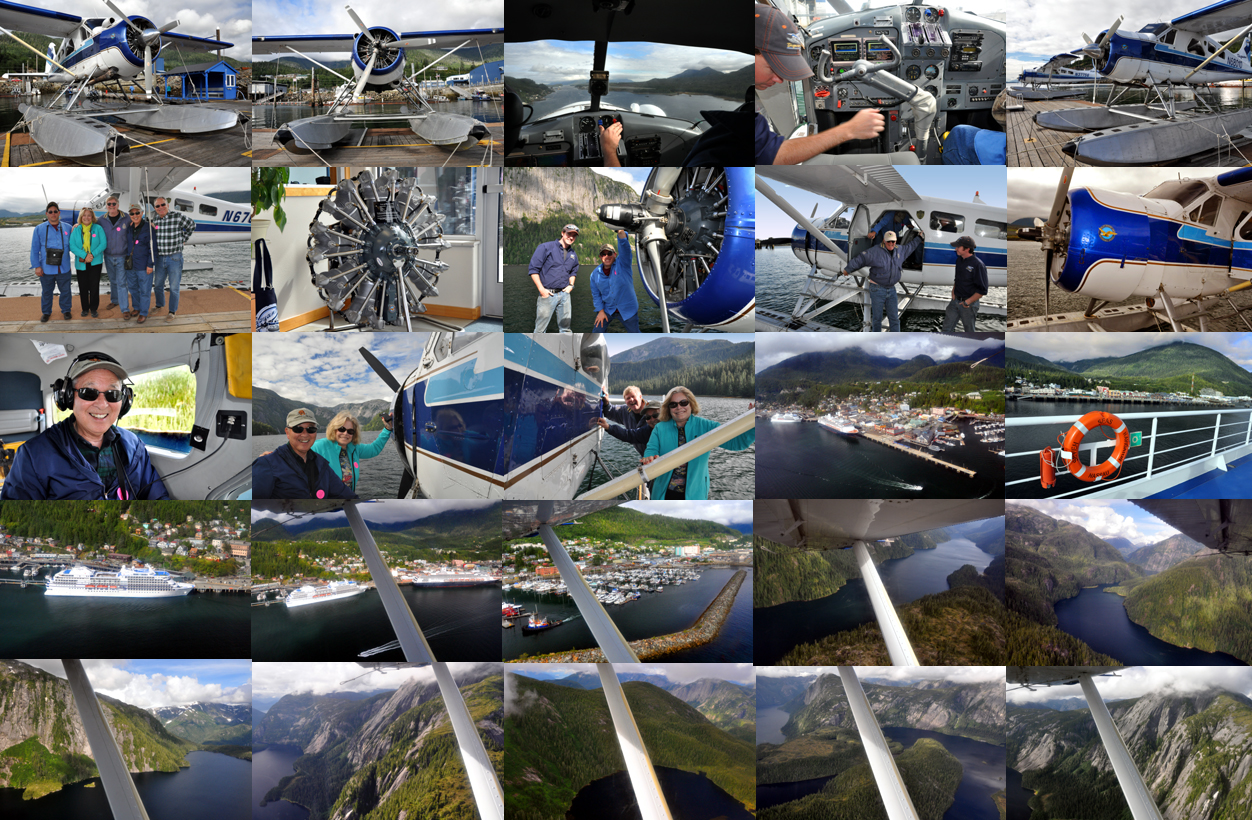
Ketchikan is the gateway to Misty Fjords National Monument, one of the most beautiful and isolated areas in the United States. Don’t miss the opportunity to go flight-seeing on a floatplane.
Along with whales, visitors to Alaska want to see bears. Though brown and black bears exist is Southeast Alaska, the best time to see them is in the late summer when tours are offered to several known bear viewing areas.
As for fishing, Ketchikan is the Salmon Capitol of The World and all five species run through the nearby rivers and streams at different times of the spring through fall. Though you can fish for other species in Ketchikan , it's all about the salmon. Tours are available from the ship as well as charters.
Across Tongass Narrows is Pennock Island; the island has been a quiet spot for weekend fishing cabins or second homes. Bounded by the Tongass National Forest to the east and the Tongass Narrow to the west, the borough of Ketchikan has a limited amount of space in which to grow. Consequently, more and more people are moving out to Pennock Island, prompting speculation that a bridge may one day be built from Revilla Island to Pennock and on to Gravina Island. That speculative bridge became known as the, "Bridge to Nowhere" made famous during the 2008 presidential campaign. There is not much on Gravina Island except the Ketchikan International Airport; and yes, it is an international airport, as there are flights to Canada. Because there is no bridge between the islands passengers must take a small ferry across the Tongass Narrows to catch a plane. As you pass the airport notice the pier used for float planes; this is the airport’s connecting terminal, Ketchikan-style.
The Ketchikan International Airport has the claim to fame of being the only airport in the world where the runway is higher than the control tower.
FUN and FREE
Ketchikan is a quirky town: most of what is now the downtown has been built-up on pilings and suspended out over water; many of the streets are actually nothing more than stairways and as a cannery town fish figure prominently in local folklore. With all the rain that falls, people have developed an unusual sense of humor when it comes to the weather – note most everyone owns a pair of brown, high-top, rubber boots which are affectionately called Ketchikan Sneakers. As you get ready to explore town, remember what the locals say, 'if you wait for the rain to stop you will never get anything done!'
Creek Street - Located on Salmon Creek, the stilted houses of Creek Street were once used as bordellos during cannery days. The local joke is Ketchikan was the only place where both men and salmon went upstream to spawn. Today the area has been renovated and contains many shops for the visitor along its boardwalk as well as the old brothel called Dolly's House (admission charged). Just behind Creek Street is the funicular (small charge) up to the Cape Fox Lodge Hotel; from the hotel you will have great view of Ketchikan. If you are up for a walk you can return back to town via either the trail down to the fish hatchery and the Totem Heritage Center, or Married Man’s Trail (so named for the obvious.) During the late summer Salmon Creek is teeming with salmon on their way upstream to spawn. If you walk between SoHo CoHo Gallery and the (currently) Chinese restaurant you will find the salmon look-out over the creek.
Salmon Shuttle – During the summer the salmon bus runs a continuous loop from all the cruise docks to downtown, Creek Street, the Totem Heritage Center and Salmon Hatchery. You can hop on and off compliments of the City of Ketchikan. The bus is easy to recognize as it covered with colorful salmon painted by local artist Ray Troll.
Totem Poles - Throughout Ketchikan totem poles have been carved and raised, telling the story of individuals as well as myths and legends in Tlingit culture. Take a moment to read the interpretive signs. Two famous totem poles are along Creek Street next to the library, which is also the home of Ketchikan’s small city museum.
Street Stairs - In Ketchikan there are streets that are no more than a flight of wooden stairs. In some parts of town, where access to houses on a steep hillside were only via stairs, the stairs became named streets. The easiest place to see a stair street is on the corner of Front Street and Grant just before the tunnel; notice the stairs going up the hill – they are the continuation of Front Street!
Eagle’s Nest – There is a great eagle’s nest that has continued to be occupied for the last five years by a mated pair. It is located on Gravina Island, across from downtown Ketchikan. Best time to see the nest is on your way in or out of town. Look for the green channel marker with the #7 on it; scan to the west and look the huge mat of branches and sticks that is the nest. Both eagles take turns on the nest and when the eaglets hatch sometimes you can see them with binoculars.
TOURING and EXPLORING
Ketchikan is known by nicknames that reflect the many things there are to see and do in town; like Native American Capital, First City; Gateway to the Tongass National Forest and Misty Fjords National Monument; as well as Salmon Capital of the World.
Totem Tours – Ketchikan is called the Native American capital of the state because of the concentration of Native people primarily from the Northwest Coast Culture. In Ketchikan you will find Tlingit, Haida and Tshimshian. To experience all the town has to offer in the way of Native history, take a tour. Tours will drive you out to Totem Bight State Park, where you can see the largest collection of poles in the state; Totem Heritage Center with the oldest poles, and Saxman Village, home of world-famous carver Nathan Jackson. Not all tours will go to all locales so read descriptions carefully.
Duck Tour – Have you seen those amphibious buses that drive off the road into the water? Well, they have one in Ketchikan – the Duck Tour! It is a fun way to see the town and they also go out to the Marker 7 eagle’s nest, if you are interested in seeing that closer!
Misty Fjords - At the southern tip of the maze of islands that form Alaska's panhandle lies Misty Fjords National Monument. Accessible only by air or sea, it is pristine wilderness located east of Revillagigedo Island. Float planes from Ketchikan, 22 miles away, tour the area and are permitted to land in designated mountain lakes and inlets. Flights can be booked through your tour desk onboard. However, since the other option for visiting this wilderness is by sea, many excursion boats call on Misty Fjords, as do a few cruise ships.
Misty Fjords became a National Monument in 1978; with 2.3 million acres of land it is the second largest protected wilderness area in the country. It is located amidst the 17 million acre Tongass National Forest, largest national forest in the country. Tongass was one of the first national forests to be set aside for protection and preservation against the ravages of industry. Theodore Roosevelt created Tongass National Forest in 1908. Today 80% of the forest is protected from timber harvesting.
The name says it all; Misty Fjords is a spectacularly beautiful misty fjord. Three-thousand foot granite cliffs rise straight up out of the sea, their tops shrouded in ethereal fingers of mist. In the early morning, low wispy clouds comb their way through stands of Sitka spruce and red cedar trees. Eagles perch on trees along the shore and look so close you could reach out and touch them. Due to the ideal conditions between land and sea few areas contain as many species of unusual animals. Within the temperate rainforest you are likely to see mountain goat, brown bear, black bear, moose, and river otter. The sea is filled with all five species of Pacific salmon. Spawning salmon attract bear as well as killer whale. The salmon must share their rivers and streams with Dolly Varden char, cutthroat trout, steelhead, and grayling. Steller sea lions and harbor seals also make their home in Misty Fjords.
By definition a fjord is a glacially carved valley that has been filled in by the sea. Misty Fjords is no exception. Not too long ago in geologic time the land was covered by 4,000 feet of ice. Most of this area of Southeast Alaska is now free of glacial ice; the northeastern corner of the national monument, however, still contains an area of active glaciers. As the ice retreated, the sea filled in these steep narrow "U" shaped valleys and bowls. &nbs;The Punchbowl, with its 3,000 foot granite cliffs, is a magnificent example of a glacially carved bowl.
WILDLIFE ENCOUNTERS
One of the highlights of a visit to Alaska is seeing a bear; and one of the best places to see bears will be in Ketchikan. Viewing platforms have been constructed along several rivers and streams to enable visitors to watch the bears during salmon season. These areas are outside of town and require a boat trip or floatplane.
Bears – Starting mid to late summer when the salmon return to spawn bears are plentiful in the creeks around Ketchikan. Several companies offer tours to Prince of Wales Island and Anan Creek. Most of the sightings are of black bears. Some areas have formal viewing platforms others excursions take you out to where there have been recent sightings.
OUTDOOR ADVENTURE
Visitors interested in getting out and experiencing the great outdoors have ample opportunities in Ketchikan. There are numerous hiking and biking trails, ziplines and a go-cart track; but as the Salmon Capital of the World, Ketchikan is known for being a fisherman’s paradise.
Fishing, Fishing and More Fishing – Ketchikan is the salmon capital of the United States. All five species of Pacific salmon are fished for commercially from this port; king (Chinook), silver (coho), red (sockeye), pink (humpies) and chum (dog). Boat, bait, and tackle are provided by the charter company; you will need to pay additionally for a license.