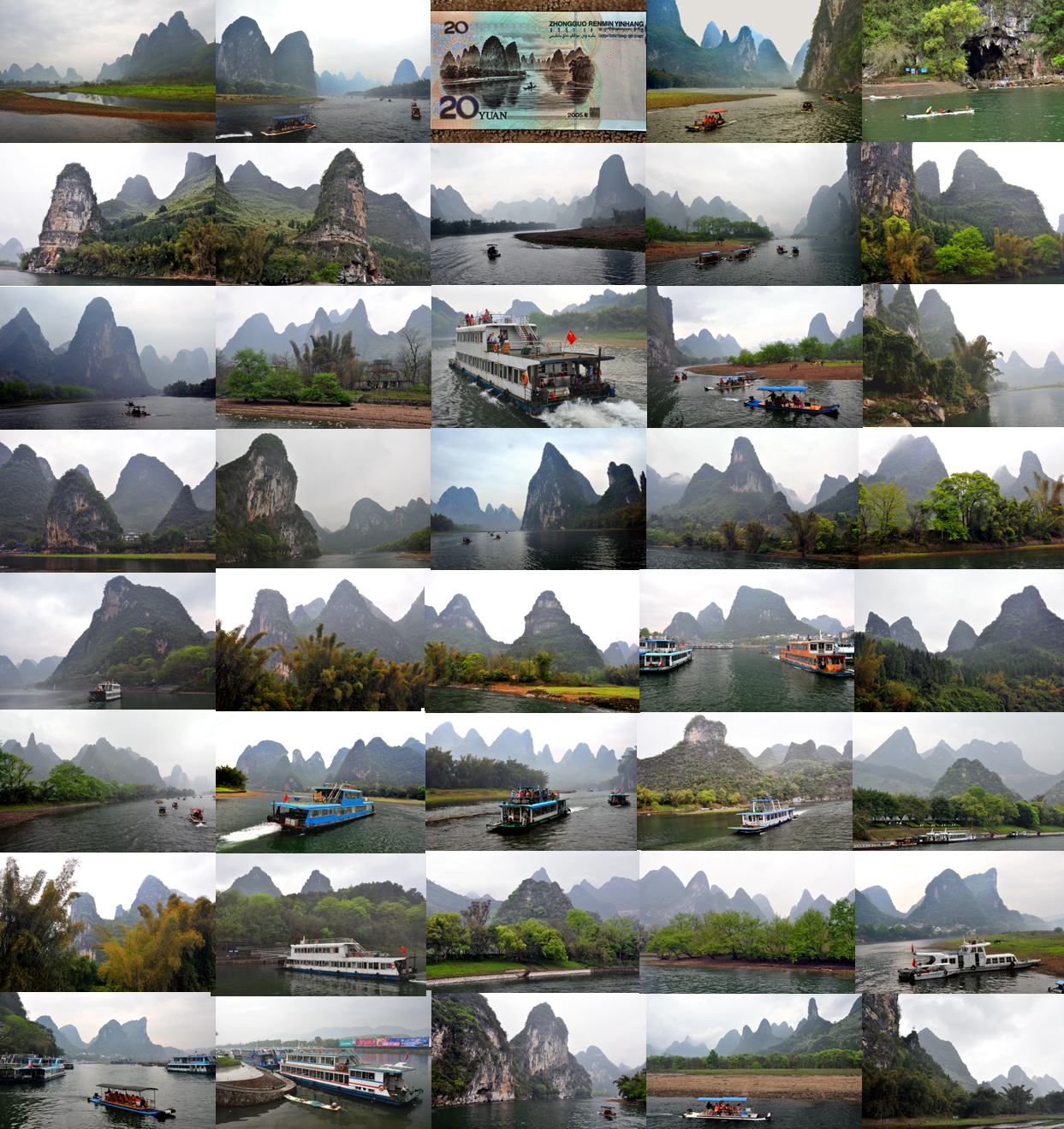
GUILIN
Cassia Tree Forest
"I have visited over 80 countries and over 100 cities, but no city's scene can surpass that of Guilin."
Richard M. Nixon
The landscape of Guilin should be listed the rank if "the eighth wonder of the world."
Anderlidy, President of Italy
"Rather to be a Guilin citizen than to be immortal."
Chen Yi Poet
Karst Topography in Guilin, China
The South China Karst region extends over a surface of half a million km2 lying mainly in Yunnan, Guizhou and Guangxi provinces. It represents one of the world’s most spectacular examples of humid tropical to subtropical karst landscapes. The stone forests of Guilin are considered superlative natural phenomena and a world reference with a wider range of pinnacle shapes than other karst landscapes with pinnacles, and a higher diversity of shapes and changing colors. The cone and tower karsts of Libo, also considered the world reference site for these types of karst, form a distinctive and beautiful landscape. Wulong Karst has been inscribed for its giant dolines (sinkholes), natural bridges and caves. South China is unrivalled for the diversity of its karst features and landscapes. The property includes specifically selected areas that are of outstanding universal value to protect and present the best examples of these karst features and landscapes. South China Karst is a coherent serial property comprising three clusters, Libo Karst and Shilin Karst, each with two components, and Wulong Karst with three components.
South China Karst represents one of the world's most spectacular examples of humid tropical to subtropical karst landscapes. The stone forests of Shilin are considered superlative natural phenomena and the world reference site for this type of feature. The cluster includes the Naigu stone forest occurring on dolomitic limestone and the Suyishan stone forest arising from a lake. Shilin contains a wider range of pinnacle shapes than other karst landscapes with pinnacles, and a higher diversity of shapes and colours that change with different weather and light conditions. The cone and tower karsts of Libo, also considered the world reference site for these types of karsts, form a distinctive and beautiful landscape. Wulong includes giant collapse depressions, called Tiankeng, and exceptionally high natural bridges between which are long stretches of very deep unroofed caves. These spectacular karst features are of world class quality.
Both Shilin and Libo are global reference areas for the karst features and landscapes that they exhibit. Major developments in the stone forests of Shilin occurred over some 270 million years during four major geological time periods from the Permian to present, illustrating the episodic nature of the evolution of these karst features. Libo contains carbonate outcrops of different ages that erosive processes shaped over millions of years into impressive Fengcong (cone) and Fenglin (tower) karsts. It contains a combination of numerous tall karst peaks, deep dolines, sinking streams and long river caves. Wulong represents high inland karst plateaus that have experienced considerable uplift, and its giant dolines and bridges are representative of South China's Tiankeng landscapes. Wulong's landscapes contain evidence for the history of one of the world's great river systems, the Yangtze and its tributaries.
Travels in Geology April 2007 posted April 20, 2007
Exploring Karst in Guilin, China
Jordan Clary
On first arriving in Guilin, China, you may feel like you have stumbled into J. R. R. Tolkien's Middle-earth. At any moment you might see Gandalf the Wizard galloping across the plains on his white steed or a dragon roaring down from the sharp cliffs. Guilin, however, is no trick of a novelist's imagination. Its more than 5,180 square kilometers of karst landscape is the result of a perfect alchemy of geological conditions.
Located in the northeast of the Guangxi Zhuang Autonomous Region, Guilin is one of China's leading tourist locations. The Guilin Liangjiang Airport serves approximately 50 domestic and international air routes. Most Western visitors spend a day or two in Shanghai or Hong Kong before coming here, which is only an hour away by plane. Many people prefer, however, to take the train rather than fly. A sleeper car on the train gives ample opportunity to enjoy southern China's landscape at a leisurely pace. A number of bus routes also service Guilin. If you are up for an adventure, road travel in China is something you are likely to remember for a long time. When I rode the bus from Yunnan Province to Guilin, we spent three hours in a rice paddy in the middle of the night surrounded by men in pickup trucks while our driver exchanged some type of "goods" off the top of the bus.
Guilin's most renowned feature is its dramatic karst terrain. Rising sharply at odd angles, limestone peaks look like giant teeth growing out of the green plain. Karst topography is characterized by many caverns and sinkholes that form by the dissolution of limestone or other carbonate rocks. Florida and Virginia's Shenandoah Valley are good examples of where karst can be found in the United States. However, the topography looks completely different from that in China, thanks to conditions that exposed China's karst and eroded its softer limestone faster. The specific conditions for forming the magnificent topography of Guilin "are fourfold," according to Ray Beiersdorfer, a geologist at Youngstown State University in Ohio. "First, you need hard, compact carbonate rock. In Guilin, it's Devonian limestone. Secondly, you need strong uplift, in this case provided by the collision of India with Asia to form the Himalaya. Third, you need a Monsoon climate of high moisture during the warmest season. Finally, the area must not have been scoured by glaciers, which this region wasn't."
Two types of karst landscapes predominate in Guilin: fenglin or peak forest (isolated towers) and fengcong or peak cluster (linked-base towers). The two types may have evolved sequentially from peak forest to peak cluster, or they may have evolved simultaneously. Beiersdorfer described this landscape, which he saw during a recent visit to China: "China in general and the Guilin area specifically boasts some of the most spectacular karst topography in the world."
The area also boasts having signficant archeological finds, such as human teeth and stone tools, that place humans in the Guilin area for the last 30,000 years. A site at Zengpiyan, a cave and local historical monument, has revealed additional cultural artifacts, such as pottery, from the 10th to the 7th millennium B.C. Guilin City proper was first established more than 2,000 years ago during the Qin Dynasty (221 to 206 B.C.) by Emperor Qin Shi Huang, who is best known for creating the army of terra-cotta warriors uncovered in Xian during the 1970s. Emperor Qin Shi Huang is also credited with building the Ling Canal in the Guilin area. The Ling Canal linked the Yangtze and Pearl River systems, thus becoming a significant factor in cultural and economic exchange between central and southern China.
During the Tang Dynasty (A.D. 618 to 907), Guilin thrived. Huge halls were built and stone walls erected around the city. Today, Guilin is a rather large, bustling city that attracts visitors from around the world. The names of the hills surrounding Guilin are poetic: Cloud-Catching Pavilion, Bright Moon Peak, White Horse Cliff, Five Tigers Catch a Goat Hill, Folded Brocade Mountain. In fact, as well as a geologist's paradise, this area has long been an inspiration to countless poets and artists. Many of the traditional Chinese landscape paintings we see today were inspired by this region.
Most visitors to the Guilin area find a boat trip down the Li River to the town of Yangshuo to be one of the highlights of their trip. "The river forms a green gauze belt, the mountains are like jade hairpins," Han Yu, a Tang Dynasty poet wrote. Drifting down the Li River, it's easy to feel lost in time. Women kneel on the banks washing clothes. Farmers follow along behind their water buffalo. Small villages dot the shore. And the boatman will likely point out animal shapes they see in the surrounding landscape as you float down the river: horses galloping through the mountainsides, a stone frog leaping into the water or what looks like a turtle in the sides of a cliff as you float down the river.
The cobblestone Western Street (Xi Jie) in Yangshuo has garnered a reputation as the place in China where East and West really do meet. An abundance of small guest houses and hotels line the street, most of which are quite inexpensive. I've stayed at The Bamboo House several times — one of the few places in China with soft beds. Although its rooms are small, the guest house has charm and the staff is friendly. The Bamboo House has two locations, the newer one being a bit quieter than the old one, which is built over a bar.
Yangshuo's geological offerings can be explored in many ways. Bicycles or electric bikes may be rented to take a riding tour of the countryside. Either buy a map and do it yourself, or hire one of the many local guides who will no doubt approach you on the street. Your guest house will also be happy to recommend a guide.
Black Buddha Cave. Moon Water Cave. Dragon Cave. If it's caving you want, plenty can be found around Yangshuo. Caves and subterranean waters mark this area, and although the caves that can be visited have been domesticated with paved walkways and colored lights, they are, nevertheless, home to some dazzling stalagmites and stalactites. Furthermore, many of the caves are quite large and may include mud baths as part of the admission price. If your interest in rocks tends to be more above ground than below, be sure to bike up to Moon Hill, a mountain with a naturally circular rock window at the top that provides a spectacular panoramic view of the area. A number of shops can also set you up with rock-climbing gear if you want to get a real feel for the craggy landscape.
Although, the Guilin and Yangshuo area can be visited all year, summer offers a few extra pleasures, such as taking a Bamboo Raft on the Yulong (Dragon) River, a tributary of the Li River, or golfing at one of the many golf resorts. And like all places in China, be prepared to bargain for anything you buy, from souvenirs to tour guide fees and bus tickets.
No matter what time of year you go, do your homework first and plan to spend at least a few days in the region. Celebrations that include everything from a lantern festival to dragon boat races abound, so be sure to check to see if one will be occurring while you're there. It's well worth it.