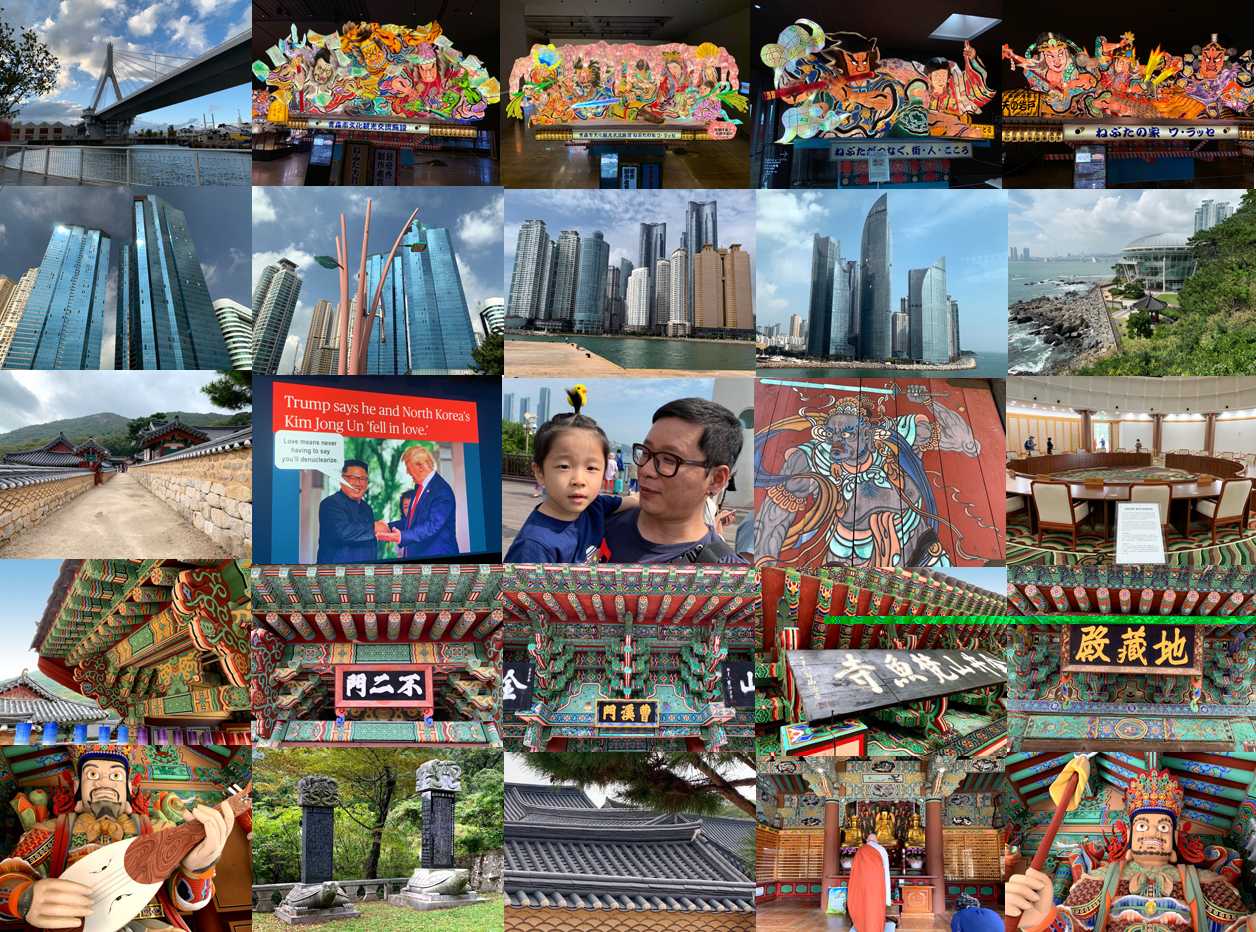
Aomori, Japan
Is located in the far north of Japan and is known for its orchards, it's Japan's most beautiful prefectures. It's renown for its Fish, (Oma tuna), [$3million], scallops, rice, sake, black garlic, Fuji apples and Coca Cola with garlic.
August 2-7 is the famous Neubta (Wa-Rasse) Matsuri festival with illuminated floats of gigantic samurai figures - draws over 2 million visitors a year to see the 20 large-size floats - originally designed to ward off the "sleep demons."
Japanese proverb ~ Post Marriage ~ you don't need to feed a fish after its been caught!
Korea
Korean temples have been a place of refuge for the Korean people for more than 1700 years. These temples, with a tradition over a thousand years have open their gates to allow everyone to experience the traditional Korean Buddhist culture. Beomeosa Temple offers overnight "Templestay" programs and one-day Temple Life programs for visitors to learn and feel Korean Buddhism.
Geumjeong "Chongrim" ~ (Comprehensive Training Monastery) Beomeosa Temple
Is one of 25 major temples in Korea and has 11 Hermitages is on the mountain and more than 200 branch temples around the nation. It is also is Korea’s major temple of Seon practice as well as a comprehensive training monastery. The Cheongwangmun Gate, (Guardian Kings Gate) is the second gate into the compound, guarded by four Guardian Kings who protect Buddha-dharma: North - Vaisravana. South - Virudhka. East - Dhrtarastra. West - Virupaksa.
The one pillar gate, or Mountain gate was built in 1614. The three Buddhist Temples were built in 1906.
My favorite sign - before entering the temples: "COME UP OFF YOUR SHOES"
Courtesy of Dr. John Freedman - from his (live) lectures aboard the SILVER MUSE ... "Travel is the passport to peace." (www.ScholarAtSea.com)
~ ~ ~ ~ ~ ~ ~ ~ ~ ~ ~ ~ ~ ~ ~ ~ ~ NORTH KOREA ~ ~ ~ ~ ~ ~ ~ ~ ~ ~ ~ ~ ~ ~ ~ ~ ~ ~ SOUTH KOREA
OFFICIAL NAME: Democratic People's Republic of Korea (DPRK) Republic of Korea (ROK)
LAND MASS: 55% 45%
GOVERNMENT/SYSTEM: Communist Theocracy Dictatorship Capitalist Democracy
POPULATION: 25M 52M
GDP: 40B 1.2T
GDP PER CAPITA: $600/yr $31,000/yr
LIFE EXPECTANCY: 70 82
Sake is not 'Rice Wine.' It's made from grain, (not fruit). It's brewed, (not vinted) with a double parallel fermentation, which is starch to sugar ("koji") and then sugar to alcohol (yeast).
SAKE "Seimaibaui" ~ Rice Polishing Ratio ~ "ratio of rice remaining"
FUTSUU SHU (Table Sake) ... more than 71% rice remaining
JUNMAI (Honjozo Sake) ... less than 70% rice remaining
GINJO (Premium Sake) ... less than 60% rice remaining
DAI GINJO (Sake) ... less than 50% rice remaining
"WABI SABI" incorporated "Shibui - "Shimbumi" ~ Simplicity and subtlety - lacking artifice.
"Wabi" ~ means rustic simplicity and "Sabi" means imperfection associated with aging.
"Wabi" ~ less is more and "Sabi" ~ Transience - a sense of things coming a going.
The 7 Elements of Wabi Sabi:
"Fukinsei" ~ Asymmetry Irregularity
"Kanso" ~ Simplicity
"Koko" ~ Weathering
"Shizen" ~ Natural, Unaffected
"Yugen" ~ Subtle Grace
"Seijaku" ~ Tranquility
"SHINTO" is the root, embedded in the heart of the Japanese people
"CONFUCIANISM" provides the branches and leaves, affecting politics, morality and education
"BUDDHISM" yields the flowers and fruit
The Japanese word "Hai" literally means "Yes," but depending on the tone and volume it can mean:
Yes
Maybe
I see
No
This is the stupidest thing I have ever heard in my life
We will feed your proposal to a goat!