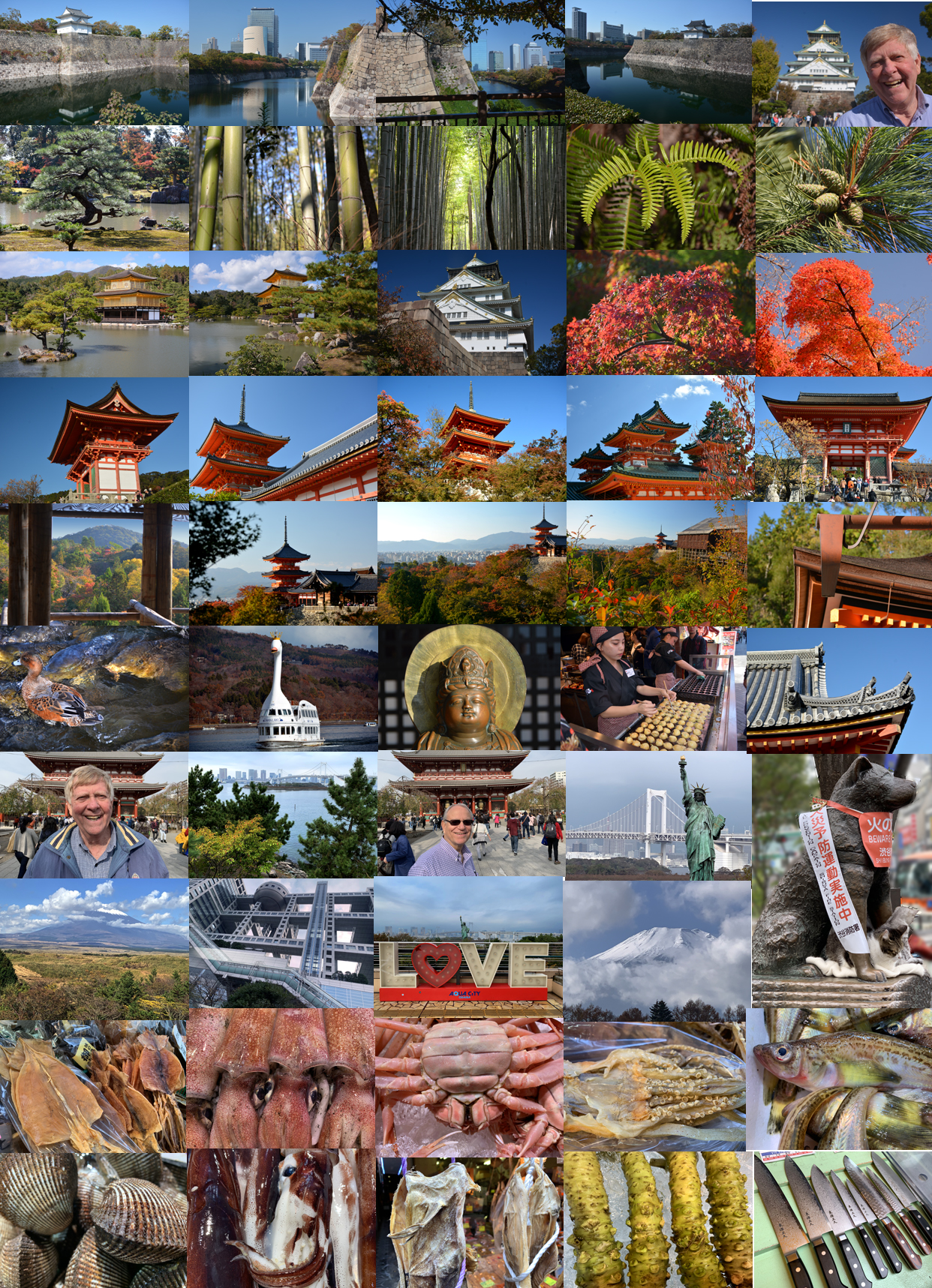
Osaka ~ Nara ~ Kyoto
Osaka Castle Garden with its iconic stone wall and gigantic moat.
Kyoto Fushimi Inari Shrine (the god of rice).
Kyoto's Kinkakuji (Golden Pavilion) is a Zen temple whose top floors are completely covered in gold leaf and was the retirement villa of the shogun Ashikaga Yoshimitsu and then in 1408, became a Zen temple.
Kyoto's Heian Jingu Shrine is Japan's top ranked Shrine with one of Japan's largest torii. The Shrine is used for weddings and concerts.
Kyoto's Kiyomizudera (Pure Water Temple) is one of the most celebrated temples of Japan. It was founded in 780 and is associated with the Hosso sect, one of the oldest sects within Japanese Buddhism this UNESCO World Heritage Site offers a breathtaking view of Kyoto.
Kyoto's Arashiyama Bamboo Grove is spectacular.
Lake Yamanakako (Mt. Fuji), the largest of the Fuji Five Lakes offers magnificent views of Mt. Fuji.
"Tsukiji Fish Market dates back to the 16th century and is the largest fish market of the world.
Odaiba Kaihin Koen (Odaiba Seaside Park)
Sensoji, AKA Asakusa Kannon Temple is Tokyo's most significant, colorful and popular temples and is associated with the Tendai sect of Buddhism.
Kabukicho (Sleepless Town), is an entertainment and red-light district in Shinjuku, Tokyo.
Tokyo Metro Subway and the bronze statue of Hachiko in front of the Shibuya train station.
Sony Pictures Entertainment -- "Hachi: A Dog's Tale" staring Richard Gere
~ is a film based on one of the most treasured and heartwarming true stories ever told. It's a 2009 English-language drama film. Based on the true story of a faithful Akita Inu. The film is a remake of the 1987 Japanese film Hachikō Monogatari.
(Trailers: https://www.youtube.com/watch?v=JImj5lV7al4 - or - https://www.youtube.com/watch?v=drTiv5r57nI
Hachi is a story of love and devotion between a dog and a man, and based on the true story of Hachikō, November 10, 1923 to March 8, 1935). The story is told by Ronnie, the man's grandson. When Ronnie has to give a presentation at school about a personal hero, his chosen subject is his grandfather's dog, Hachiko. Despite his classmates' laughing, Ronnie tells the story of how his grandfather, Professor Parker Wilson, finds a lost puppy which has been freighted to America from Japan and accidentally left at the train station of the Professor's small Rhode Island hometown. The professor ends up taking the puppy home, planning to search out its intended destination and send it on to its real owner. However the search for the puppy's owner is unsuccessful, and Parker and the puppy begin to form a close connection. From his friend Ken, a Japanese professor, Parker learns that the dog is of the Japanese Akita breed. Ken also translates the symbol on the puppy's collar as Hachi, Japanese for the number 8, signifying good fortune, even though the puppy's life so far has seemed anything but lucky. Thus the puppy acquires his name, 'Hachiko, or Hachi for short, and although Parker's wife, Cate, is opposed to keeping the puppy, eventually she relents upon realizing how strong the bond between Parker and Hachi has become.
Over the next year or so, Parker and Hachi become even closer. Parker tries, but Hachi refuses to do dog-like activities such as chasing and fetching. One morning, Parker leaves for work and Hachi follows him to the train station and refuses to leave until Parker walks him home. Later that afternoon, Hachi walks to the station to wait patiently for Parker to return. Parker is surprised to find Hachi waiting for him, and it becomes a daily routine.
One day, Hachi waits patiently as the train arrives, but there is no sign of Parker. He waits, lying in the snow for hours until Parker's son-in-law Michael comes to get him. Although everyone tries to tell Hachi that Parker has died (of a cerebral hemorrhage during a lecture in class), Hachi doesn't understand. Hachi continues to return to the station and wait every day.
As time passes, Cate sells the house and Hachi is sent to live with Parker and Cate's daughter Andy, her husband Michael, and their baby Ronnie. However, Hachi escapes and finds his way back to the station, where he sits at his usual spot. Andy arrives and takes him home, but after seeing how depressed the dog is she lets him out to return to the station. Hachi waits every day at the train station and sleeps in the rail yard at night. He is fed daily by the train station workers who knew the professor. After seeing a newspaper article about Hachi, Ken visits Hachi.
Cate comes back to visit Parker's grave on the tenth anniversary of his death and meets Ken. She is stunned to see a now elderly Hachi still waiting at the station. Overcome with grief, Cate sits and waits for the next train with him. At home, Cate tells the now ten-year-old Ronnie about Hachi. Meanwhile, Hachi continues waiting until his body can wait no longer, and is last seen lying in the snow, alone and still, although he is comforted by a final vision of Parker finally appearing and picking him up to go, presumably to the afterlife.
Ronnie concludes his story of why Hachi will forever be his hero. The story has clearly moved the class, with some students holding back tears, including those who had laughed at the beginning. After school, Ronnie, coming off the school bus, is met by his dad and his own puppy, also named Hachi. The film ends with Ronnie and Hachi walking down the same tracks where Parker and the previous Hachi had spent so much time together.
On May 19, 2012, a bronze statue of Hachiko the dog was placed at the train depot at Woonsocket Depot Square, Woonsocket, Rhode Island, where Hachi was filmed. The train depot at One Depot Square has been named Hachiko Place. A bronze statue of Hachiko is in front of the Shibuya train station, (Tokyo, Japan), in his honor.
Interesting Facts: Animal trainer Mark Harden and his team trained the three Akitas, Leyla, Chico and Forrest, who played the role of Hachi in the movie. Harden adopted Chico after the movie was completed.
According to the movie's closing cards, the real Hachiko died in March 1934, while the earlier movie, Hachiko Monogatari, and other sources state that he died in March 1935 (9 years and 9 months after Professor Ueno's death).
The movie was based on the real Japanese Akita dog Hachiko, who was born in Japan in 1923. After the death of his owner, Ueno Hidesaburō, in 1925, Hachiko returned to the Shibuya train station the next day and every day after that for the next nine years until he died in March 1935.
Hachiko is known in Japanese as chuken Hachiko faithful dog Hachiko, hachi meaning eight and ko meaning affection.
Youtube Movie ~ Enjoy the original Japanese version
Hachiko Monogatari 1987 Film with English subtitles
The film is broken into eleven, ten minute segments
https://www.youtube.com/watch?v=1C4k2tz_Dh4
The youtube trailer is only 4-minutes and 30 seconds
https://www.youtube.com/watch?v=xbnuUW6wH44
Shirataki Noodles
These low-carb noodles can satisfy your spaghetti cravings, and are a gluten free replacement for pasta. Shirataki Noodles are made from the root of a very special type of plant in Asian, and are naturally low in calories and carbs, plus they are an excellent source of fiber, depending on the brand you prefer. These low fat noodles are tender and absorb the flavors you cook them with, so be creative and try them with every meal. If you are a health-conscious eater then Shirataki Noodles are for you.
Shirataki, often written with the hiragana are very low carbohydrate, low calorie, thin, translucent, gelatinous traditional Japanese noodles made from devil's tongue yam (elephant yam or the konjac yam). The word "shirataki" means "white waterfall", describing the appearance of these noodles. Largely composed of water and glucomannan, a water-soluble dietary fiber, they have little flavor of their own.
Shirataki noodles can be found both in dry and soft "wet" forms in Asian markets and some supermarkets. When wet, they are purchased pre-packaged in liquid. They normally have a shelf life of up to one year. Some brands may require rinsing or par-boiling as the water they are packaged in has an odor that may be unpleasant to those not accustomed to it.
Alternatively, the noodles can be drained and dry roasted. This gets rid of the aku (bitterness). It also makes the noodles have a more pasta like consistency. Dry roasting is done by placing noodles in a non-stick skillet on high for a minute or until you hear a slight squeaking noise when moving them around. After that they are ready to be added to soup stock or have a sauce added to them.
There are two types of shirataki noodles sold in the United States. Traditional shirataki noodles have zero net carbohydrates, no food energy, and no gluten, and they are useful for those on low-carbohydrate diets. Tofu-based shirataki-style noodles are becoming increasingly popular in U.S. supermarkets and health food stores. They have a much shorter shelf life and require refrigeration even before opening. Tofu-based noodles contain a minimal amount of carbohydrate.
* made of naturally water-soluble fiber with no fat, sugar, or starch.
* contain zero net carbohydrates and zero calories, no gluten -made of a healthy natural fiber called Glucomannan.
* wheat & gluten free and kosher.
* Easily absorbs the flavors of any soup, dish, or sauce.
* are instant and come in a variety of styles
* have shown beneficial effects backed by medical studies for Type II Diabetes, Constipation, Obesity, and Cholesterol.