The Magical Islands of Venice
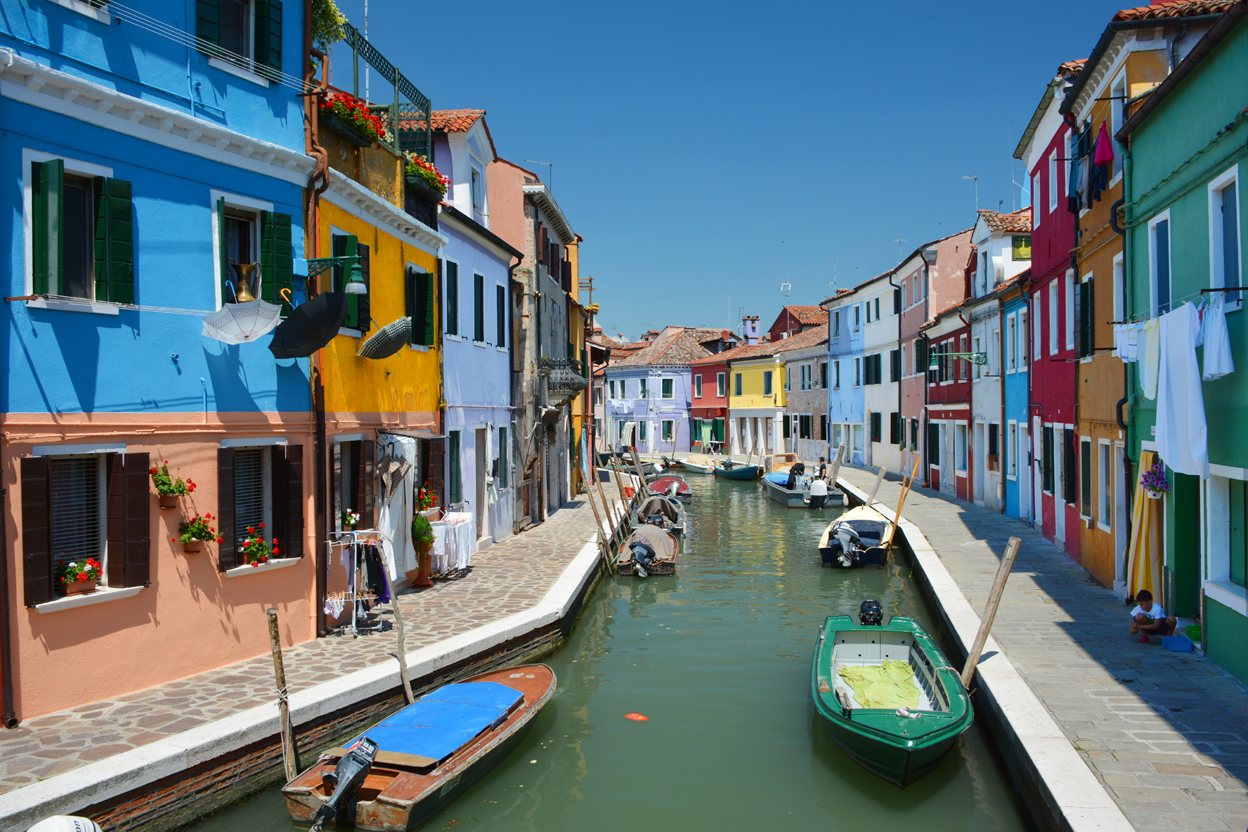
Colorful Burano with its lace making, Torcello's great Cathedral, and peaceful Mazzorbo's exclusive wine vineyard.
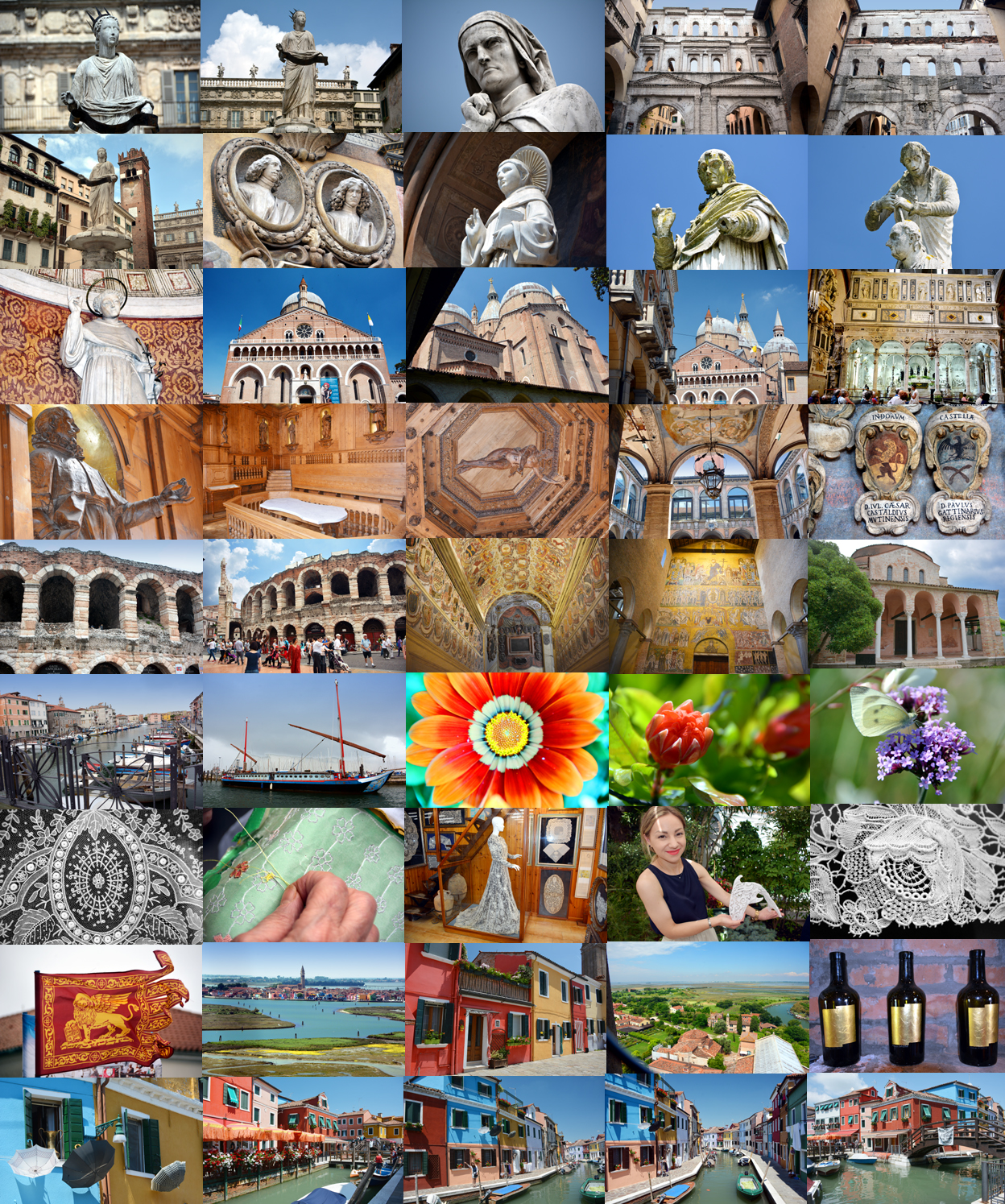
Burano, known for its colorful houses and lace making tradition, and Mazzorbo, famous for its exclusive wine made from golden-hued Dorona grapes, a time-honored and historic variety that dates back for centuries. The 500ml bottles with their 24-karat gold leaf designs sell for 80 Euros…empty!
The island of Torcello is the home of the Cattedrale di Santa Maria Assunta and its spectacular mosaics: "The Last Judgement" and "The Virgin and the Apostles." The Cathedral of Santa Maria Assunta (Cattedrale di Santa Maria Assunta) is a basilica church on the island of Torcello, Venice, northern Italy. It is a notable example of Venetian-Byzantine architecture, one of the most ancient religious edifices in the Veneto, and containing the earliest mosaics in the area of Venice.
According to an ancient inscription, it was founded by the exarch Isaac of Ravenna in 639, when Torcello was still a rival to the young nearby settlement at Venice.
The original church is believed to have had a nave with one aisle on each side and a single apse on the eastern wall of the cathedral. It's difficult to tell what the original church was like because very little of it survived the subsequent renovations. Much of the plan of the original church survives as its present form is very similar to the original but the only physical parts that survive are the central apse wall and part of the baptistery that survives as part of the façade of the current church.
The first of two major renovations occurred in 864 under the direction of Bishop Adeodatus II. In this renovation, the two aisle apses that appear today were built. Also, the synthronon that fills the central apse was created and the crypt was placed under it. After this renovation, the cathedral would have resembled the current cathedral more than the original church would have but it is not until after the second and final major renovation that the cathedral appears very similar to its current design.
The final renovation was consecrated under Bishop Orso Orseolo, whose father Pietro Orseolo II was the Doge of Venice at the time, in 1008. With this renovation, Orseolo raised the nave, added windows to the western wall, and created the arcade that runs along the nave on both sides separating it from the aisles and helping to support the clerestory.
The façade is preceded by a narthex to which was once annexed the 7th century baptistry, only traces of which remain. The bell tower dates from the 11th century, offering a spectacular view of Venice. Also annexed was in origin the Bishop's Palace. The façade has 12 semi-columns connected by arches at the tops. The narthex (11th century) was enlarged in the 13th century. In the middle is the marble portal (1000).
The most striking exterior features are the decoration of the façade and the frontal portico, enlarged in the 14th century. The interior, with a nave and two aisles, has a marble pavement, the throne of the bishops of Altino and the sepulchre of St. Heliodorus, first bishop of Altino. The counter-façade has a mosaic of the Universal Judgement. Noteworthy is also a mosaic depicting a Madonna with Child (of the Hodegetria type) in the middle apse (15th century).
The most important artistic element of the cathedral is the mosaics, the earliest remaining mosaics in the neighbourhood of Venice. The main apse has an 11th-century mosaic of famous beauty of the standing Virgin Hodegetria, isolated against a huge gold background, above a register of standing saints. These seem originally late 11th-century, by a team of Byzantine mosaicists, but the main figure was reworked a century later after an earthquake, while the saints remain from the first period of work. The west wall (over the door) was done in this second phase: from the top it contains a Crucifixion in the gable, then a vigorous Harrowing of Hell with a large figure of Christ, above a Last Judgement taking up four lower registers. The skull of Saint Cecilia is also kept as a relic here.
Bologna
Bologna, known as the epicurean capital of Italy and home of Dante's "Inferno" is also famous for the first "Anatomical Theatre" of the University of Bologna.
The Archiginnasio Palace
New Schools
The Archiginnasio Palace, (University of Bologna), was built in 1563, combining the schools of Legisti, (civil and canon law), and Artisti, (philosophy, mathematics physics medicine and natural sciences). Included in the Archiginnasio Palace is the Stabat Mater Hall - commemorating the first performance of Gioacchino Rossini’s Stabat Mater which took place on March 18, 1842 under the direction of Maestro Gaetano Donizetti. In the Anatomy Theatre - anatomy was taught empirically through dissection of corpses dating back to 1637. Not to be missed are the thousands of coats-of-arms, including one from the New World known as “Non-India” or "INDORVM" (pictured above). The library houses over 800,000 books and pamphlets, 2,500 “incunabula” (early printed books, especially those printed before 1501), 15,000 sixteenth century books, 12,000 manuscripts, 50,000 letters and 15,000 drawings…making this most important city library in Italy.
Padua
Padua is a city in Veneto, northern Italy 25 miles west of Venice. It is the capital of the province of Padua. The city is sometimes included, with Venice (Venezia) and Treviso, in the Padua-Treviso-Venice Metropolitan Area, having a population of 1,600,000 and claims to be the oldest city in northern Italy. Padua is the setting for most of the action in Shakespeare's The Taming of the Shrew.
The Scrovegni Chapel (Italian: Cappella degli Scrovegni) is Padua's most famous sight. It houses a remarkable cycle of frescoes completed in 1305 by Giotto. The fresco cycle details the life of the Virgin Mary and has been acknowledged by many to be one of the most important fresco cycles in the world. Entrance to the chapel is an elaborate ordeal, as it involves spending 15 minutes prior to entrance in a climate-controlled, airlocked vault, used to stabilize the temperature between the outside world and the inside of the chapel.
The most famous of the Paduan churches is the Basilica di Sant'Antonio da Padova, locally known as "Il Santo." The bones of the saint rest in a chapel richly ornamented with carved marbles. The basilica was begun around the year 1230 and completed in the following century.
Donatello's magnificent equestrian statue of the Venetian general Gattamelata (Erasmo da Narni) can be found on the piazza in front of the Basilica di Sant'Antonio da Padova. It was cast in 1453, and was the first full-size equestrian bronze cast since antiquity.