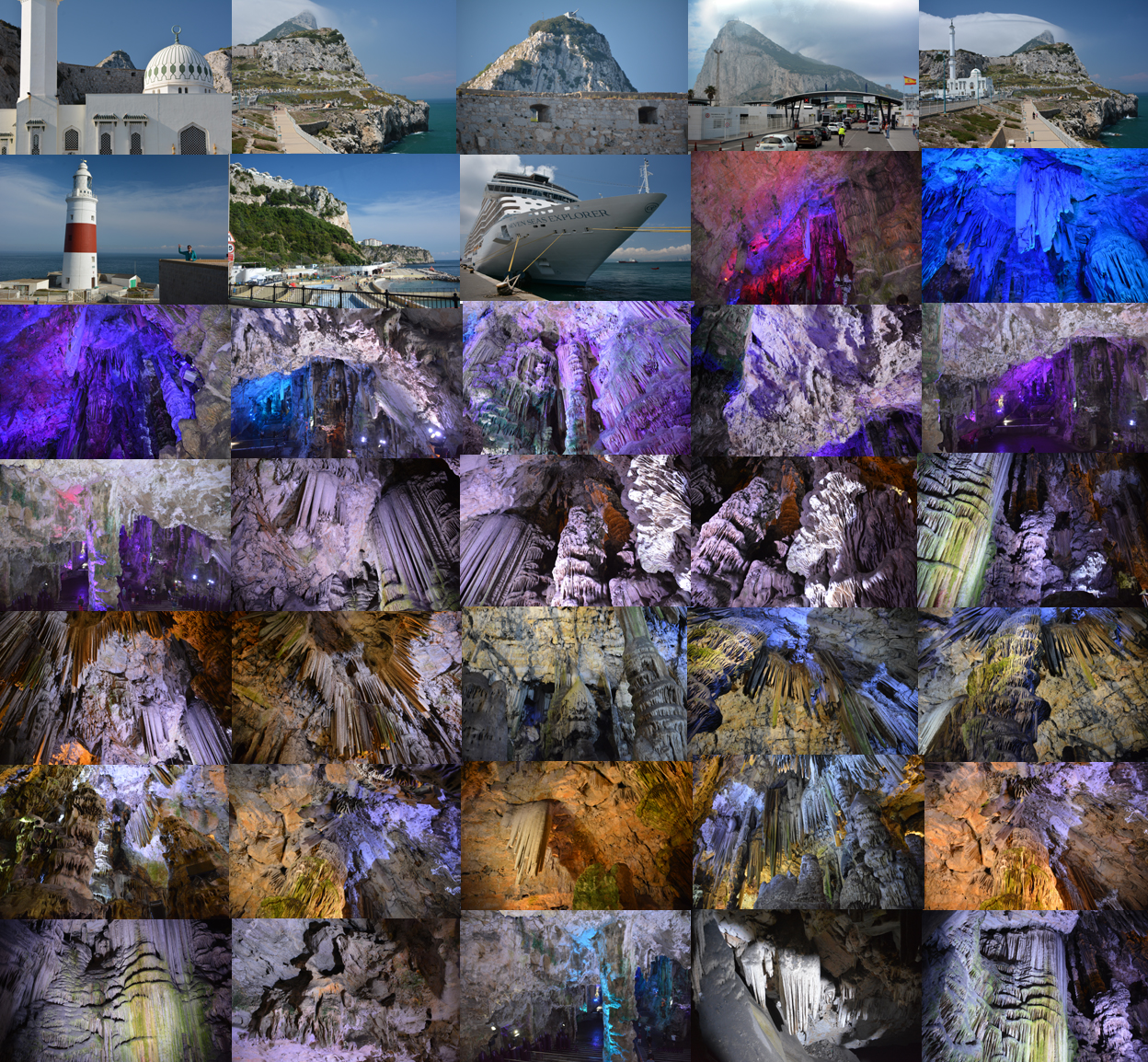
St. Michael's Cave or Old St. Michael's Cave
St. Michael's Cave or Old St. Michael's Cave is the name given to a network of limestone caves located within the Upper Rock Nature Reserve in the British Overseas Territory of Gibraltar, at a height of over 980 ft above sea level. It is the most visited of the more than 150 caves found inside the Rock of Gibraltar, receiving almost 1,000,000 visitors a year.
The cave was created by rainwater slowly seeping through the limestone rock, turning into a weak carbonic acid which gradually dissolved the rock. Through this process, tiny cracks in The Rock's geological fault grew into long passages and large caverns over thousands of years. The numerous stalactites and stalagmites in the cave are formed by an accumulation of traces of dissolved rock deposited by water dripping from the ground above.
1974 a Neolithic bowl was discovered in the cave, one of many examples which prove that the cave was known to prehistoric humans. Another would be the recently discovered cave art depicting an ibex drawn in charcoal on one of the cave walls. It has been dated to the solutrean period (15,000 to 20,000 years ago) based on the style used. However, since two Neanderthal skulls have been discovered in Gibraltar, it is possible that they were among the first to set foot in the cave around 40,000 BC.
During the first century of the British period, there are some records of the attempt by the new owners of the Rock to change the name of the cave using the name of the English patron Saint, Saint George. However, the new name, St. George's Cave, was not successful and, although still used in the 19th century, has not remained in use, being replaced by its original name.
During the Victorian era the cave was used as a venue for picnics, parties, concerts, weddings and even duels. The caves would be decorated for many of these events and even illuminated for distinguished visitors by soldiers who would perch on stalagmites with torches.