|
|
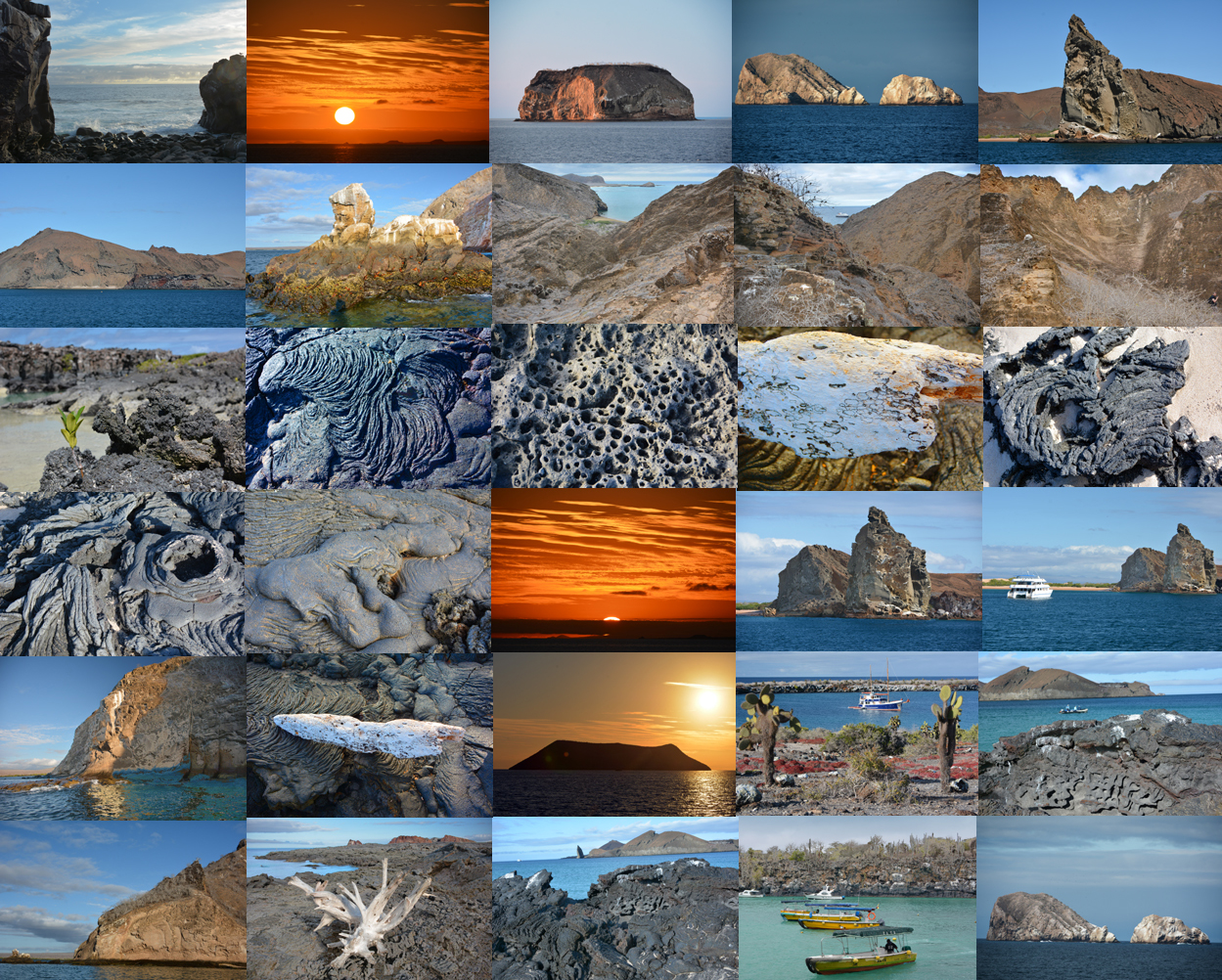
North Central Galápagos IslandsUNESCO declared Galápagos a World Heritage Site in 1978 and subsequently a World Biosphere Reserve in 1985.The Galápagos islands are the islands which changed the world....they very crucible/evolution of life....located on the equator, 600 miles off the coast of Ecuador. These islands were "born of fire" and inspired Charles Darwin's "Origin of the Species" in 1859 as well as his "Principles of Geology" - 1835 written when he was 26 years of age. Since Darwin's death, the Galápagos Islands, (a look back at a prehistoric world), have physically moved more than thirty feet and nearly 200,000 tortoises have since been removed from the islands. Thirteen species of Finches have now been identified. 24,000 permanent residents live in the Galápagos Islands with as many as 16,000 additional undocumented residents. No place on earth can compare to the 13 main, and 100 smaller, enchanted, distinctly unique, biodiverse, Galápagos Islands, ("Islands of the Tortoises") -- whose shell is shaped like a Spanish "galloping saddle" resulting in the original name: "De Los Galo Pegos." With its four major ocean currents, the waters of the Galápagos Islands are the richest on the continent - home to more than 500 species of fish. The history of the Galápagos Islands dates back to 1535 when Tomas de Berlanga accidentally discovered the islands. From 1500 to 1700 the Galápagos Islands were dominated by pirates and Buccaneers. From 1780 to 1880 there were whalers and seal poachers. From 1833 to 1957 San Cristobal Island was a penal colony. Then, in 1950 the Galápagos Islands became a national park.
Galápagos Cacti
Most cacti have spines, which have evolved from leaves. Spines serve several purposes – guarding against predation, providing shade to keep the internal temperature of the plant lower, and channeling rainwater toward the base of the plant. Another important adaptation of the cactus is the waxy coating that covers the skin. This is called the ‘glaucus bloom’ and it reduces evaporation by the plant by sealing in moisture. Leaf-like stems known as pads store and conserve moisture and work as photosynthetic organs for the cacti. Endemic cacti in the Galápagos Islands include the Lava Cacturs, Candulabra Cactus, and the species of Opuntia (Prickly Pear), found in the Galapagos.
~ ~ ~ ~ ~ ~ ~ ~ ~ ~ ~ ~
A visually inspiring flight to Ecuador lined my heart with all the right colors and moods, and armed me with all the exhilaration needed for an unusual adventure. Awestruck, I stared out of the airplane window at the sea of brilliant orange and luminous pink flat cloud variations, some looking like floating mashed-potato clumps outlined in red and gold, all lined up against the sun setting fiery red into the horizon somewhere over the Caribbean.The night-time landing in Quito, no less breathtaking, was like flying into a giant stone-carved fruit bowl filled to the brim with sparkling jewels, an ambient city spread out like a yellow diamond necklace on mounds of black velvet inside the abruptly protruding Andean massif nine-thousand feet above the Pacific Ocean. Flying six hundred miles westward the following morning toward the Galapagos proved equally inspiring. Beginning the descent, I could see the cluster of islands, looking like monstrous brown dragons floating in one gigantic pile in the big blue Pacific. I also sensed a place where the bountiful sea had rumbled and roared for millenniums while these islands slumbered. Once on terra firma, I could feel I was in a place where earth seemed utterly untamed; where moods could no doubt range easily and suddenly from serene and somber to nerve-tingling natural violence. Here was a paradise, neither found nor lost, neither harried nor hurried, and at peace with time. What manifested itself immediately was that this little Archipelago was not a holiday resort! As the days proceeded, guided expeditions revealed everything from the islands’ innermost natural activities to nature’s outermost natural evolutions, and I was reminded that, in this secluded environment for the undisturbed expansion of indigenous species, on land, in the air, and in the sea, I was very much a second-class citizen. On land: ancient turtles, ambling; entwined iguanas, motionless; black lizards, camouflaged; flightless cormorants, lumbering; blue-footed boobies, courting; red-throated frigates, mating; and yellow-billed albatrosses, strutting. In the air: oystercatchers plunging into the sea for dinner; swallow-tailed gulls in lofty flight patterns; pink flamingos soaring; storm petrels jostling for cliff space; pelicans swooping; hawks gawking; plovers dancing; and yes, those tiny Darwin finches all vying for landing patches on yellow prickly pear blossoms. In the near sea: wobbly penguins gliding with ease through the watery brink; orange ceramic-looking crabs cavorting on backs of sleeping sea lions. And in the farther deep: giant manta rays, sharks, dolphins, star fish, and millions upon millions of fish species, each inhabiting their territorial space in a deep, blue-green watery kingdom.
|