|
|
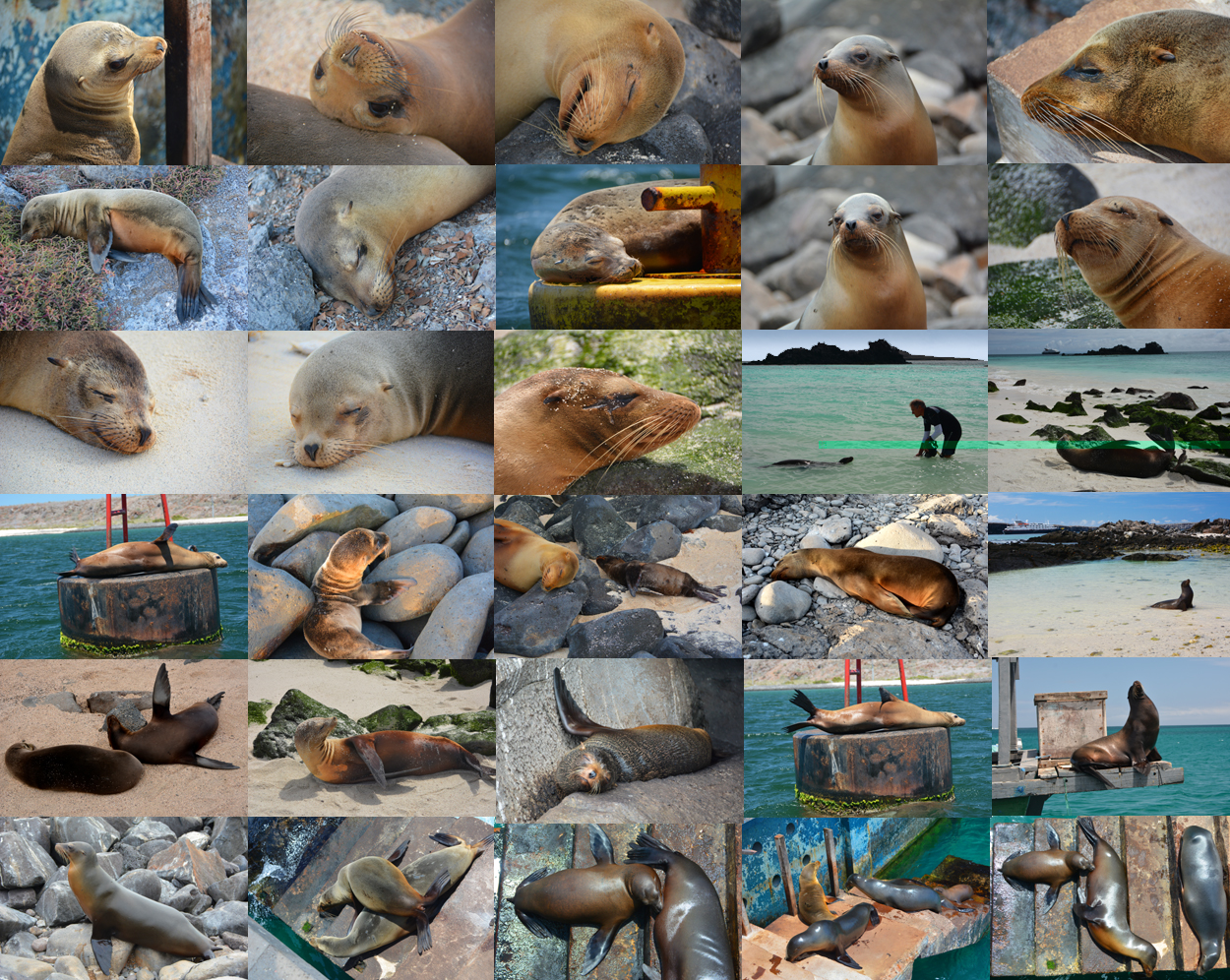
Galápagos Sea Lions are common throughout the islands and are endemic to the archipelago. There are an estimated 40,000 individuals.
Characteristics-male versus female….Galápagos sea lions are very similar in appearance to their Californian relatives, but are smaller.
Males and females are sexually dimorphic, with males growing much larger and having several distinctive features. Sexually mature males have a steeply slopping forehead, raised crown (sagittal crest) and thick, robust neck, chest and shoulders, with a slender abdomen. Juveniles lack the crest altogether-having a flat head with little or no forehead.
Females are smaller, more graceful, have a dog-like muzzle, and a longer, more slender neck with a thicker abdomen.
When wet, their fur changes color drastically - males appear nearly black and females dark brown. When dry, males are dark brown and females are creamy brown.
Galápagos sea lions share their range with Galápagos fur seals and at first glance, they can look alike. They both belong to the group of seals called the Ottaridae or “eared seals,” and have external ear flaps (pinnae), long fore-flippers used for walking, and hind flippers that they rotate under while on land.
Sea lions, however, can be distinguished from fur seals by their blunter, less pointed muzzles and darker coloration.
How did they get to the Galápagos? Galápagos sea lions have descended from ancestors who lived off the South American coast. It is thought that violent storms probably brought the first sea lions to the Galápagos, where they thrived and evolved into their own species.
Diet: Sea lions are daytime hunters, using vision to hunt-mainly sardines. Foraging trips can take several days, covering 10-15 km in one trip.
Mating and Breeding: On land, sea lions form large colonies. Dominant males, called bulls, fight one another for control of territories and harems, consisting of 5-25 females.
The dominant bulls continuously swim back and forth along the shoreline, patrolling his harem and frequently rears his head out of the water and barks indicating his territorial ownership. During this time the male will not feed and he eventually becomes tired and weak. On average, a dominant bull only holds his territory for a few months before being challenged by a newcomer.
The ‘surplus bachelors’ (immature, non-breeding or harem-less males), congregate in bachelor colonies on other sections of the coastline.
The breeding season coincides with the dry, or Garua season-from May through January.
Pups: Each female gives birth to a single pup. She will remain with the pup for the first week, then leave the pup alone to go to the ocean to feed, returning regularly to nurse the pup. Young pups left ashore form creches - often with one mother “baby-sitting” while other mothers are at sea. Mothers and pups recognize each other by their barks - as soon as a mother returns to the beach and starts barking for her pup. A mother can pinpoint her own pup’s bark easily-even if it is in the middle of a crowd of 30 youngsters, all barking at once!
After the second week, however mothers lead their pups into the ocean and them to swim, and will follow the mothers on feeding trips. However, pups cannot survive on their own hunting skills and are still nursed for up to a year.
When the pup is only 2-3 weeks old the mother will mate again with dominant male of her harem. Gestation is about 11 months.
Environmental threats of El Niño: Galapagos sea lions are protected by law. However, their numbers can fluctuate greatly as a result of major natural events such as the El Niño.
During El Niño events, the numbers of sardines in the area drastically drops, resulting in an increased mortality of adults from starvation and a cessation of reproduction.
Status: Endangered-Studies confirmed that numbers of Galápagos sea lions declined nearly 50% over the past 30 years, but is currently stable.