The Waved Albatross
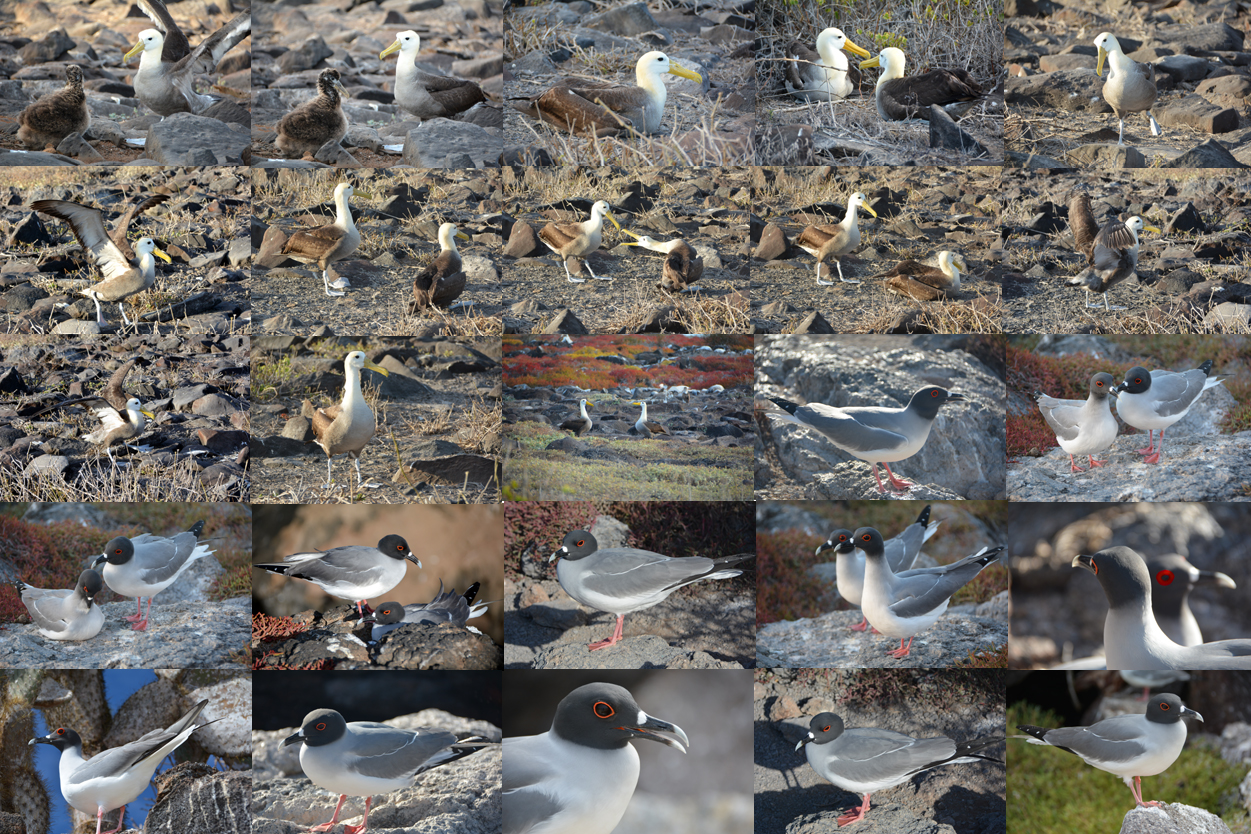
Waved Albatross are the largest bird in the Galápagos, weighing 7.5 pounds, standing 3 feet tall with a wingspan of up to 8 feet, it has a lifespan of 45 years. Nearly the entire breeding population of 12,000 pares nests on Espanola Island. It is the only albatross species that breeds in the tropics – all other are found much farther south.
Males and females look alike, with males only slightly larger than females. They have blue feet. They are exceptional fliers – but terrible at taking-off from land. Once in the air, they can glide for days without flapping their wings, except in calm conditions. Their wings are too large to take-off from flat ground, so they must waddle to cliff edges and fall – spreading their enormous wins to catch the air.
Albatross do not dive into the ocean to grab their prey, (mainly fish and squid), but deftly snag them off the surface using their long, strongly hooked bills like fishing hooks. The forage from 6 to 60 miles away from their nesting sites to get food for their chicks.
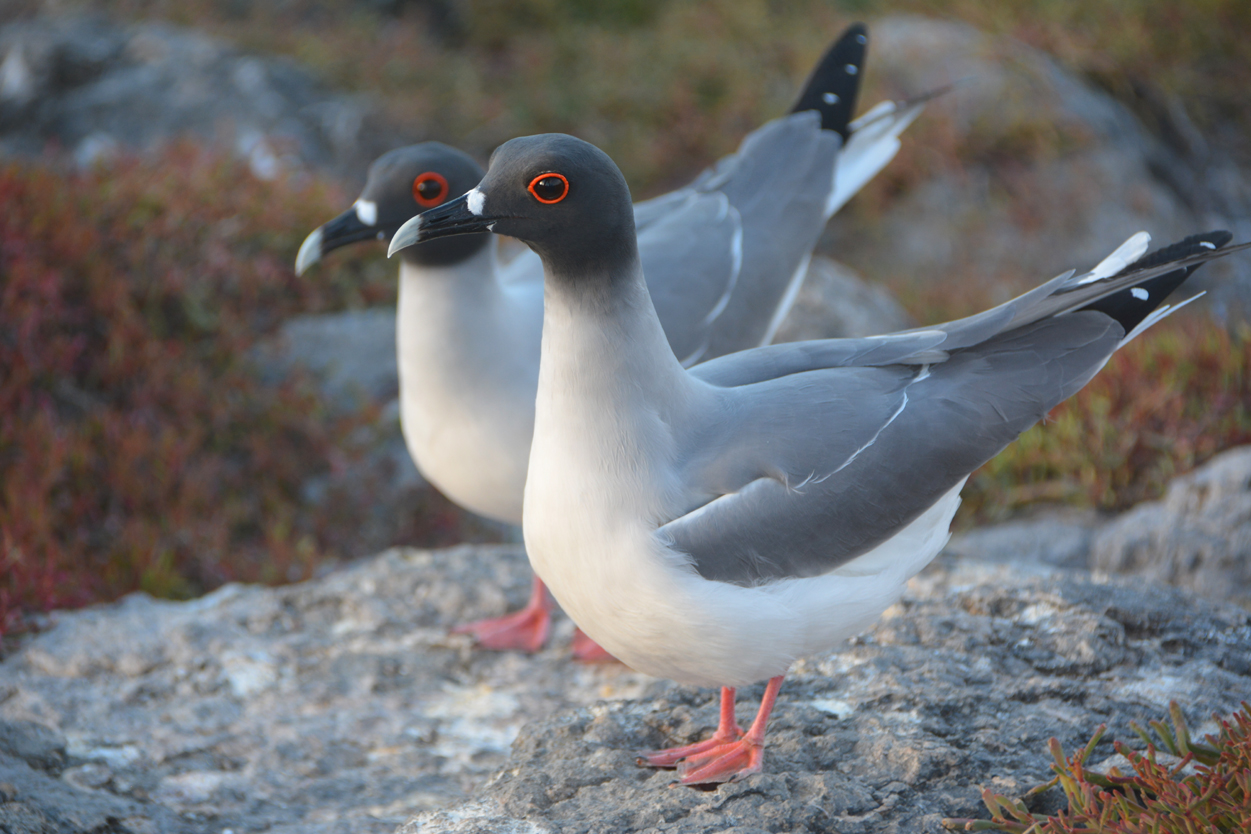
Lava Gulls
The Galápagos Lava Gull is endemic to the Galápagos and has not been reported anywhere else in the world. It has a lifespan of 15 years and is considered the rarest gull in the world with only 300-400 pairs in the wild.
The Lava Gull is unmistakable…being the only all-dark gull. They have black heads, black wings, dark grey bodies with paler gray bellies. Bill and legs are black and have very distinctive markings: 1) The white upper and lower eyebrows… 2) The red eye-rings… 3) The scarlet red inside of the mouth, which is easily seen as they frequently make loud raucous calls with their bills wide open.
The primary breeding season is from May to October, but they can breed all year round. They are solitary nesters, laying two olive splotched, well camouflaged eggs in nests along the shoreline. Incubation takes 30 days and chicks fledge in only 60 days.
Like most gulls, Lava Gulls are omnivores. They scavenge along the tide line and are also notorious nest-robbers. They will grab small lizards and newly hatched iguanas and turtles, but rarely catch fish. They do not rest on the ocean.
Galápagos Finches
There are 13 endemic species of finches in the Galapagos. They are jointly referred to as “Darwin’s Finches,” phrase that was first used in 1936, and became popular in 1947 when the ornithologist, David Lack published the first modern ecological and evolutionary study of the finches.
The nickname “Darwin’s Finches” was attributed to these Finches because they played such an important role in Darwin’s thoughts that eventually led to his development of the theory of evolution and survival of the fittest.
Darwin was fascinated with the diversity of the species, and how quickly they seemed to have evolved from a common ancestor and adapted to different food types on each island. These adaptations are mainly manifested in the shape and size of their beaks.
Despite all their fame, these birds are not particularly beautiful or striking, although they do have a melodious lilting song. They all look pretty much alike, (size, plumage behavior). They are small, sparrow-sized land birds with drab black, brown or olive feathers. They have short round wings and short tails that are cocked to one side.
Although commonly seen, they are hard to tell apart without close observation. The major difference is the size and shape of their beaks.
Galápagos Finches ~ species divergence and their specialized beaks
It is believed that all 13 species derived from a single species similar to the Blue-black Grassquit Finch commonly found along the Pacific Coast of South America. But once the birds arrived in the Galapagos Islands, they learned to feed on different foods, and were able to diversity into all the habitats due to limited compensation from other land birds.
The shape and size of the beak, more than any other feature, reflect their specializations. To the finches, their beaks are tools designed to perform a limited job.