|
|
The Galápagos IslandsThe volcanic Galápagos archipelago is a living museum of evolutionary changes. Animals are free and completely fearless, just as Charles Darwin found them in 1835, the very inspiration for his theory of the "Origin of the Species" ... which shook the world. Charles Darwin, (a “revolutionary naturalist”), was a medical student-turned student of Divinity, was twenty-two when he sailed to South America in 1831, where he spent four years...five weeks in the Galápagos Islands on just four islands! UNESCO declared Galápagos a World Heritage Site in 1978 and subsequently a World Biosphere Reserve in 1985. The Galápagos islands are the islands which changed the world....they very crucible/evolution of life....located on the equator, 600 miles off the coast of Ecuador. These islands were "born of fire" and inspired Charles Darwin's "Origin of the Species" in 1859 as well as his "Principles of Geology" - 1835 written when he was 26 years of age. Since Darwin's death, the Galápagos Islands, (a look back at a prehistoric world), have physically moved more than thirty feet and nearly 200,000 tortoises have since been removed from the islands. Thirteen species of Finches have now been identified. 24,000 permanent residents live in the Galápagos Islands with as many as 16,000 additional undocumented residents. No place on earth can compare to the 13 main, and 100 smaller, enchanted, distinctly unique, biodiverse, Galápagos Islands, ("Islands of the Tortoises") -- whose shell is shaped like a Spanish "galloping saddle" resulting in the original name: "De Los Galo Pegos." With its four major ocean currents, the waters of the Galápagos Islands are the richest on the continent - home to more than 500 species of fish. After experiencing the North Central Galápagos Islands....compare the completely different world of the "Western" Galápagos Islands....equal in intensity and interest, but completely different. The history of the Galápagos Islands dates back to 1535 when Tomas de Berlanga accidentally discovered the islands. From 1500 to 1700 the Galápagos Islands were dominated by pirates and Buccaneers. From 1780 to 1880 there were whalers and seal poachers. From 1833 to 1957 San Cristobal Island was a penal colony. Then, in 1950 the Galápagos Islands became a national park.
THE FOUR PROVINCES
Galápagos
Flora and Fauna of The Galápagos IslandsGalápagos is home to an incredibly high number of endemic species such as the giant Galápagos tortoises, the blue footed, red footed and "masked" or "Nasca" boobies, flamingos, frigate birds, albatrosses, (unique, very small), penguins, non-flying cormorants, and 13 different varieties of finches....whose beaks served as proof for Darwin's theory of evolution by natural selection. The most distinctive plants are mangroves and endemic cacti, "Opuntia Cacti" or "Opuntia echios gigantean." The islands are the result of lava eruptions that came from the bottom of the ocean and rise 2,600 feet above sea level. Lava from more than 2,000 craters has continuously altered the terrain. Currently the archipelago includes 13 large and 6 minor islands and more than 40 islets. Some of the younger islands still have active volcanoes.
North Central Galápagos IslandsThe North Central Galápagos Islands are more strenuous but you see more seabirds, albatross, red-footed boobies and land iguanas.
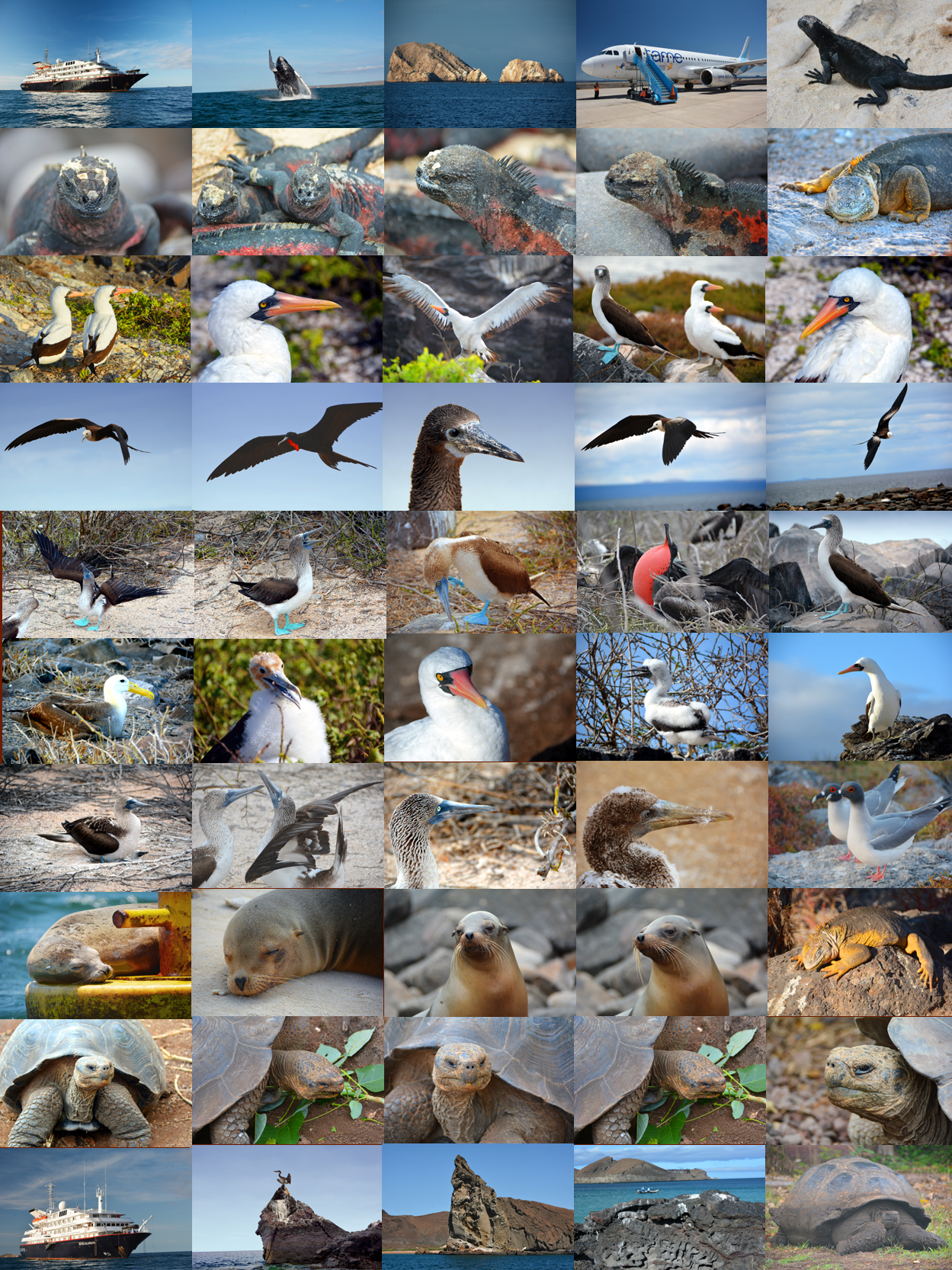
Western Galápagos IslandsThe Western Galápagos Islands are less strenuous, but you see more penguins and have better snorkeling. There are more cormorants, marine iguanas, turtles and tortoises.In general, December to May the weather is sunny and warm. From June to November, it's colder and drier. February and March are very hot, in the 90's with high humidity and rain. For bird lovers (both flying and non-flying), whale watchers, animal and botany lovers, geologists, volcano enthusiasts and snorkelers, the Galápagos Islands should be at the top of their "bucket list." You don't need to be an ornithologist to appreciate the astoundingly mating practices and the antics of the male frigate bird with his voluminous bright red throat pouch! No world-traveler has seen, experienced or understood the world, until he/she has been touched by the mysterious, uniqueness and biodiversity of the Galápagos Islands. From its smoldering (rough and horrid), interiors of "hell on fire" to its lava clad shores "harsh but not hell," to enchanted forests in Post Office Bay, Florenana, the Galápagos Islands have it all. Here's what we saw August 27, 2016 to September 3, 2016 in the North Central Galápagos. Those (35) species listed in italic followed by an asterisk (*), are endemic to the Galápagos Islands, according to the Charles Darwin Foundation Galapagos Species Checklist.
Mammal Sightings:
Galápagos fur seals* |
Silver Galapagos
Machu Picchu
Words cannot describe the experience of a Galapagos cruise. Trace the remarkable origins of the species as you discover a land that time forgot. Swim with sea turtles and Manta Rays, explore tidal pools and lush mangroves, observe Giant Tortoises ... Be one of the few to experience why Darwin was so inspired by these spectacular islands.
FEATURED EXCLUSIVE OFFERS/PROGRAMMES:
Early Booking Bonus: Save 10% if you book and pay in full by September 2nd, 2016
All-Inclusive Package: All-Inclusive package includes flights between Ecuador and the Galápagos Islands, Transfers, pre and post Hotel* and National Park fees. International Flights Offer: Enjoy roundtrip Economy Air** to Ecuador for only $199
INCLUDED IN THE CRUISE FARE:
$200 shipboard credit per stateroom (Group Amenity)
Included flights between Ecuador and the Galápagos Islands
Included Transfers
Included pre and post Hotel*
Included National Park fees
Personalized service – the best crew-to-guest ratio in expedition cruising
Butler service in every suite – all guests are pampered equally
Open-seating dining options – dine when and with whomever you please
Beverages in-suite and throughout the ship – select wines, premium spirits, specialty coffees and soft drinks, plus your own tailored mini-bar
In-suite dining and room service – available from 6:00AM to 11:00PM. Enrichment lectures by a highly qualified Expeditions Team
January 5, 2017 - Depart SFO
January 6, 2017 – Explore Quito, Ecuador
Baltra, Galapagos, Ecuador: Saturday January 7, 2017
Baltra Island, also known as South Seymour, is the gateway through which most people enter and depart the Galapagos Island. Upon arrival and once through immigrations procedures, visitors are transferred directly to a nearby dock to join the ship by Zodiac. The runway was first constructed here during World War II when the island was used as a US Army Air Base. Located near the geographic center of the Galapagos, the island itself is small, flat and arid. Its dry environment hosts salt bushes, prickly pear cactus and palo santo trees, all of which support land iguanas that can occasionally be seen crossing the runway.
Bartolome, Ecuador: Sunday, January 8, 2017
Our ship anchors in sight of the volcanic moonscape of Isla Bartolomé, at Sullivan Bay. Zodiacs bring guests ashore to ascend a boardwalk of 388 steps. Passing through the arid volcanic landscape provides a chance to watch for lava lizards, Galapagos Hawks, and Blue-footed Boobies. However, the climber’s ultimate reward is one of the most beautiful panoramas in all of the Galapagos Islands – the view towards Pinnacle Rock with black, volcanic cones of Baltra, Daphne Major and Daphne Minor in the distance.
Playa Espumilla, Santiago, Ecuador: Sunday, January 8, 2017 Arrive: 12:00PM
Playa Espumilla is located on the northwestern side of Santiago Island and is home to a variety of wildlife including nesting green sea turtles, and plentiful birds such as flamingos, White-cheeked Pintails, Yellow Warblers, Galapagos Hawks, Whimbrels, and American Oystercatchers. Zodiacs will land you at the center of the white-sand beach to join a trail that passes by a seasonal lagoon hosting a variety of bird life. The trail then leads inland to a fragrant Palo Santo (incense tree) forest before looping back to the beach in a lazy circuit past the mangrove-fringed lagoon, where you can watch shorebirds work the mudflats for their dinner.
Punta Vicente Roca, Isabela, Ecuador: Monday, January 9, 2017
The agile Silver Galapagos can anchor in deep water right up against the cliffs of Punta Vicente Roca on the northwest side of Isabela Island. From our anchorage Zodiacs set out to cruise beneath the imposing volcanic coastline. The cliffs support endemic Flightless Cormorants, Galapagos fur seals, Blue-footed Boobies, and marine iguanas. The waters below hold scores of Eastern Pacific green sea turtles swimming all around the Zodiacs. If conditions allow, fortunate snorkelers will have an opportunity to swim with eagle rays, Galapagos sea lions, Galapagos Penguins, and schools of small tuna in the blue.
Punta Espinoza, Fernandina, Ecuador: Monday, January 9, 2017 Arrive: 12:00PM
With the gentle slopes of La Cumbre volcano in the distance, the low, lava-forged coast of Punta Espinoza on Fernandina Island is a spectacular sight. Hundreds of marine iguanas rest on the black rock of recent lava flows absorbing heat from the stone and defending their territories against one another. Galapagos sea lions and their pups also take shelter here, resting on the beach and playing in the shallow tide pools sprinkled along the coast. Walk past high sandy areas where marine iguanas lay their eggs and along low, shallow mangrove ponds ringed with bright red Sally Lightfoot crabs and Flightless Cormorants drying their stubby wings in the sunshine.
Caleta Tagus, Isabela, Ecuador: Tuesday, January 10, 2017
Tagus Cove is a sheltered area southwest of Volcán Darwin on Isabela Island. The protected waters of this cove are home to sea turtles, marine iguanas, Flightless Cormorants and Galapagos Penguins. In addition, the cove has offered safe anchorage to visiting ships through the ages. Here you can choose to kayak, snorkel or head ashore to discover centuries-old names of vessels that were painted or carved onto the rock near the landing site. After landing by Zodiac, you may hike through the forest of Palo Santo trees to access the upper reaches of a volcanic cone. Watch for several species of Darwin finches and curious mockingbirds as you ascend. From the track’s high point the panoramic view is spectacular.
Bahia Elizabeth, Isabela, Ecuador: Tuesday, January 10, 2017 Arrive: 12:00PM
The tranquil inlets of Elizabeth Bay are the perfect spot for a Zodiac cruise. First pass the “Las Marielas” islets, which are home to Blue-footed Boobies, Flightless Cormorants, Galapagos Penguins, Galapagos sea lions and Sally Lightfoot crabs. Then journey on into the bay flanked by the massive volcanoes of Sierra Negra and Alcedo and continue past fresh and desolate lava fields heading towards tall green mangrove trees growing out of black lava shores. In the easternmost embayment lies a hidden inlet. Our nimble Zodiacs can enter this small cove to look for sea turtles, rays and even sharks.
Post Office, Floreana, Ecuador: Wednesday, January 11, 2017
Post Office Bay is steeped in history and received its name thanks to a post box that was placed ashore before 1813. Ships that were visiting the Galapagos on multi-year voyages would leave letters here to be collected and delivered by vessels on their way home. Visitors today can keep the tradition alive by leaving their own postcards in the post box (now a barrel) and looking for any they can deliver by hand back at home. Activities at Post Office Bay can include exploring a cave created by lava that runs underground towards the ocean. The bay itself offers kayaking along the shore and into Mystery Bay, snorkeling, swimming and relaxing on the beach.
Islote Campéon, Floreana, Ecuador: Wednesday, January 11, 2017
Isla Champion is a small islet off Floreana Island’s northeast coast. To cruise by it reveals a bare, rocky island without much allure, but to enter the infinitely blue waters around this small landmass is to discover a spectacular underwater realm. The visibility is generally impressive and thanks to this water clarity snorkelers often spot reef sharks patrolling the reef wall, cruising Pacific green turtles, and playful Galapagos sea lions. Encounters in the blue with thousands of small silver minnows, large tuna fish, or oceanic sunfish are not unheard of either.
Punta Cormorant, Floreana, Ecuador: Wednesday, January 11, 2017 Arrive: 12:00PM
Floreana Island’s northernmost point is called Punta Cormorant – named after the British naval vessel HMS Cormorant and dating back to the late 19th century. From the landing beach a short track leads to a shallow lagoon that is famous for its flamingos. The brilliantly pink birds skim the salty waters for shrimp and tend to chicks on the nest. The trail then scales a low hillside through scattered Palo Santo trees to reveal an idyllic white-sand beach on the other side of the point. Standing at the edge of the lapping waves, you might spot mammoth female sea turtles hauling themselves out of the sea to lay eggs in the sugar sand dunes that lay high above the tide line.
Galapaguera Cerro Colorado, San Cristobal, Ecuador: Thursday, January 12, 2017
Giant tortoises are emblematic of the Galapagos Islands. To experience these ancient animals firsthand, the Silver Galapagos anchors off San Cristobal Island and Zodiacs take all ashore to the pretty little town of Puerto Baquerizo Moreno. From here we set out by bus for the Galapaguera Cerro Colorado Tortoise Reserve in the highlands of the island. The trails of the reserve lead to encounters with large, lumbering adult tortoises as well as small juveniles that could fit in the palm of a person’s hand. Back in town take time to wander the shops or photograph the Galapagos sea lions resting on local boats, lazing about under park benches, or lounging on rocks surrounding the working waterfront.
Wizard Hill, San Cristobal, Ecuador: Thursday, January 12, 2017 Arrive: 12:00PM
Known as Cerro Brujo in Spanish, this stunning beach lies on San Cristobal’s northwestern coast opposite Kicker Rock. Likely to be one of the most beautiful beaches you lay eyes on, the white sand stretches for about a kilometer with gentle lapping water and the occasional breaker on the shore. Sleepy sea lions rest and nurse on the volcanic rocks on the shoreline. The collapsed crater also shelters Blue-footed Boobies, marine iguanas, Brown Pelicans, Sally Lightfoot crabs, sea turtles and stingrays. A walk along the length of the beach is highly recommended as the best way to unwind and take in the contrasts amongst black lava rock, white sandy beach, and all the wildlife to be discovered in between.
Los Gemelos, Santa Cruz, Ecuador: Friday, January 13, 2017
Los Gemelos is Spanish for “the twins” and true to the name, Los Gemelos are twin sinkholes, one on either side of the road running from Puerto Ayora to the north side of the island. The mammoth scale of the landmarks often elicits exclamations of wonder from visitors at first sight. The vertical walls of the sinkholes fall deep into the ground covered in a veil of greenery hiding the bottom of the pit. Walk along the craters’ edges before stopping at Rancho El Manzanillo to see giant Santa Cruz tortoises in the wild. On the ranch swap walking shoes for knee-high rubber boots and wade out in to the green fields to come close to majestic giant tortoises and search for the coveted Woodpecker Finch.
Estacion Darwin & Puerto Ayora, Santa Cruz, Ecuador: Friday, January 13, 2017 Arrive: 12:00PM
Silver Galapagos will anchor in front of Puerto Ayora, Santa Cruz, where the prestigious Charles Darwin Research Station is located. The station also houses the Fausto Llerena Breeding Center for giant tortoises and land iguanas where guides interpret the center’s captive breeding and reintroduction programs. In addition to these star species, throughout the station there are huge prickly pear cactus trees being fed upon by the pretty Galapagos Cactus Finch. To round out the stay in Puerto Ayora, enjoy free time in town where local artists have created charming art galleries and corner cafés.
Baltra, Galapagos, Ecuador: Saturday, January 14, 2017
Baltra Island, also known as South Seymour, is the gateway through which most people enter and depart the Galapagos Island. Upon arrival and once through immigrations procedures, visitors are transferred directly to a nearby dock to join the ship by Zodiac. The runway was first constructed here during World War II when the island was used as a US Army Air Base. Located near the geographic center of the Galapagos, the island itself is small, flat and arid. Its dry environment hosts salt bushes, prickly pear cactus and palo santo trees, all of which support land iguanas that can occasionally be seen crossing the runway.
Category ~ ~ ~ ~ ~ ~ ~ Single ~ ~ ~ ~ ~ ~ Double
SILVER ~ ~ ~ ~ ~ ~ ~ $24,500 ~ ~ ~ ~ ~ ~$12,250
DELUXE VERANDA $15,225 ~ ~ ~ ~ ~ $10,150
VERANDA ~ ~ ~ ~ ~ ~$14,325 ~ ~ ~ ~ ~ ~ $9,550
TERRACE ~ ~ ~ ~ ~ ~$14,025 ~ ~ ~ ~ ~ ~ $9,350
EXPLORER ~ ~ ~ ~ ~ $11,325~ ~ ~ ~ ~ ~ $7,550
Cruise Cancellations: If you find it necessary to cancel your reservation or any component thereof, you or your travel professional are required to contact the Silversea Reservations Department by telephone as well as submit your cancellation in writing. If your cancellation request is received more than 120 days prior to your initial sailing date, a USD$200 non-refundable administrative fee will be charged per booking. This administrative fee may be converted to a future cruise credit valid for travel within 12 months from the date of the cancelled voyage.
Cruise cancellation requests received within 120 days of the initial sailing date will be subject to the following charges, regardless of suite resale:
120 – 91 days prior to the initial sailing date:
15% of the total cruise fare per person
90 – 61 days prior to the initial sailing date:
50% of the total cruise fare per person
60 – 31 days prior to the initial sailing date:
75% of the total cruise fare per person
30 – 0 days prior to the initial sailing date or non-appearance at the time of sailing:
100% of the total cruise fare per person
THREE-DAY, POST-CRUISE - MACHU PICCHU EXTENSION...additional cost, including air: T.B.A.
January 14, 2017 - Machu Picchu
January 15, 2017 - Machu Picchu
January 16, 2017 - Machu Picchu
January 17, 2017 - Machu Picchu and Return flight to SFO
Because some experiences in life are simply better when shared with others