Galápagos Finches
There are 13 endemic species of finches in the Galapagos. They are jointly referred to as “Darwin’s Finches,” phrase that was first used in 1936, and became popular in 1947 when the ornithologist, David Lack published the first modern ecological and evolutionary study of the finches.
The nickname “Darwin’s Finches” was attributed to these Finches because they played such an important role in Darwin’s thoughts that eventually led to his development of the theory of evolution and survival of the fittest.
Darwin was fascinated with the diversity of the species, and how quickly they seemed to have evolved from a common ancestor and adapted to different food types on each island. These adaptations are mainly manifested in the shape and size of their beaks.
Despite all their fame, these birds are not particularly beautiful or striking, although they do have a melodious lilting song. They all look pretty much alike, (size, plumage behavior). They are small, sparrow-sized land birds with drab black, brown or olive feathers. They have short round wings and short tails that are cocked to one side.
Although commonly seen, they are hard to tell apart without close observation. The major difference is the size and shape of their beaks.
Galápagos Finches ~ species divergence and their specialized beaks
It is believed that all 13 species derived from a single species similar to the Blue-black Grassquit Finch commonly found along the Pacific Coast of South America. But once the birds arrived in the Galapagos Islands, they learned to feed on different foods, and were able to diversity into all the habitats due to limited compensation from other land birds.
The shape and size of the beak, more than any other feature, reflect their specializations. To the finches, their beaks are tools designed to perform a limited job.
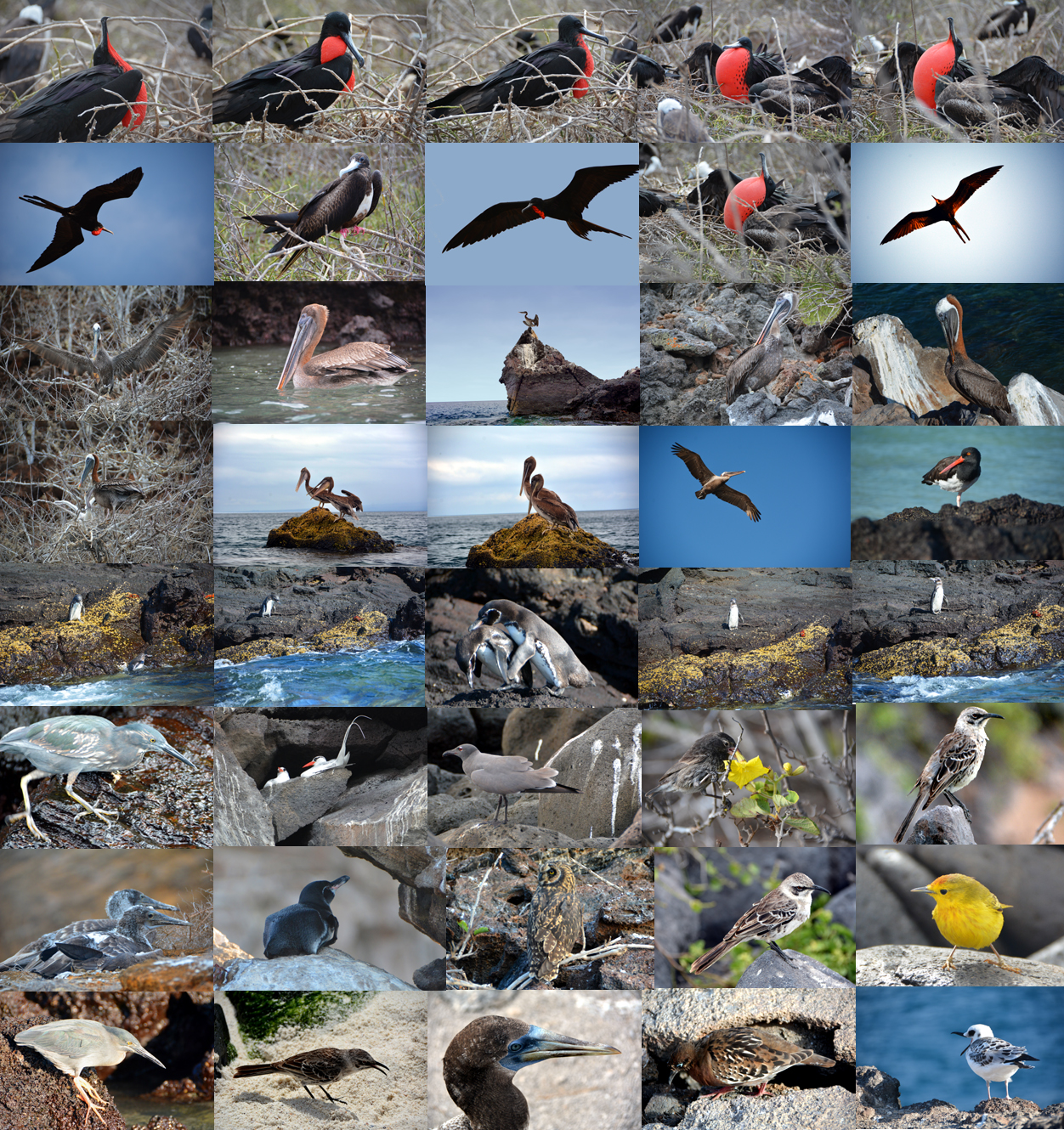
Frigatebirds: the Magnificent and the Great
Fregata magnificens and Frigata minor
MAGNIFICENT FRIGATEBIRD
Size: Largest of the two Galápagos species
Wingspan: 8 feet
Weight: 4 pounds
Lifespan: 30+ years
Males: Bodies entirely black with purplish sheen on its back. Legs and feet black or brown. Red gular pouch is only during the breeding season.
Females: Whie breast and black throat - rest of body black. Distinctive blue eye-right. Females are larger than males.
Generaly feeds closer inshore than the Great frigates. Main mode of feeding is by kleptoparasitism on other seabirds - mainly the red and blue-footed boobies.
There are an estimated 1,000 pairs spread out between the twelve colonies.
These birds breed throughout the year, but the main season is mid-December - early April.
Best sites to see them: North Seymour, Floreana, Isabela, San Cristobal and Genovesa Islands.
GREAT FRIGATEBIRD
Size: Second largest of the two Galápagos species
Wingspan: 7.5 feet
Weight: 3.4 pounds
Lifespan: 30+ years
Males: bodies entirely black with a green sheen on its back. Legs and feet red or reddish-brown. Red gular pouch is only visible during the breeding season.
Females: White breast and throat - rest of the body is black. Distinctive red or pink eye-ring. Females are larger than males.
Generally pelagic foraging far out at sea, rather than inshore like the Magnificent frigates. Feeds mainly by picking food from surface of the sea, but like the Magnificent, regularly kleptoparasites other seabirds.
There are an estimated few thousand pairs spread out between the twelve colonies.
These birds can be found breeding throughout the year.
The best sights to see them: The outer islands, principally Tower Island and Genovesa Island
GALAPAGOS PENQUINS
Spheniscus mendiculus
The Galapagos Penquin in endemic to the Galapagos Islands - it is not found anywhere else in the world. It is one of the smallest penquin species, and is the only one that lives north of the equator. There are an estimated 1,000 breeding pairs, making it the rarest penquin in the world.
These penguins are only found in a few locations - 90% of population is in the western islands of Fernandina and Isabela. There are a few small populations scattered on other islands, including Santiago, Bartolome, Northern Santa Crus, and Floreana. Distribution is correlated with the location of the Cromwell Current, which provides cold water and nutrient-rich waters.
These penquins are residents - they do not migrate away for the Galapagos. During the day they take to the cold ocean waters, foraging for small schooling fish, such as mullet and sardines. They remain within a few kilometers of their breeding site, and only return to land at night.
Unlike other penquins, Galapagos penquins do not have a particular breeding season. Breeding is triggered by a drop in sea surface temperatures to below 75 degrees F, which indicates the proximity of the cold water current and lots of fish. The main season is usually May-January.
Galapagos penquins mate for life. Nests are usually located within 160 feet of the shoreline, so the penquins can easily get to and from the water.
They lay 2 eggs (usually with 4 days between them) in caves and crevices, protected from the sun. Incubation takes approximately 40 days. Both parents share caring for the eggs and chicks-one stays on the nest while the other goes foraging at sea for several days at a time.
GALAPAGOS BROWN PELICAN
Pelecanus occidentalis urinator
Brown Pelicans are found in many places, including South America, Central America, North America, and the Caribbean. But the Galapagos Brown Pelican is a subspecies endemic to the Galapagos.
Males are larger than females.
Length: 5 feet. Wingspan: 7.5 feet. Weight 11 pounds.
Bill Length: 1.3 feet. Lifespan: 40 years.
Everyone knows what a pelican looks like! Although the brown pelican is the smallest of the pelicans, it is still very large! Adults have a white neck (often with a yellowish wash), gray-brown upper body and brown-black lower body. During breeding, the back of the neck is a rich chestnut brown.
Of the 8 species of pelicans in the world, the Brown Pelican is one of only two species that feeds by plunge diving into the ocean. The others feed less actively by scooping up fish while floating on the surface.
When underwater, they open their huge beaks to engulf the fish, and also get a lot of water too. Their gular pouch or sac can hold as much as 3.5 gallons! Once back on the surface they drain out the water, letting small shish fall out of the sides of their beaks and swallowing the remaining large fish. A single adult pelican eats up to 4 pounds of fish each day.
Nesting peaks March-April. Male pelicans pick out the nesting site and perform an “advertising” display to attract a female. Their nexts of twigs and grasses are built in mangroves or low-lying coastal bushes.
Females lay 2-3 eggs that take one month to hatch. Both parents share in incubation, feeding and care of the chicks. They will share the responsibility for the next 8-10 months. By the time the chicks leave the nest the parents would have regurgitated a total of 150 pounds of fish.
Young birds reach sexual maturity (and full adult plumage) at anywhere between two to five years.