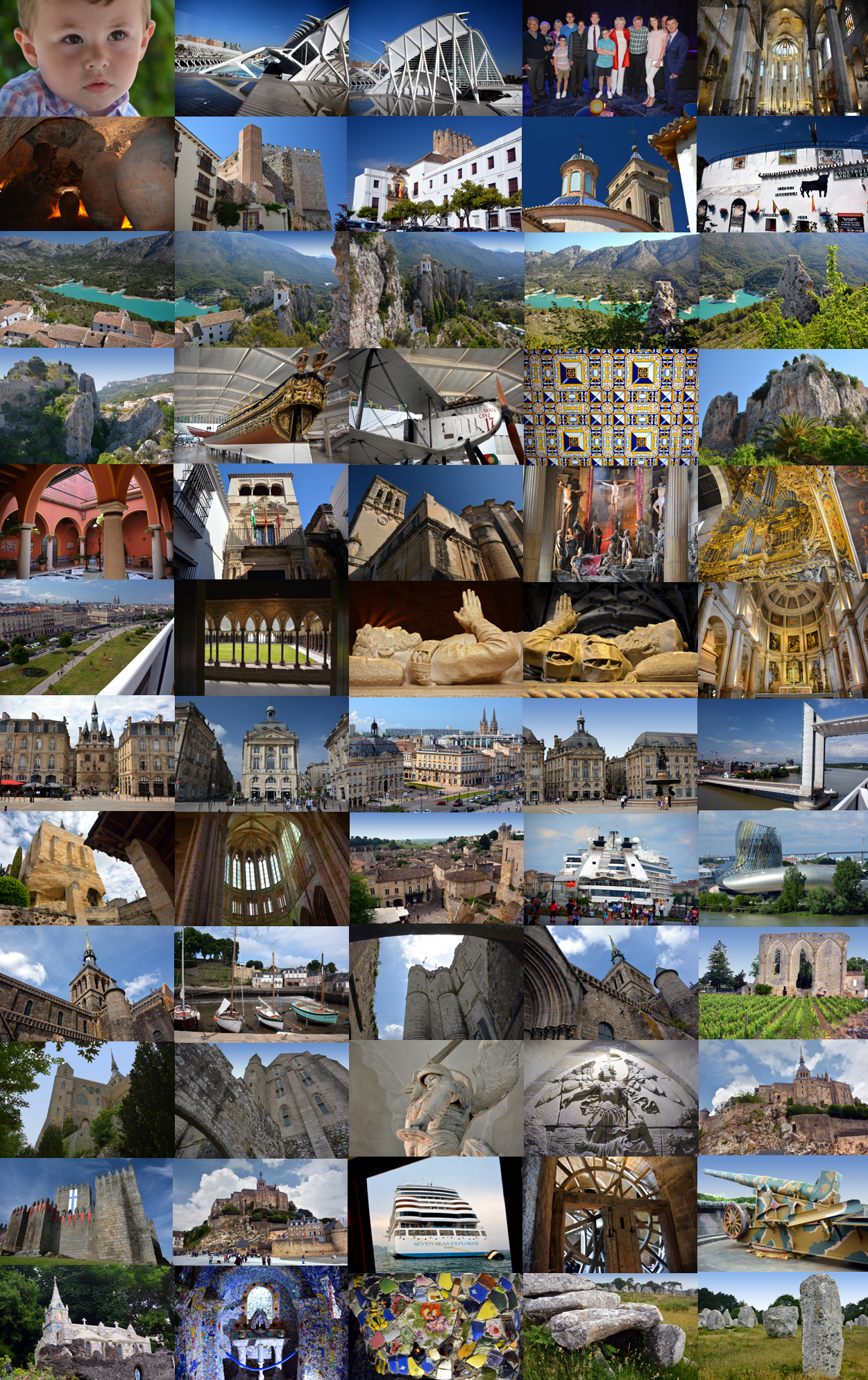
The basilica of Santa Maria del Mar in Barcelona, (Santa Maria del Mar Church in Barcelona), is the Gothic style Cathedral of Barcelona and the seat of the Archbishop of Barcelona, in Catalonia. The current cathedral was built over the old Romanesque cathedral during the thirteenth to fifteenth century. Santa Maria del Mar, ("Saint Mary of the Sea") is an imposing church in the Ribera district of Barcelona, Spain, and was built between 1329 and 1383 at the height of Aragon kingdom's maritime and mercantile preeminence. It is an outstanding example of Catalan Gothic, with a purity and unity of style that is very unusual in large medieval buildings. The 'cathedral of La Ribera' is one of the most perfect examples of Gothic style architecture due to its harmonious proportions and the serenity of the ensemble.
Valencia, Spain architecture: (photographed through the window of a moving coach).
REQUENA, SPAIN has a rich history, which stems from its strategic location and the domination that it has exerted since ancient times over the natural route linking Valencia with the Castilian plateau, passing through the 'Cabrillas' mountain range and 'Contreras' Pass.
Its old town reflects the splendor of those times in which, curiously, the municipality did not depend on the wine industry, but rather its economic activity was focused on the production of silk, as evidenced by the Silk College located in the heart of the La Villa neighborhood.
Requena offers a unique opportunity to visit a medieval city - from underneath. Visitors can enjoy a tour through the ancient caves in which wine, olive oil and cereals were formerly stored in large vats.
The 22 caves located under the town square date from the Muslim period (9th- to 13th-centuries). The transit of carts was prohibited in the City in the 15th century in order to avoid the sinking of the roads due to the existence of the caves. They were in use until the 17th century, when the private houses and public buildings in the square were demolished and they caves were semi-filled with debris. As of 1972-1973, they were cleared of debris and subsequently conditioned.
Some caves have vats, others have wells. Those corresponding to the former ossuary that was reused as a mass grave are located on the highest level. Two of them are vessel-shaped, from which it may be deduced that they were used as silos. Some still retain remains of their stairs and vents. The most common use was that of a space for the storage and conservation of wine, which was stored in large vats, accompanied by complementary wine-making elements, such as tanks, teals for treading the grapes, barrels and tanks for decanting must. Below the caves there is a network of tunnels that run throughout the Villa neighborhood. There construction lasted from 1706 until recent times.
LISBOA, PORTUGAL ... Santa Maria de Belum - The tomb of Luis Vaz de Camces (1524-1580) - one of Portugal's greatest poets and author of the maritime epic Os Lusadas, an account of the exploits of the Portuguese navigators, particularly of Vasco da Gama, and the history of the Portuguese people.
Vasco Da Gama and the first maritime voyage to India, 1497-1499 Vasco da Gama left from the Tagus river bound for India on July 8, 1497, commanding a fleet of four ships: two carracks, the flagship "S. Gabriel" and the S. Rafael," a caravel, the "Berrio" and a small support ship, meant to be dismantled for spare parts.
Over ten months and many difficulties, later, the Portuguese fleet finally reached it's destination on May 20, 1498. It had completed the first maritime connection to India and established the route that would be sailed by the ships for three centuries.
The Royal Barge was built in 1778 by order of Queen Maria I, by the Royal Naval Shipyard in Lisbon (Lisboa), for the betrothal of Prince Joao, Later King Joao VI. The barge then served the official service of the Royal Souse and was manned by 80 orsmen, 1 coxswain and 1 bowman, transporting H.M. Queen Elisabeth II of England in the river Tagus at the time of her official visit to Portugal in 1957....the very last service rendered by this barge.
In 1922, the Rolls-Royce powered Hidroavio Fairey F III-D n- 17 "Santa Cruz" (Museu de Marinha de Lisboa) flew from Lisboa to Rio de Janeiro.
THE CARNAC ALIGNMENTS -or- "Alignements de Carnac" (6,000-Year-Old Megaliths) - An exceptional Neolithic site. The Carnac alignments were erected in the Neolithic era, between the fifth and third millennia B.C. These stone constructions combine rows of menhirs, individual tombs, (mounds) and dolmens, collective tombs. Le Menec is located west of Carnac and has 1,050 stones standing 11 feet high. Kermario at Carnac has the largest monoliths. www.menhirs-carnac.fr
In 1941, Hitler ordered the Channel Islands be turned into a naval fortress until 1945. The battery was known as HKB 471 Batterie Pleinmont and redesignated as the 15th Battery of the IV Battalion of the 1265 Artillery Regiment and then renamed the Batterie Generaloberst Dollmann. The battery was equipped with 4 x 22 cm K532(f) guns which had a range of 22 kilometers. The guns were originally manufactured during WWI for the French Army. In 1940, the German Army overran France and re-deployed these cannons to Guernsey. After liberation in 1945, the guns remained in position until scrapped and the emplacements were backfilled and landscaped in 1948. In 2001, 1,000 tons of backfill was removed so that this German heavy coastal artillery battery could be restored.
LE MONT SAINT-MICHEL - Normandy, France is located in a bay, less than a mile off the country's northwestern coast, at the mouth of the Couesnon River.
In the 8th century, Aubert, bishop of Avranches, claimed that the Archangel Michael himself pressured him into having a church and gravity-defying medieval monastery built atop the magical island. Since 966,dukes of Normandy and French kings, supported the development of a major Benedictine abbey on the Mont-Saint-Michel. Magnificent monastic buildings were added through medieval times, one vertiginous section being nicknamed The Marvel. The abbey became a renowned center of learning. The ramparts at the base of the island were built to keep English forces out.
St. Michael the Archangel's prayer . . .
"Defend us in battle. Be our defense against the wickedness and snares of the Devil. May God rebuke him, we humbly pray, and do thou, O Prince of
the heavenly hosts, by the power of God, thrust into hell Satan and all the evil spirits, who prowl about the world, seeking the ruin of souls. Amen"
Stunning Mont St-Michel Inspires by Rick Steves
The vast Bay of Mont St-Michel, which turns into a mudflat at low tide, has long played a key role here. Since the sixth century, hermit monks came here in search of solitude. The word "hermit" comes from an ancient Greek word meaning "person of the desert." The closest thing to a desert in this part of Europe was the sea. Imagine the "desert" this bay provided as the first monk climbed that rock to get nearer to God.
This rock - a small mountain forming an island - was even more isolated by they bay's dangerous quicksand, disorienting fog, and mythic tides. Pilgrims crossed the mudflat to the island quickly and carefully, knowing that the sea swept in "at the speed of a galloping horse." In the late 1800s a causeway was built, connecting the island to the mainland and letting pilgrims come and go without hip boots. The result: Much of the bay silted up, and Mont St-Michel started gradually becoming part of the mainland. But in 2005 an ambitious 10-year project was launched to keep it an island ... and today a super-sleek, artistically swooping bridge allows water to flow freely around Mont St-Michel, preserving its island character.
The shallow bay it sits in stretches from Normandy to Brittany, fed by the Couesnon River - which marks the historic border between the two lands. Brittany and Normandy have long vied for Mont St-Michel, and the river used to pass on the other side of the abbey, making it part of Brittany. Today Mont St-Michel is just barely - but thoroughly a part of Normandy.
The town of Mont St-Michel ... with fewer than 50 residents ... now entertains more than 2.5 million tourists a year (and a steady trickle of pilgrims). If this place seems built for tourism, in a sense it was. It's accommodated, fed, watered, and sold trinkets to generations of travelers who visit its towering abbey. Its main street - lined with shops and hotels leading up to the abbey - is always flooded with visitors, and grotesquely commercial. It's some consolation to remember that, even back in the Middle Ages, this was a retail gauntlet, with stalls selling souvenir medallions, candles, and fast food. Omelets were popular for eat-and-run pilgrims who needed to beat the tide - and they're still an island specialty and popular with tourists.
Early risers win with the best light and the fewest other tourists. As the town fills up, you can skirt the main-street crowds and enjoy Mont St-Michel's fine 15th-century fortifications by following the ramparts up to the abbey. They were built to defend against a new weapon - the cannon. Rather than tall, they were low - to make a smaller target. While the English took all the rest of Normandy, they never took this well-fortified island. Because of its stubborn success against the English through all those years, Mont St-Michel became a symbol of French national identity.
For centuries pilgrims and monks have climbed the abbey's stone steps. The abbey of Mont St-Michel has been a holy site since the year 708, when a local bishop had a vision in which the Archangel Michael convinced him to build here. This was an immense building project evolving over many centuries. It was a marvel - a medieval skyscraper, built upon a rock crowned by a gilded statue of Saint Michael. When you visit, imagine the headaches and hassles of the monks who ferried granite from across the bay and hiked it uphill.
A walk in the abbey is a one-way route through fine ... but barren ... Gothic rooms. A rented audio guide or English-language tour make this historic sight more meaningful. A highlight is the giant tread-wheel, which six workers once powered hamster-style to haul two-ton loads of stones and supplies from the landing below. This was used until the 19th century. The centerpiece of this extraordinary construction is its church. While it's mostly 11th-century Romanesque (with round arches and small windows), the apse behind the altar was built later. It's Gothic with pointed arches and bigger windows. The monks built as close to heaven as possible, on the tip of the island rock. The downside: There just wasn't enough level ground to support such a big abbey and church. The solution: Immense crypts were built under the church to create a platform supporting each of its wings.
Sitting atop all this heavy construction like a delicate flower is the abbey's cloister. This peaceful zone connected various rooms. Here monks would grow vegetables and medicinal herbs. They'd meditate and read the Bible. The more secluded a monk could be, the closer he was to God. And, for thoughtful travelers today, this abbey still inspires.
THE LITTLE CHAPEL is the smallest chapel in the world and is situated in the Les Vauxbelets valley, Saint Andrew, Guernsey. It was created in July 1914, by Brother Dodat. He planned to create a miniature version of the grotto and basilica at Lourdes, the Rosary Basilica using broken bricks and small stones set in mortar made from lime, earth and gravel. Broken ceramics and shells were stuck to the surface. What you see today is actually the third version. The first, measuring a tiny 9 feet long by 4.5 feet wide, was criticized, so Brother Deodat spent the following night demolishing the building. He soon set to work again and, in July 1914, the grotto was completed and officially blessed. This survived until September 1923; Brother Deodat demolished it in that month because the Bishop of Portsmouth had not been able to fit through the doorway. He soon set about the construction of a third chapel - which we see today. The building operation proved laborious, collecting pebbles and broken china to decorate the shrine. Then suddenly the Little Chapel became famous, thanks to an illustrated article in the Daily Mirror. Presents poured in from around the world and Islanders brought colored china to Les Vauxbelets.