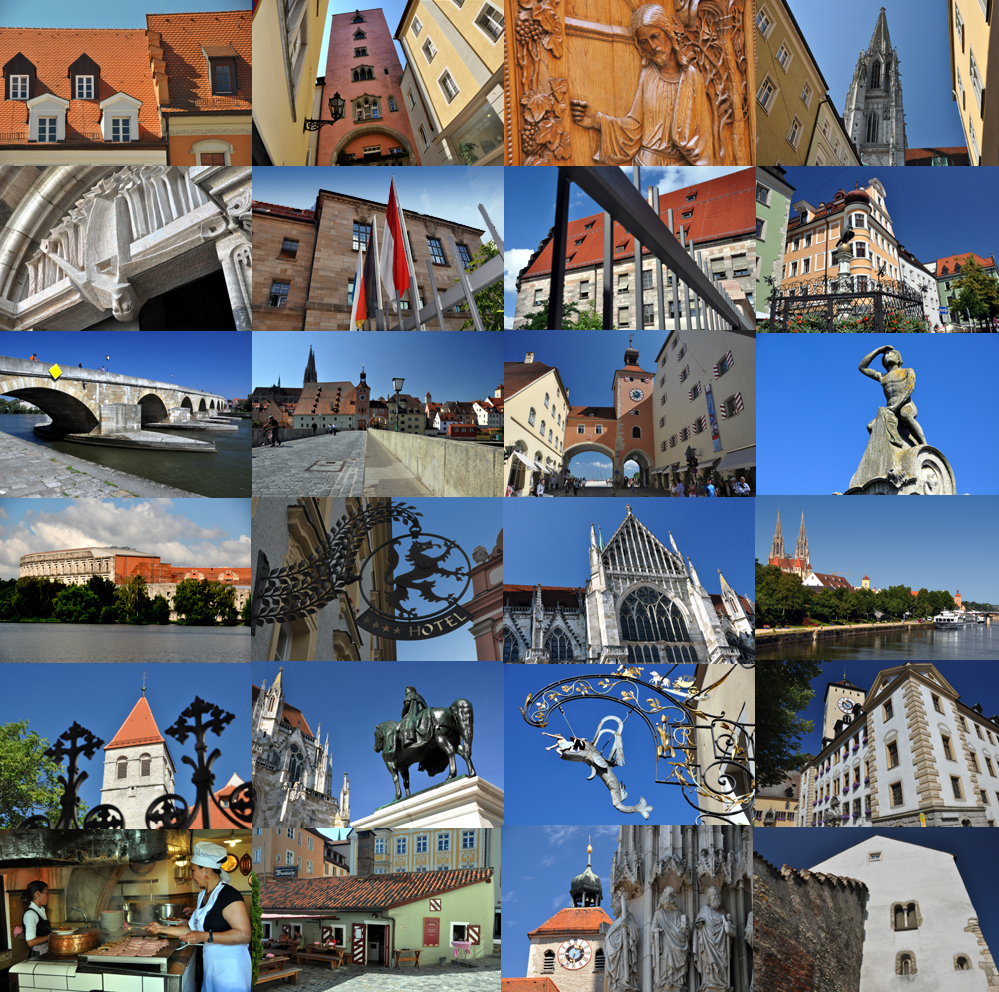
Danube River, Regensburg
|
|
Black dogs and the Devil's bridges
By George Csicsery
9/1/13
To this day, the sight of a black dog hovering around the famous medieval bridge in Regensburg, Germany at night provokes raised eyebrows among savvy locals who recognize the Devil in his canine disguise. But contrary to what you might believe from recent stories about superstitions connected to black animals, the devil's presence around the bridge is not a portent of disaster. On the contrary, the hapless black dog of Regensburg's bridge is the consequence of a success story.
Regensburg's old stone bridge, built between 1135 and 1146, was the first to link northern and southern Europe, and for hundreds of years the only way to cross the Danube without a boat or ferry. It has been standing for close to a millennium. The bridge is linked to the black dog through a beautiful legend, the origins of which go back to the time of its construction. The bridge's architect, it is said, was in competition with the builder of Regensburg's famous medieval Dom to see who would finish first.
When he saw that the cathedral was nearly finished and the bridge was nowhere near completion, the bridge builder made a pact with the Devil to help speed up his work. The deal they struck gave the Devil the souls of the first eight feet to cross the bridge. Not bad, thought the Devil, a harvest of four human souls in exchange for some minor technical wizardry.
With the Devil's help, the bridge was indeed finished first, whereupon the cathedral's architect threw himself from the Dom's spire in despair. His suicide is thought to explain the image of a falling man depicted on the cathedral.
Not only did the wily bridge builder win his wager with the cathedral's architect, when it came time to inaugurate the bridge-he tricked the Devil by sending a hen, a rooster, and a dog across the bridge before any human crossed. There were the first eight feet to cross the new bridge. Outsmarted by a human, the Devil was forever stuck with the souls of these three beasts, but there was nothing he could do about it. This is why that black dog is seen skulking around the old stone bridge in Regensburg ever since.
The association of a black dog with the Devil was immortalized in dramatic literature by Goethe in Faust, where Mephistopheles (the Devil) first appears to Faust as a poodle before revealing his true identity. The link between bridges and the Devil is far more widespread than the Regensburg legend. A Wikipedia search reveals hundreds of devil's bridges, 49 in France alone.
Many of them are some of the oldest and most beautiful bridges in Europe. Why these bridges are tied to stories involving demonic forces in folklore, and why the legends are so similar, is not difficult to understand. A man-made bridge is not natural; it defeats the force of gravity, connecting two places that nature, or God, have separated. That act of defiance is made possible by technological dexterity, and in folklore all such acts are related to wizardry, magic, the invocation of supernatural forces. In myth, the technologically daring are punished for their efforts at experimentation (think of Icarus and Prometheus).
Building bridges over precipitous gorges and wide bodies of water is a dangerous business, and in folklore can only be accomplished if some supernatural power is involved. Enter the Devil.
Looking into the Devil's bridge stories provides some insight into humanity's longstanding love/hate relationship with technological progress and scientific innovation. Bridges are not only actual paths and connections; they are also metaphorical links between two different points, or even phases of life. We are more vulnerable in transition than on terra firma. Science and technology are paths to the new and unfamiliar, often involving counter-intuitive ideas and processes. Engineers practice a kind of wizardry few others can fathom.