Ancient Corinth & The Corinth Canal
Nafplion, Greece
October 1, 2021
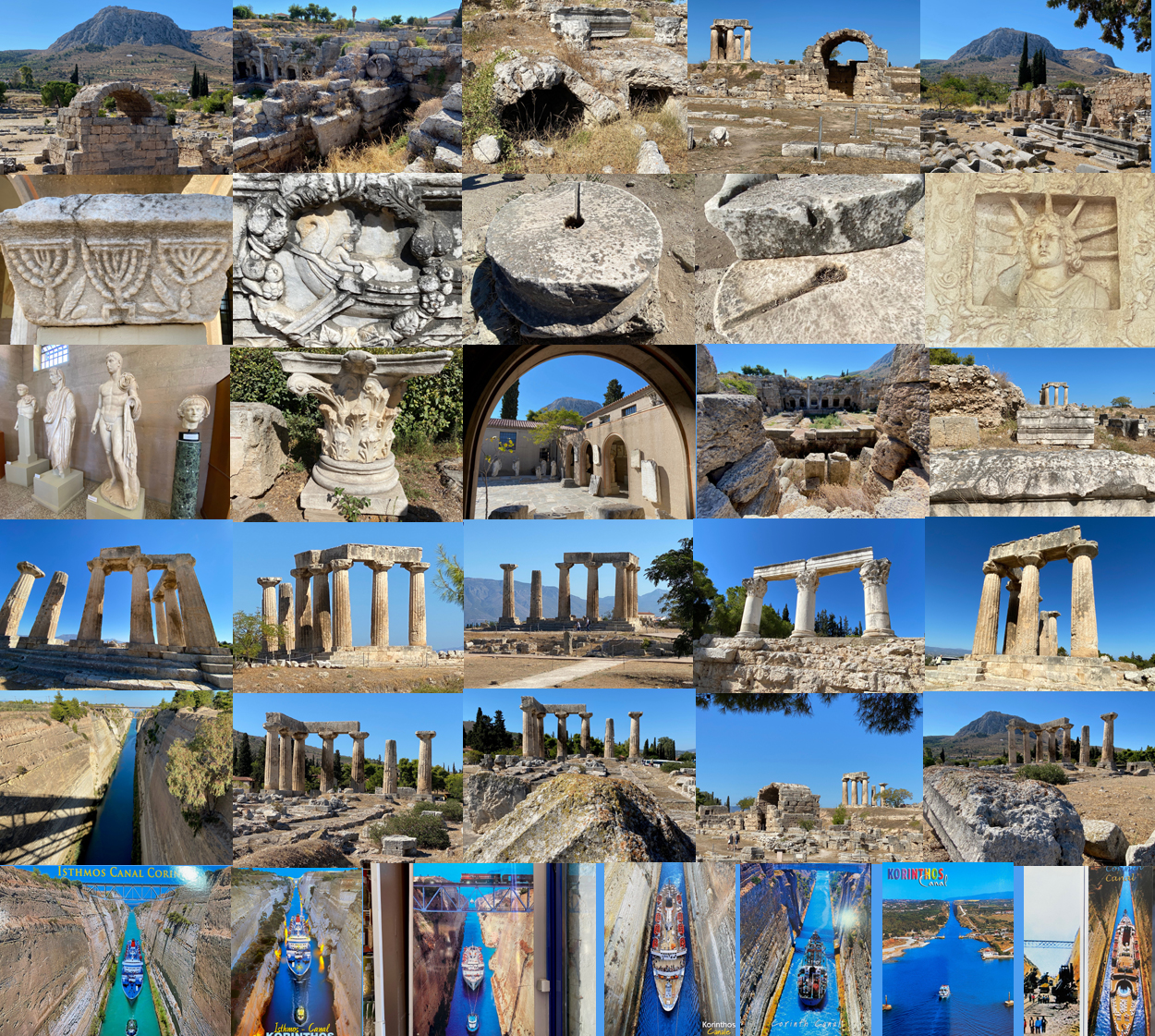
Ancient Corinth is a mix of a 6th-century BC city, and a 44 BC Roman city - the latter was established as a Roman colony and a fortified citadel, resettled by Julius Caesar.
Corinth's Archaic Temple of Apollo, (with its seven monolithic Doric peripteral 'poros' limestone columns), is where Saint Peter preached, (and wrote letters), to the Corinthians in AD 52: "Where the spirit of the Lord is, there is liberty."
In the Fifth Century BC, Corinth was one of the three major powers in Greece.
Corinth was a wealthy city blessed with fertile plains, a superb location and very impregnable defense system. Corinth survived numerous human invasions but nature, in the form of earthquakes, eventually devastated this once-thriving city.
The Corinth Canal connects the Gulf of Corinth with the Saronic Gulf in the Aegean Sea. The canal cuts through the narrow Isthmus of Corinth and separates the Peloponnesian Peninsula from the Greek mainland.
An engineering and technological masterpiece of 19th century engineering, (1881-1893), the Corinth Canal is 4-miles long, 70-feet wide, with 170-foot sloping sides . . . connecting the Ionian and Aegean Seas. Prior to the canal's constitution, ships were transported on wooden platforms pulled on grooved rails. [Corinth Canal crossing: v.salpadimos@spanopoulous-group.com]
A word about the Greek language . . .
Going back to the earliest Greek writings, there are over 3,400 years of documentable history. Greek is a part of the Indo-European language family, meaning it’s distantly connected with a huge number of languages spoken in the world, including English, Spanish, German, Bulgarian and Iranian. As Indo-European splintered into various languages thousands of years ago, the Hellenic branch broke off, and Greek is the primary (if not the sole) member of this language group.
The first written evidence of Greek comes from the 15th century BCE in the form of Linear B, a writing system that the Mycenaean Greeks adapted from the neighboring Minoans. There isn’t a huge amount of Linear B writing that has survived until today — mainly clay tablets that record accounts of Mycenaean palaces — but it’s the first record we have of Greek culture.
The Greek language evolved over the next several centuries, and there was a variety of dialects spoken throughout the Mediterranean region. The dialects could roughly be divided into West, Aeolic, Arcado-Cypriot and Ionic-Attic groups, all of which formed Ancient Greek. Ancient Greek comprises the language spoken in the region of Greece from about the 9th century BCE to the 6th century CE, thus encompassing a huge amount of time. During this period, Homer’s epics were written, the Roman Empire rose and fell, and the basis for all Western Civilization was constructed.
In roughly the 4th century BCE, one form of Greek became popular enough to become the lingua franca of the region: Koine Greek. It evolved from Attic Greek, the dialect spoken in Athens. This language was spoken by Alexander the Great, and it was also the language of the New Testament of the Christian Bible.
Koine Greek went on to evolve into Medieval/Byzantine Greek — which lasted from roughly the 6th to the 15th centuries CE, when the Byzantine Empire fell — which then became Modern Greek. Today, there are several dialects of Greek spoken, as well as attempts to keep Ancient Greek alive.
A Few English Words That Are Actually Greek
There are approximately 150,000 more Greek-English words
Acrobat
From the word akri (άκρη — “tip” or “edge”) and the verb vaino (βαίνω — “to walk”), an acrobat is someone who walks on the edge, often on tiptoe.
Cemetery
Many Greek words used in English like to disguise themselves as Old French or Latin. "Cemetery" comes from the Greek word koimame (κοιμάμαι — “to sleep”), which is also the root of another word, koimitirion (κοιμητήριο — “dormitory”). We call our final places of rest “dormitories for the dead”?
Cynicism
Cynicism comes from the Cynics, a school of Ancient Greek philosophers. Their namesake is probably derived from a public gymnasium (“school”) where one of Socrates’s pupils taught called Cynosarges (“white dog” or “swift dog." According to one myth, the Athenians were in the middle of making an offering to Heracles when a dog snatched the animal and deposited it near the location where the school was later built.
Democracy
Combining demos (δήμος — “people”) and kratos (κράτος — “power”), the meaning of this quintessential Greek word used in English is simply put: power to the people!
Dinosaur
“Fear-Inspiring Reptile!” The word "dinosaur" comes from the Greek words deinos (δεινός — “terrible”) and savra (σαύρα — “lizard”).
Europe
According to Ancient Greek mythology, Europe was a mythological princess with big, beautiful eyes, a trait reflected in the very origins of her name: evrys (ευρύς — “broad”) and ops (ωψ — “eye”). When the god Zeus laid his own eyes on her, it was love at first sight. He quickly transformed himself into a white bull and spirited her off to the faraway lands we now call Europe. Greece has since immortalized the story on its national version of the two-euro coin.
Galaxy
Many Greek words used in English have mythological origins. Galaxy, a.k.a. the Milky Way, comes from the Greek word for milk, gala (γάλα). According to one myth, the Milky Way was created by Zeus’s baby son, Heracles, after he tried suckling on his step-mother’s milk while she slept. When Hera woke up to discover that she was breastfeeding an infant that was not her own, she pushed the child away, causing her milk to spurt into the universe.
Hermaphrodite
Hermaphrodite was the son of Hermes and Aphrodite, who apparently couldn’t be bothered finding a new name for their child. As the most handsome man in the word, Hermaphrodite became an object of affection for the nymph Salmacis. After wishing for eternal love, the gods answered her prayers by joining the two lovers in one body.
Marathon
A marathon is 42.1 km (or 26.1 miles) long, the actual distance between two Greek cities. Legend has it that in 490 BCE, Pheidippides ran all the way to Athens from a battlefield in Marathon to announce to the world that the Persians had been defeated at the aptly-named Battle of Marathon. After his victorious announcement, he collapsed and died. In 2010, Greece celebrated the battle’s 2,500 year jubilee with a marathon.
Marmalade
Although English took this word from Portuguese, you can trace it further back to the Greek words meli (μέλι — “honey”) and milo (μήλο — “apple”). Some sources say that the Ancient Greeks liked cooking quinces (marmelos in Portuguese) with honey.
Melancholy
This common Greek word has a bizarre etymology. Coming from the Greek words melas (μέλας — “black”) and khole (χολή — bile), it was once thought that when your spleen produces an excess of black bile, you feel gloomy. This belief is rooted in the Ancient Greek school of medicine called humorism, which hypothesized that body fluids (“humors”) directly influenced a person’s mood.
Music
Music literally means art of the Muses, the nine Greek goddesses who presided over the arts and sciences. The concept of a museum was originally intended to be a shrine for the Muses.
Narcissism
Narcissism comes from the Ancient Greek mythological figure of Narcissus, a young man who fell in love with himself when he saw his reflection in a lake. One nymph who fell passionately in love with him withered away when he ignored her, leaving no trace behind but her voice. Her name was Echo.
Panic
The word panic comes from the name of the Ancient Greek goat-god Pan, who spread terror among nymphs like Echo.
Phobia
Coming from another word for terror, a phobia is an irrational fear — and there are many strange phobias with names also derived from Greek. "Paraskevidekatriaphobia" is to be scared of Friday the 13th. "Arachibutyrophobia" is to worry about getting peanut butter stuck to the roof of your mouth and "myrmecophobia" is the fear of ants.
Planet
Another word for the heavens, planet comes from the Greek verb planomai (πλανώμαι), which means “to wander.” To the Ancient Greeks, planets were simply wandering stars.
Sarcasm
From the Greek word for flesh, sarx (σάρξ), sarcasm describes the (metaphorical) act of stripping someone’s flesh off with a sneering comment.
Schizophrenia
Combining the words schizein (σχίζειν — “to split”) and phren (φρην — “mind”), the meaning of this particular Greek word used in English is pretty self-explanatory.
Sycophant
The origin of "sycophant" is a bit obscure, as no one knows for sure where it comes from. One story ties it to the word syko (σύκο — “fig”) and the verb phainein (φαίνειν — “to show”), back when stealing and exporting figs was considered a crime. People who informed on those breaking this particular law were called sycophants. The meaning of the word has changed since then. It now gives name to insincere flatterers.
Tele + word
There are scores of Greek words used in English that start with tele, a prefix denoting distance. A telephone carries your voice across distances, a telescope helps you see far-off places and a telegraph lets you send long-distance messages.
Thespian
Thespian is a fancy word for actor, especially a theater actor. The name comes from Thespis himself, a sixth century BCE Ancient Greek poet who was said to be the first person to ever appear on a stage as an actor.
From the word akri (άκρη — “tip” or “edge”) and the verb vaino (βαίνω — “to walk”), an acrobat is someone who walks on the edge, often on tiptoe.
Cemetery
Many Greek words used in English like to disguise themselves as Old French or Latin. "Cemetery" comes from the Greek word koimame (κοιμάμαι — “to sleep”), which is also the root of another word, koimitirion (κοιμητήριο — “dormitory”). We call our final places of rest “dormitories for the dead”?
Cynicism
Cynicism comes from the Cynics, a school of Ancient Greek philosophers. Their namesake is probably derived from a public gymnasium (“school”) where one of Socrates’s pupils taught called Cynosarges (“white dog” or “swift dog." According to one myth, the Athenians were in the middle of making an offering to Heracles when a dog snatched the animal and deposited it near the location where the school was later built.
Democracy
Combining demos (δήμος — “people”) and kratos (κράτος — “power”), the meaning of this quintessential Greek word used in English is simply put: power to the people!
Dinosaur
“Fear-Inspiring Reptile!” The word "dinosaur" comes from the Greek words deinos (δεινός — “terrible”) and savra (σαύρα — “lizard”).
Europe
According to Ancient Greek mythology, Europe was a mythological princess with big, beautiful eyes, a trait reflected in the very origins of her name: evrys (ευρύς — “broad”) and ops (ωψ — “eye”). When the god Zeus laid his own eyes on her, it was love at first sight. He quickly transformed himself into a white bull and spirited her off to the faraway lands we now call Europe. Greece has since immortalized the story on its national version of the two-euro coin.
Galaxy
Many Greek words used in English have mythological origins. Galaxy, a.k.a. the Milky Way, comes from the Greek word for milk, gala (γάλα). According to one myth, the Milky Way was created by Zeus’s baby son, Heracles, after he tried suckling on his step-mother’s milk while she slept. When Hera woke up to discover that she was breastfeeding an infant that was not her own, she pushed the child away, causing her milk to spurt into the universe.
Hermaphrodite
Hermaphrodite was the son of Hermes and Aphrodite, who apparently couldn’t be bothered finding a new name for their child. As the most handsome man in the word, Hermaphrodite became an object of affection for the nymph Salmacis. After wishing for eternal love, the gods answered her prayers by joining the two lovers in one body.
Marathon
A marathon is 42.1 km (or 26.1 miles) long, the actual distance between two Greek cities. Legend has it that in 490 BCE, Pheidippides ran all the way to Athens from a battlefield in Marathon to announce to the world that the Persians had been defeated at the aptly-named Battle of Marathon. After his victorious announcement, he collapsed and died. In 2010, Greece celebrated the battle’s 2,500 year jubilee with a marathon.
Marmalade
Although English took this word from Portuguese, you can trace it further back to the Greek words meli (μέλι — “honey”) and milo (μήλο — “apple”). Some sources say that the Ancient Greeks liked cooking quinces (marmelos in Portuguese) with honey.
Melancholy
This common Greek word has a bizarre etymology. Coming from the Greek words melas (μέλας — “black”) and khole (χολή — bile), it was once thought that when your spleen produces an excess of black bile, you feel gloomy. This belief is rooted in the Ancient Greek school of medicine called humorism, which hypothesized that body fluids (“humors”) directly influenced a person’s mood.
Music
Music literally means art of the Muses, the nine Greek goddesses who presided over the arts and sciences. The concept of a museum was originally intended to be a shrine for the Muses.
Narcissism
Narcissism comes from the Ancient Greek mythological figure of Narcissus, a young man who fell in love with himself when he saw his reflection in a lake. One nymph who fell passionately in love with him withered away when he ignored her, leaving no trace behind but her voice. Her name was Echo.
Panic
The word panic comes from the name of the Ancient Greek goat-god Pan, who spread terror among nymphs like Echo.
Phobia
Coming from another word for terror, a phobia is an irrational fear — and there are many strange phobias with names also derived from Greek. "Paraskevidekatriaphobia" is to be scared of Friday the 13th. "Arachibutyrophobia" is to worry about getting peanut butter stuck to the roof of your mouth and "myrmecophobia" is the fear of ants.
Planet
Another word for the heavens, planet comes from the Greek verb planomai (πλανώμαι), which means “to wander.” To the Ancient Greeks, planets were simply wandering stars.
Sarcasm
From the Greek word for flesh, sarx (σάρξ), sarcasm describes the (metaphorical) act of stripping someone’s flesh off with a sneering comment.
Schizophrenia
Combining the words schizein (σχίζειν — “to split”) and phren (φρην — “mind”), the meaning of this particular Greek word used in English is pretty self-explanatory.
Sycophant
The origin of "sycophant" is a bit obscure, as no one knows for sure where it comes from. One story ties it to the word syko (σύκο — “fig”) and the verb phainein (φαίνειν — “to show”), back when stealing and exporting figs was considered a crime. People who informed on those breaking this particular law were called sycophants. The meaning of the word has changed since then. It now gives name to insincere flatterers.
Tele + word
There are scores of Greek words used in English that start with tele, a prefix denoting distance. A telephone carries your voice across distances, a telescope helps you see far-off places and a telegraph lets you send long-distance messages.
Thespian
Thespian is a fancy word for actor, especially a theater actor. The name comes from Thespis himself, a sixth century BCE Ancient Greek poet who was said to be the first person to ever appear on a stage as an actor.
Narcissism
Narcissism comes from the Ancient Greek mythological figure of Narcissus, a young man who fell in love with himself when he saw his reflection in a lake. One nymph who fell passionately in love with him withered away when he ignored her, leaving no trace behind but her voice. Her name was Echo.
Panic
The word panic comes from the name of the Ancient Greek goat-god Pan, who spread terror among nymphs like Echo.
Phobia
Coming from another word for terror, a phobia is an irrational fear — and there are many strange phobias with names also derived from Greek. "Paraskevidekatriaphobia" is to be scared of Friday the 13th. "Arachibutyrophobia" is to worry about getting peanut butter stuck to the roof of your mouth and "myrmecophobia" is the fear of ants.
Planet
Another word for the heavens, planet comes from the Greek verb planomai (πλανώμαι), which means “to wander.” To the Ancient Greeks, planets were simply wandering stars.
Sarcasm
From the Greek word for flesh, sarx (σάρξ), sarcasm describes the (metaphorical) act of stripping someone’s flesh off with a sneering comment.
Schizophrenia
Combining the words schizein (σχίζειν — “to split”) and phren (φρην — “mind”), the meaning of this particular Greek word used in English is pretty self-explanatory.
Sycophant
The origin of "sycophant" is a bit obscure, as no one knows for sure where it comes from. One story ties it to the word syko (σύκο — “fig”) and the verb phainein (φαίνειν — “to show”), back when stealing and exporting figs was considered a crime. People who informed on those breaking this particular law were called sycophants. The meaning of the word has changed since then. It now gives name to insincere flatterers.
Tele + word
There are scores of Greek words used in English that start with tele, a prefix denoting distance. A telephone carries your voice across distances, a telescope helps you see far-off places and a telegraph lets you send long-distance messages.
Thespian
Thespian is a fancy word for actor, especially a theater actor. The name comes from Thespis himself, a sixth century BCE Ancient Greek poet who was said to be the first person to ever appear on a stage as an actor.
Tom Taffel
(415) 566-7673
www.TomsGroupCruises.com
…Because some experiences in life are simply better when shared with others