|
|
|
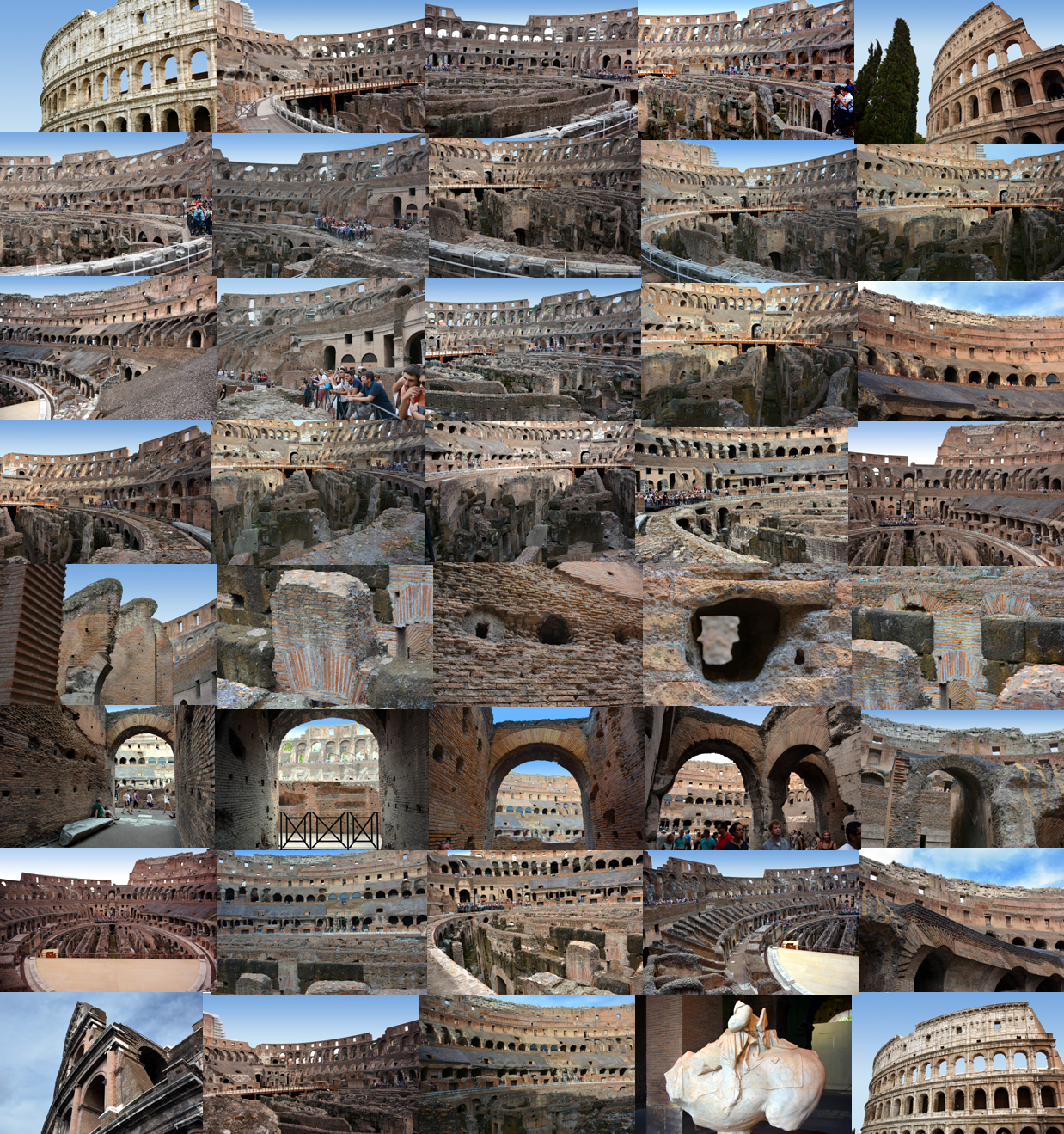
Colosseum – Rome – Amphitheatre – 72-80 ADFrom Wikipedia, the free encyclopediaThe Colosseum or Coliseum is an elliptical amphitheatre in the center of the city of Rome, Italy. Built of concrete and stone it’s the largest amphitheatre ever built and is considered one of the greatest works of architecture and engineering.The Colosseum could hold between 50,000 and 80,000 spectators,having an average audience of 65,000. It was used for gladiatorial contests and public spectacles such as mock sea battles, animal hunts, executions, re-enactments of famous battles, and dramas based on Classical mythology. The building ceased to be used for entertainment in the early medieval era. It was later reused for such purposes as housing, workshops, quarters for a religious order, a fortress, a quarry, and a Christian shrine. Although in the 21st century it remained partially ruined because of damage caused by devastating earthquakes and stone-robbers, the Colosseum is an iconic symbol of Imperial Rome. It is one of Rome's most popular tourist attractions and has close connections with the Roman Catholic Church, as each Good Friday the Pope leads a torchlit "Way of the Cross" procession that starts in the area around the Colosseum. The Colosseum's original Latin name was Amphitheatrum Flavium, often anglicized as Flavian Amphitheater. The building was constructed by emperors of the Flavian dynasty, following the reign of Nero. This name is still used in modern English, but generally the structure is better known as the Colosseum. In antiquity, Romans may have referred to the Colosseum by the unofficial name Amphitheatrum Caesareum (with Caesareum an adjective pertaining to the title Caesar). Construction was funded by the opulent spoils taken from the Jewish Temple after the Great Jewish Revolt in 70 AD led to the Siege of Jerusalem. According to a reconstructed inscription found on the site, "the emperor Vespasian ordered this new amphitheatre to be erected from his general's share of the booty." Along with the spoils, estimated 100,000 Jewish prisoners were brought back to Rome after the war, and many contributed to the massive workforce needed for construction. The slaves undertook manual labor such as working in the quarries at Tivoli where the travertine was quarried, along with lifting and transporting the quarried stones 20 miles from Tivoli to Rome. Along with this free source of unskilled labor, teams of professional Roman builders, engineers, artists, painters and decorators undertook the more specialized tasks necessary for building the Colosseum. In 217, the Colosseum was badly damaged by a major fire (caused by lightning which destroyed the wooden upper levels of the amphitheatre's interior. It was not fully repaired until about 240. Gladiatorial fights are mentioned around 435. An inscription records the restoration of various parts of the Colosseum under Theodosius II and Valentinian III (reigned 425–455), possibly to repair damage caused by a major earthquake in 443. The arena continued to be used for contests well into the 6th century. Animal hunts continued until at least 523. The Colosseum underwent several radical changes of use during the medieval period. By the late 6th century a small chapel had been built into the structure of the amphitheater, though this apparently did not confer any particular religious significance on the building as a whole. The arena was converted into a cemetery. The numerous vaulted spaces in the arcades under the seating were converted into housing and workshops, and are recorded as still being rented out as late as the 12th century. Severe damage was inflicted on the Colosseum by the great earthquake in 1349, causing the outer south side, lying on a less stable alluvial terrain, to collapse. Much of the tumbled stone was reused to build palaces, churches, hospitals and other buildings elsewhere in Rome. A religious order moved into the northern third of the Colosseum in the mid-14th century and continued to inhabit it until as late as the early 19th century. The interior of the amphitheater was extensively stripped of stone, which was reused elsewhere, or (in the case of the marble façade) was burned to make quicklime. The bronze clamps which held the stonework together were pried or hacked out of the walls, leaving numerous pockmarks which still scar the building today. During the 16th and 17th century, Church officials sought a productive role for the Colosseum. Pope Sixtus V (1585–1590) planned to turn the building into a wool factory to provide employment for Rome's prostitutes, though this proposal fell through with his premature death. In 1671 Cardinal Altieri authorized its use for bullfights; a public outcry caused the idea to be hastily abandoned. In 1749, Pope Benedict XIV endorsed the view that the Colosseum was a sacred site where early Christians had been martyred. He forbade the use of the Colosseum as a quarry and consecrated the building to the Passion of Christ and installed Stations of the Cross, declaring it sanctified by the blood of the Christian martyrs who perished there. However, there is no historical evidence to support Benedict's claim, nor is there even any evidence that anyone prior to the 16th century suggested this might be the case; the Catholic Encyclopedia concludes that there are no historical grounds for the supposition. Later popes initiated various stabilization and restoration projects, removing the extensive vegetation which had overgrown the structure and threatened to damage it further. The façade was reinforced with triangular brick wedges in 1807 and 1827, and the interior was repaired in 1831, 1846, and in the 1930s. The arena substructure was partly excavated in 1810–1814 and 1874 and was fully exposed under Benito Mussolini in the 1930’s. The Colosseum is today one of Rome's most popular tourist attractions, receiving millions of visitors annually. The effects of pollution and general deterioration over time prompted a major restoration program carried out between 1993 and 2000, at a cost of $19,300,000. In recent years the Colosseum has become a symbol of the international campaign against capital punishment, which was abolished in Italy in 1948. Several anti–death penalty demonstrations took place in front of the Colosseum in 2000. Since that time, as a gesture against the death penalty, the local authorities of Rome change the color of the Colosseum's night time illumination from white to gold whenever a person condemned to the death penalty anywhere in the world gets their sentence commuted or is released, or if a jurisdiction abolishes the death penalty. Most recently, the Colosseum was illuminated in gold in November 2012 following the abolishment of capital punishment in the American state of Connecticut in April 2012. Because of the ruined state of the interior, it is impractical to use the Colosseum to host large events; only a few hundred spectators can be accommodated in temporary seating. However, much larger concerts have been held just outside, using the Colosseum as a backdrop. Performers who have played at the Colosseum in recent years have included Ray Charles (May 2002), Paul McCartney (May 2003). Unlike earlier Greek theatres that were built into hillsides, the Colosseum is an entirely free-standing structure. It derives its basic exterior and interior architecture from that of two Roman theatres back to back. It is elliptical in plan and is 615 feet long, and 510 feet wide, with a base area of 6 acres. The height of the outer wall is 157 feet. The perimeter originally measured 1,788 feet. The central arena is an oval 287 feet long and 180 feet wide, surrounded by a wall 15 feet high, above which rose tiers of seating. The outer wall is estimated to have required over 3,531,467 cubic feet of travertine stone which were set without mortar; they were held together by 300 tons of iron clamps. However, it has suffered extensive damage over the centuries, with large segments having collapsed following earthquakes. The north side of the perimeter wall is still standing; the distinctive triangular brick wedges at each end are modern additions, having been constructed in the early 19th century to shore up the wall. The remainder of the present-day exterior of the Colosseum is in fact the original interior wall. The surviving part of the outer wall's monumental façade comprises three stories of superimposed arcades surmounted by a podium on which stands a tall attic, both of which are pierced by windows interspersed at regular intervals. The arcades are framed by half-columns of the Doric, Ionic, and Corinthian orders, while the attic is decorated with Corinthian pilasters. Each of the arches in the second- and third-floor arcades framed statues, probably honoring divinities and other figures from Classical mythology. Two hundred and forty mast corbels were positioned around the top of the attic. They originally supported a retractable awning, known as the “velarium” that kept the sun and rain off spectators. This consisted of a canvas-covered, net-like structure made of ropes, with a hole in the center. It covered two-thirds of the arena, and sloped down towards the center to catch the wind and provide a breeze for the audience. Sailors, specially enlisted from the Roman naval headquarters at Misenum were used to work the velarium. The Colosseum's huge crowd capacity made it essential that the venue could be filled or evacuated quickly. Its architects adopted solutions very similar to those used in modern stadiums to deal with the same problem. The amphitheatre was ringed by eighty entrances at ground level, 76 of which were used by ordinary spectators. Each entrance and exit was numbered, as was each staircase. The northern main entrance was reserved for the Roman Emperor and his aides, whilst the other three axial entrances were most likely used by the elite. All four axial entrances were richly decorated with painted stucco reliefs, of which fragments survive. Many of the original outer entrances have disappeared with the collapse of the perimeter wall, but entrances XXIII (23) to LIV (54) still survive. Spectators were given tickets in the form of numbered pottery shards, which directed them to the appropriate section and row. They accessed their seats via vomitoria (singular vomitorium), passageways that opened into a tier of seats from below or behind. These quickly dispersed people into their seats and, upon conclusion of the event or in an emergency evacuation, could permit their exit within only a few minutes. The name “vomitoria” derived from the Latin word for a rapid discharge, from which English derives the word vomit. According to the Codex-Calendar of 354, the Colosseum could accommodate 87,000 people, although modern estimates put the figure at around 50,000. They were seated in a tiered arrangement that reflected the rigidly stratified nature of Roman society. Special boxes were provided at the north and south ends respectively for the Emperor and the Vestal Virgins, providing the best views of the arena. Flanking them at the same level was a broad platform or podium for the senatorial class, who were allowed to bring their own chairs. The names of some 5th century senators can still be seen carved into the stonework, presumably reserving areas for their use. The tier above the senators, known as the maenianum primum, was occupied by the non-senatorial noble class or knights (equites). The next level up, the maenianum secundum, was originally reserved for ordinary Roman citizens (plebeians) and was divided into two sections. The lower part (the immum) was for wealthy citizens, while the upper part (the summum) was for poor citizens. Specific sectors were provided for other social groups: for instance, boys with their tutors, soldiers on leave, foreign dignitaries, scribes, heralds, priests and so on. Stone (and later marble) seating was provided for the citizens and nobles, who presumably would have brought their own cushions with them. Inscriptions identified the areas reserved for specific groups. Another level, the maenianum secundum in legneis, was added at the very top of the building during the reign of Domitian. This comprised a gallery for the common poor, slaves and women. It would have been either standing room only, or would have had very steep wooden benches. Some groups were banned altogether from the Colosseum, notably gravediggers, actors and former gladiators. p> Each tier was divided into sections (maeniana) by curved passages and low walls (praecinctiones or baltei), and were subdivided into cunei, or wedges, by the steps and aisles from the vomitoria. Each row (gradus) of seats was numbered, permitting each individual seat to be exactly designated by its gradus, cuneus, and number. The arena itself was 272 feet by 157 feet. It comprised a wooden floor covered by sand (the Latin word for sand is harena or arena), covering an elaborate underground structure called the hypogeum (literally meaning "underground"). Little now remains of the original arena floor, but the hypogeum is still clearly visible. It consisted of a two-level subterranean network of tunnels and cages beneath the arena where gladiators and animals were held before contests began. Eighty vertical shafts provided instant access to the arena for caged animals and scenery pieces concealed underneath; larger hinged platforms, called hegmata, provided access for elephants and the like. It was restructured on numerous occasions; at least twelve different phases of construction can be seen. The hypogeum was connected by underground tunnels to a number of points outside the Colosseum. Animals and performers were brought through the tunnel from nearby stables, with the gladiators' barracks at the Ludus Magnus to the east also being connected by tunnels. Separate tunnels were provided for the Emperor and the Vestal Virgins to permit them to enter and exit the Colosseum without needing to pass through the crowds. Substantial quantities of machinery also existed in the hypogeum. Elevators and pulleys raised and lowered scenery and props, as well as lifting caged animals to the surface for release. There is evidence for the existence of major hydraulic mechanisms and according to ancient accounts, it was possible to flood the arena rapidly, presumably via a connection to a nearby aqueduct. Immediately to the east is the remains of the Ludus Magnus, a training school for gladiators. This was connected to the Colosseum by an underground passage, to allow easy access for the gladiators. The Ludus Magnus had its own miniature training arena, which was itself a popular attraction for Roman spectators. Other training schools were in the same area, including the Ludus Matutinus (Morning School), where fighters of animals were trained, plus the Dacian and Gallic Schools. Also nearby were the Armamentarium, comprising an armory to store weapons; the Summum Choragium, where machinery was stored; the Sanitarium, which had facilities to treat wounded gladiators; and the Spoliarium, where bodies of dead gladiators were stripped of their armor and disposed of. The Colosseum was used to host gladiatorial shows as well as a variety of other events. The shows, called munera, were always given by private individuals rather than the state. They had a strong religious element but were also demonstrations of power and family prestige, and were immensely popular with the population. Another popular type of show was the animal hunt, or venatio. This utilized a great variety of wild beasts, mainly imported from Africa and the Middle East, and included creatures such as rhinoceros, hippopotamuses, elephants, giraffes, aurochs, wisents, Barbary lions, panthers, leopards, bears, Caspian tigers, crocodiles and ostriches. Over 9,000 wild animals were killed during the inaugural games of the amphitheatre. Battles and hunts were often staged amid elaborate sets with movable trees and buildings. Such events were occasionally on a huge scale; Trajan is said to have celebrated his victories in Dacia in 107 with contests involving 11,000 animals and 10,000 gladiators over the course of 123 days. During lunch intervals, executions ad bestias would be staged. Those condemned to death would be sent into the arena, naked and unarmed, to face the beasts of death which would literally tear them to pieces. Other performances would also take place by acrobats and magicians, typically during the intervals. During the early days of the Colosseum, ancient writers recorded that the building was used for naumachiae (more properly known as navalia proelia) or simulated sea battles. Accounts of the inaugural games held by Titus in AD 80 describe it being filled with water for a display of specially trained swimming horses and bulls. There is also an account of a re-enactment of a famous sea battle between the Corcyrean (Corfiot) Greeks and the Corinthians. This has been the subject of some debate among historians; although providing the water would not have been a problem, it is unclear how the arena could have been waterproofed, nor would there have been enough space in the arena for the warships to move around. It has been suggested that the reports either have the location wrong, or that the Colosseum originally featured a wide floodable channel down its central axis (which would later have been replaced by the hypogeum). Sylvae or recreations of natural scenes were also held in the arena. Painters, technicians and architects would construct a simulation of a forest with real trees and bushes planted in the arena's floor, and animals would then be introduced. Such scenes might be used simply to display a natural environment for the urban population, or could otherwise be used as the backdrop for hunts or dramas depicting episodes from mythology. They were also occasionally used for executions in which the hero of the story – played by a condemned person – was killed in one of various gruesome but mythologically authentic ways, such as being mauled by beasts or burned to death. The Colosseum is generally regarded by Christians as a site of the martyrdom of large numbers of believers during the persecution of Christians in the Roman Empire, as evidenced by Church history and tradition. On the other hand, other scholars believe that the majority of martyrdoms may have occurred at other venues within the city of Rome, rather than at the Colosseum, citing a lack of still-intact physical evidence or historical records. These scholars assert that "some Christians were executed as common criminals in the Colosseum—their crime being refusal to reverence the Roman gods", but most Christian martyrs of the early Church were executed for their faith at the Circus Maximus. The Colosseum today is now a major tourist attraction in Rome with thousands of tourists each year paying 12 Euros to view the interior arena.
|