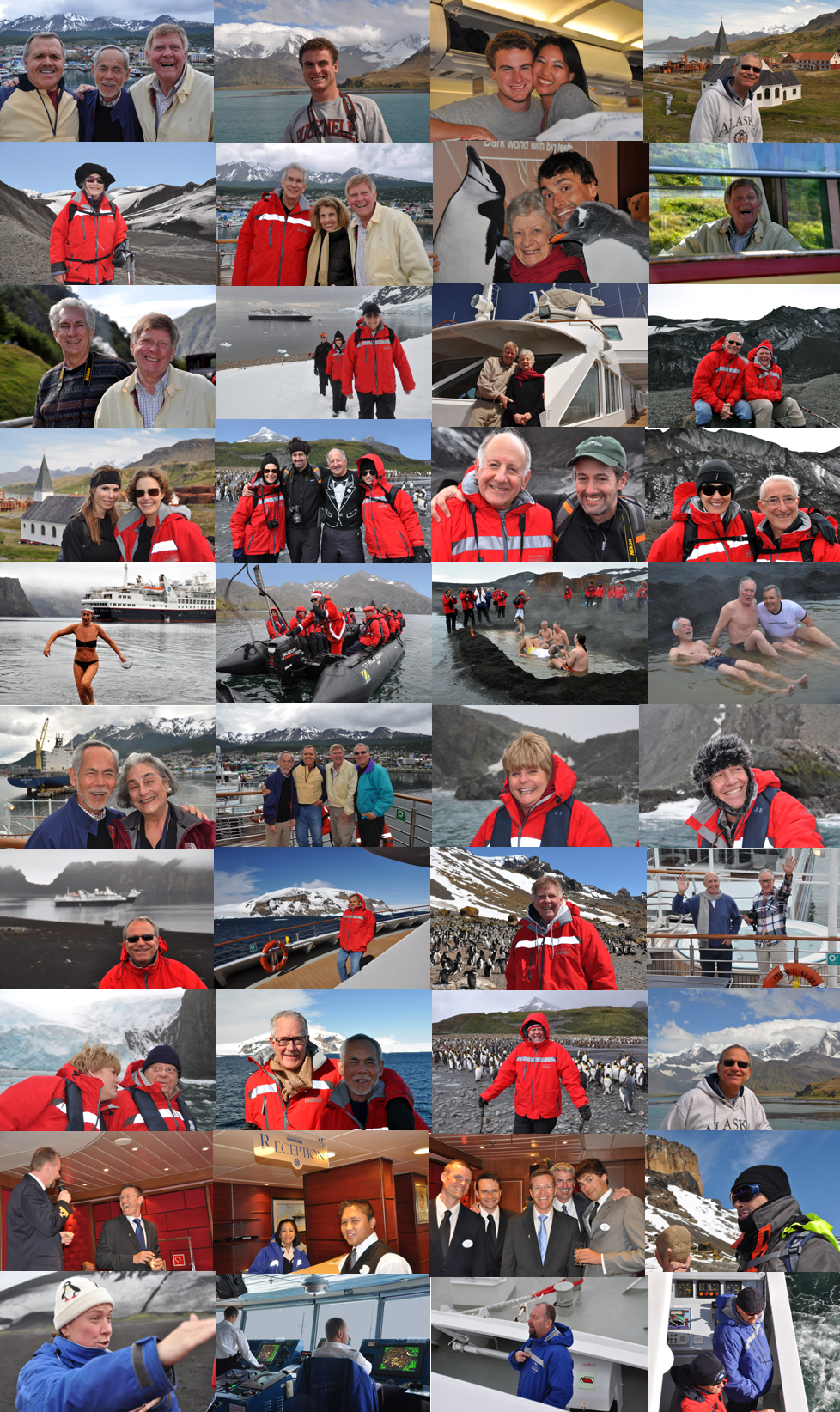
Penguins: Rockhopper, Gentoo, Magellanic, King, Adelie, and Chinstrap penguins; seals, dolphins and whales. Albatross, shearwaters and petrels and approximately 346,000 penguins on this expedition as well as three white penguins with leucism.
Antarctica covers about 10% of the earth's land surface. Under 200,000 people have ever set foot in Antarctica.
DERIVATION OF THE TERMS: "PORT" and "STARBOARD"
The derivation of port and starboard goes back to the days of rowing ships. As most people are right handed, the rudder was on the right side of the vessel, so this side became known as the steering board side which was eventually abbreviated to starboard side.
When vessels came into the harbor it was safer to berth with the left hand side of the ship against the pier, thus avoiding any possibility of damaging the steering board. Hence, the left hand side of the vessel became known as the port side.
THE ANTARCTIC TREATY
No country owns Antarctica, but seven nations have claimed slices of the continent. The Antarctic Treaty was signed in 1959 and came into force in 1961. It covers the area south of 60 degrees South, including all ice shelves which accounts for 10% of the earth's surface. Antarctica is to be used for peaceful purposes only and all scientific information must be shared. All vessels and scientific stations must be open for inspection at any time. Nuclear explosions and disposal of nuclear waste are prohibited. The original treaty document was covered on 4-1/2 pages!
In 1992 the Antarctic Treaty parties adopted a Protocol on Environmental Protection. This stipulates that all human activities must be planned on the basis of prior environmental impact assessments. Regulations on waste disposal, pollution and wildlife conservation have been drawn up and introduces an indefinite ban on mineral exploitation.
MEMBERS: Argentina, Australia, Austria, Belgium Brazil, Bulgaria, Canada, Chile, China, Colombia, Cuba, Czech Republic, Denmark, Ecuador, Estonia, Finland, France, Germany, Greece, Guatemala, Hungary, India, Italy, Japan, North Korea, South Korea, Netherlands, New Zealand, Norway, Papua New Guinea, Poland, Romania, Russia, Slovakia, South Africa, Spain, Sweden, Switzerland, Turkey, United Kingdom, United States, Ukraine, Uruguay, Venezuela.
There are 48 nations involved in the treaty and they operate by consensus.
The station at McMurdo is staffed with 2000 people in the summer and 100 in the winter.
The Falklands War
The Falklands War (Conflict), of 1982 was foreshadowed on South Georgia, where on March 18, 1982, the Argentine ship BAHIA BUEN SUCESCO began scrap metal recovery at Leith Harbour without the approval of the local administration. A week later, the BAHIA PARAISO arrived at Leith Harbour with special forces and equipment to establish a garrison. On April 3, 1982, the Argentine forces attacked the British Antarctic Survey scientific station at King Edward Point, which was defended by Royal Marines who had landed several days previously. When the military and BAS personnel surrendered, they were imprisoned, taken to Argentina, and eventually released into Uruguay. On April 2, 1982, Argentine forces had invaded the Falklands, taking control of Stanley after a short battle with the small detachment of Royal Marines.
THE KINGDOM OF THE KRILL
Antarctic waters have been called the Kingdom of Krill after the shrimp-like crustaceans that dominate the zooplankton. There are estimated to be some 600,000 billion krill in the Southern Ocean. They collectively weigh from 400-600 million tons. Krill is the primary food of millions of fishes, squids, seals, penguins, albatrosses, petrels, and the great baleen whales.
Day 1 (Dec. 19) - Ushuaia, Argentina. The southernmost city in the world - once a penal colony is now the starting point for 90% of Antarctica's visitors. We embarked the m/v PRINCE ALBERT II and bid farewell to Tierra del Fuego, the Land of Fire and Land at the End of the World. We were berthed across from the (newsworthy) m/v CLELIA II. Tom Taffel was invited aboard to photograph the replaced navigational bridge window at 4:00PM on Sunday, December 19, 2010, just before our beautiful sail away from Ushuaia. [Photos to follow].
Ushuaia is separated from the rest of the continent by the Strait of Magellan and bordered by the Beagle Channel to the south, the Atlantic to the east and the Pacific to the West. Ushuaia is part of Chile and part of Argentina. The Chilean side is rough and hilly and laden with fjords. The Argentinean side has a more gentle coastline. Ushuaia is famous for its wild life: red foxes, (huge) rabbits, geese and over 90 other species of birds plus the troublesome North American beavers. Ushuaia - population 57,000, has abundant natural gas and ample (reddish) peat bogs.
Day 2 - At Sea
Day 3 (Dec. 21st) - West Point Island, Falkland Islands. Originally known as "Albatross Island" is famous for its distinctively marked black and white Commerson's dolphins, and colonies of black-browed albatrosses nesting side by side with feisty Rockhopper penguins. West Point was a popular site for slaughtering seals and penguins for oil at the turn of the 19th century. The rare Felton plant, a unique form of vegetation grows in the Falkland Islands. Tom was fortunate to find and photograph the illusive Felton flower.
Day 4 (Dec. 22nd) - Stanley, Falkland Islands. The capital of the remote Falkland Islands has a distinct British ambience, charming streets, quaint cottages, friendly shops and traditional pubs. There are still reminders of the 1982 Falklands War between Britain and Argentina. Stanley, (formerly known as "Port Stanley" is the capital of the Falkland Islands and has a population of 2115, affectionately known as "Kelpers." Stanley is situated 300 miles from Argentina, 584 miles north of Antarctica. It's the capital with the southernmost cathedral of the world. The original capital of the islands was Port Louis. It was moved to Port Jackson and renamed "Stanley Harbour" because Stanley Harbour had a deeper harbor. As a diversionary tactic from Argentina's internal problems, the war of 1982 resulted in 807 deaths: 649 Argentine, 255 British, and 3 Falkland Islanders. Stanley was occupied by Argentine troops for about ten weeks during the Falklands War in 1982 and unsuccessfully renamed "Puerto Argentino" by the Argentine government. Stanley suffered considerable damage during the war, a result of both the Argentine occupation and the British navel shelling. We passed by several of the 125 uncleared active minefields – presently being deactivated by both British and Zimbabwe specialists. Today, "Squidocracy" (squid fishing) and the issuance of fishing licenses has replaced the raising of sheep as the Falkland's primary source of income.
Days 5 and 6 - At Sea
Day 7-8- South Georgia. This breathtaking destination of towering snow-covered mountains, might glaciers, and low-lying grasslands attracts an astounding concentration of wildlife: Southern fur seals, southern elephant seals and a variety of albatross species including black-browed, light-mantled sooty, grey-headed and the spectacular wandering albatross, plus 450,000 pairs of flamboyant king penguins well over a million pairs of macaroni penguins and thousands of pairs of gentoos and chinstraps. Known for its unexpected and ferocious catabatic winds, South Georgia is also linked to the early Antarctic explorers, Captain James Cook first stepped ashore in 1775, but perhaps more famous is Ernest Shackleton's arrival in 1916 following the sinking of his ship, the "ENDURANCE." South Georgia processed 90% of the world's whale catch, in excess of 46,000 whales in 1938.
(Dec. 25th) - Godthul and Cobbler's Cover (Zodiac Expedition) . . . Rusting tanks and drums.
(Dec. 25th) - Grytviken – ("Little Pot"). A most historic whaling station with rusted hulls of long abandoned whalers a whaling museum and Sir Ernest Shackleton's burial site.
(Dec. 26th) - Salisbury Plain - Breeding ground for 250,000 king penguins.
(Dec. 26th) - Stromness whaling station (where they organized the rescue mission for the men on Elephant Island and where we retraced the last leg of Shackleton's heroic journey from Fortuna Bay to Stromness Leith whaling station, the largest in South Georgia.
Day 9-10 - At Sea
Day 11 (Dec. 29th) - Elephant Island, South Shetland Islands
Days 12-15 - Antarctic Peninsula. Antarctica's vast white wilderness including her spectacular iceberg sculptures and calving glaciers, humpback, minke and orca whales.
(Dec. 30th) - Brown Bluff, Tabarin Peninsual (a 2,200 foot bluff on the Antarctic continent). Brown Bluff is an ice-capped 745-metre-high flat-topped mountain with prominent cliff or reddish-brown volcanic rock. Adlelie and gentoo penguins, kelp gulls and pintado petrels, all-white snow petrels and skuas as well as Weddell seals . . . basking in the sunlight.
(Dec. 30th) – Kinnes Cove
(Dec. 31st) - Port Foster, Whalers Bay (Deception Island) in the South Shetland Islands off of the Antarctic Peninsula. This collapsed volcano is an excellent example of a "caldera" where it is believed that the volcano's summit collapsed with one section sinking far enough to allow the sea to flood the interior. The last two eruptions were in 1967 and 1969, causing serious damage to the scientific stations. We sailed inside this breach wall through a narrow entrance called "Neptune's Bellows" just 754 feet wide with a hazardous rock just 8 feet below the surface, positioned in the middle of the entrance. The island is approximately circular with a diameter of 7 miles and its highest point is Mt. Pont, 1,778 feet above sea level. The whaling stated was abandoned in 1931 with the falling prices of whale oil. Even the 45 men buried in the station’s cemetery have been re-buried by falling ash in the 1969 eruption. All that remains are the rusting boilers and tanks.
(Dec. 31st) - Telephone Bay (Named after the sailing vessel "Telephone" which ran aground in 1920). This part of the collapsed volcano last erupted in 1970 and which erupts every 30 years! The summit of Telephone Bay offers some of the greatest views and ash covered ice imaginable.
(Jan. 1st) - Cuverille Island, Errera Channel. More gentoo penguins, storm-petrels and fur seals.
Paradise Bay. On the Antarctic peninsula. Mountains . . . Glaciers and Icebergs! We visited the Almirante Brown Station, one of many Antarctic research stations on the continent. Here were found crabeater seals and minke whales.
(Jan. 1st) - Coverville Island. Icebergs, Large cobble beach skuas beautiful rock. Zodiac cruise.
(Jan. 1st) - Neko Harbour. A continental landing plus a zodiac cruise…Minke whales, glaciers and nesting Gentoos. You can hike to top of hill and hike slide down.
Jan. 2nd) - Port Lockroy, Goudier Island. Built by the British as a listening station for enemy activities during WWII, then used as a research station in the 1950's and since 1962 as a museum and gift shop, around which snowy sheathbills and gentoo penguins roam. We saw what had to be the world's largest snow flakes which measured a square inch in size!
Days 16-17 (Jan 2nd) - Drake Passage The Drake Passage, or "Mar de Hoces" named after the Spanish navigator Francisco de Hoces, is a "lively" body of water, (a rite of passage for Antarctic tourists) and named after Sir Francis Drake, who never sailed in the Drake Passage! It extends 400 miles from Cape Horn, the southern tip of South America to the northernmost tip of Antarctica. Notorious for its turbulent seas due to the Antarctic Convergence, a natural boundary where cold polar water flows northward and the warmer equatorial water moves southward, it has some of the roughest seas in the world. When they meet, nutrients are pushed to the surface, often attracting a multitude of seabirds and whales. The passage carries a huge volume of water, about 600 times the flow of the Amazon around Antarctica.
Day 18- (Jan. 5th) Disembark the "PRINCE ALBERT II" for our return flight to Buenos Aires.
MISCELLANEOUS INFORMATION:
The Name of all Silversea Ships . . . . Rolls Royce Names: Silver Shadow, Silver Cloud, Silver Wind, Silver Whisper. "Silver Dawn" was going to be the name of the "Prince Albert II." She has a Class 1A hull and can push ice, 1/2 meter thick of 1st year ice. Silversea Cruises anticipates operating the ship for ten years…till 2018.
Electrical Equipment: 220VAC 50 Hertz Euro plug, (type "C") as well as German (type "F") and French (type "E") plugs.
ANTARCTIC SEASON . . . Mid-November to Beginning of March.
At present, there are 27 ships in Antarctica. Only 25,000 people per year can visit.
<> <<>> <<<>>> <<>> <>