
|
|
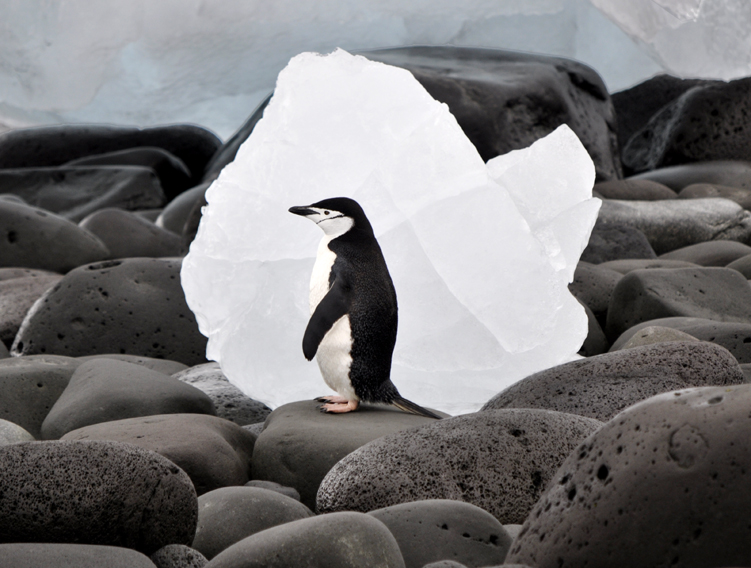
Grouped scientifically into about 17 species, penguins are highly specialized, non-flying, marine birds, ranging in size from the Little Penguin at 2.25 pounds in weight and 16 inches in height, to the Emperor Penguin which weighs up to 84 pounds and reaches 45 inches in height. Male penguins are generally heavier than females and have larger, more powerful bills and longer flippers. All have dark backs and white fronts and each species has a unique pattern, in some cases including orange and yellow, around the head and chest.
Unlike most other seabirds, penguins have lost the ability to fly, so that they do not need to minimize thier weight. Their feathers have also modified from flying equipment to waterproof insulation, thickening the birds up and shaping them to hold air agains the body. Swimming compresses their feathers and gradually forces out the insulating layer of air, so that a swimming penguin leaves a fine trail of bubbles.
https://www.bing.com/videos/riverview/relatedvideo?q="The+Penguin+Lessons"&mid=FEB73F7955C6A36F57DCFEB73F7955C6A36F57DC&FORM=VIRE
. . . . . . And Another Trailer:
https://www.bing.com/videos/riverview/relatedvideo?q="The+Penguin+Lessons"&mid=59C9AE4E6E527EAF77C359C9AE4E6E527EAF77C3&FORM=VIRE
. . . . . . So sorry, there aren't any free streaming options for "The Penguin Lessons" at this time
This remarkable, bittersweet, well-crafted film about a Magellanic penguin ("Juan Salvador"), is based on a true story.
The film premiered at the Toronto International Film Festival on September 6, 2024. The script was adapted by Jeff Pope from Tom Michell's memoir of the same name, published in 2015.
Tom Michell's 2015 memoir chronicles his experience as a British teacher who travelled to South America to teach at a boys' boarding school in Argentina in the 1970s. On a trip to Uruguay, he visited a beach in the Uruguayan resort of Punta del Este where he stumbled on many dead penguins soaked with oil. He noticed one penguin still alive, and so he decided to rescue it, bringing it to his hotel to clean and feed it. After that, the penguin would not leave him and kept following him; eventually he took it back to the school, where it became a popular pet.
The Plot: Disillusioned itinerant educator Tom Michell arrives at St. George's College, an exclusive boys school in Argentina, to teach English and coach rugby. He befriends his housekeeper Maria, her granddaughter Sofia, a political activist protesting the escalating 1976 Argentine coup d'etat, and St. George's science teacher Tapio. Despite Headmaster Buckle's full confidence in Michell's background, the latter struggles to keep his class attentive and well-behaved.
When a bombing in the city calls for students to be sent home for a week, Michell and Tapio take a trip to Uruguay. Michell meets a woman named Carina at a dance club, and they find an oil slick on the beach that has killed several Magellanic penguins, except for one. They take the surviving penguin to his hotel room to clean it in the bathtub.
Michell's attempts to release the penguin to the ocean result in it returning to him. Every time he tries to leave it behind, other people insist he accept responsibility, even under threat of arrest. So, Michell reluctantly smuggles it back to St. George's, and contacts a zoo. Upon observing the zoo's horrid conditions, he resolves to adopt the penguin, naming it Juan Salvador.
Maria and Sofia are charmed by the penguin, leading Michell to introduce Juan Salvador to his class, which succeeds in making them pay attention and excel in their studies. Michell bonds more with his students, permitting them to feed Juan Salvador fish while urging them to keep it secret from Buckle. Tapio also meets the penguin and has a personal conversation with it.
In the city, Michell witnesses Sofia being kidnapped by Argentine authorities for her activism. Visiting a grieving Maria at her home, Michell learns she will protest for Sofia's release and, touched by her strong family bond, he shares that he lost his teenage daughter to a car accident, which then caused a rift in his marriage. He confesses to Maria that he saw Sofia being taken away yet did nothing.
Buckle learns of Juan Salvador and, enforcing strict policies, orders Michell to leave St. George's. Michell confronts the militant that ordered Sofia's kidnapping and presses him to release her. He is promptly arrested and beaten, later bailed out by Tapio. Following the incident, Buckle reconsiders firing Michell, admitting that Juan Salvador's presence has positively affected the staff and student body, even having a personal talk with it himself. Juan Salvador is granted a swim in the school's pool.
Shortly after, Juan Salvador suddenly dies. Devastated, Michell gives it a burial on St. George's campus under a tree near the rugby field. As he presents his eulogy to the staff and students, a beaten and shaken Sofia returns. Michell looks on as Maria and her granddaughter reunite.