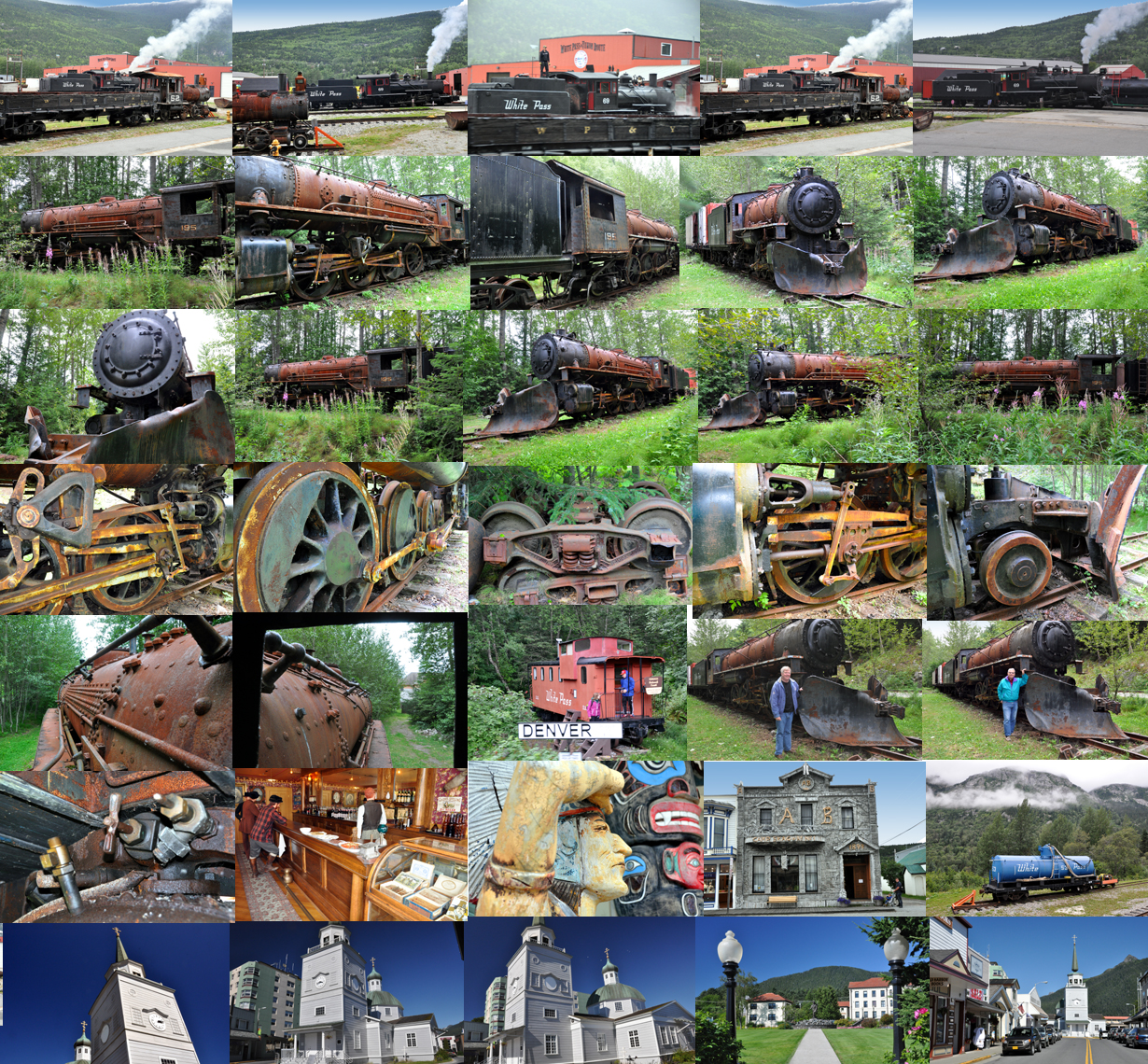
|
|
by Terry Breen
www.terryslog.com
Make the most of your Alaskan cruise with www.terryslog.com where you'll find everything to enjoy your days at sea and in port!
• Current Weather
• Port maps and information
• Updated port events and activities
• Points of interest, shopping and dining
• Fun Facts and Figures on "Alaska: the Great Land!"
Skagway is probably the hokiest town in Southeast Alaska, but by far, the most fun. This tiny community of 870 year-round residents swells to 1,600 people when seasonal workers come up for the summer. With essentially one main street it is easy to explore the many shops and museums located within the nineteen buildings on the national historic register. Not to be missed is the Klondike Gold Rush National Historical Park Ranger's Station located in old Assayer's Office near the train station. Rangers give walking tours of town and documentaries are shown regularly in the small theater, free of charge. Skagway is one of the destinations from which you can access the Juneau Icefield for more dog-sledding and glacier flightseeingas wellzip-lining. But it is also the home of the world-famous narrow-gauge White Pass & Yukon Railroad; designated an International Historic Civil Engineering landmark.
Skagway 2012 population 870
Located on the northeast fork of Taiya Inlet, Skagway is the northernmost town in Southeast Alaska and was the gateway to the Yukon for hundreds of thousands of prospectors during the Klondike Gold Rush. The name in Tlingit means, Place of the North Wind. In the summer the wind comes down Lynn Canal, making the climate warmer and drier than the rest of Southeast. Skagway residents take advantage of this and are known for their prolific flower gardens. Don't hesitate to admire. In the winter the cold, dry wind from the Yukon makes Skagway colder and snowier than the rest of Southeast.
As one of the two most popular routes available for prospectors to cross the mountains into the Yukon, Skagway at the base of the 43 mile long White Pass Trail, became a boom town of the 1898 Klondike Gold Rush. Nineteen buildings dating back to that time have been preserved and are on the National Historic Register. Part of the town is included in the Klondike Gold Rush National Historical Park, which also includes the 33-mile-long Chilkoot Trail, and parts of Pioneer Square in downtown Seattle.
In the summer of 1889, thousands of people were camped out on the mud flats. The town was run by thugs and thieves like Soapy Smith. In protest, Frank Reid organized a group called the Committee of 101. They intercepted Soapy and shot him dead. Reid was fatally wounded. The townsfolk honored Reid by erecting a monument to him in the Klondike Gold Rush Cemetery. No honors for Soapy; the town didn't even want him buried within the cemetery. So, the grave was dug outside the grounds. Now, however, since the cemetery continued to grow, Soapy’s grave is at the cemetery entrance and his is the first name you see.
The White Pass was purportedly traversable by pack animals which was not true and in 1898, thousands died on the narrow trail, giving it the nickname the Dead Horse Trail. However, the pass was lower in elevation by 600 feet than nearby Chilkoot, and in 1898 construction was started on a narrow-gauge railroad under the leadership of Michael J. Heney. It took 26 months and 10 million dollars, but with British financing, US engineers and Canadian labor, the White Pass and Yukon Railway began service in 1900. Even though the Gold Rush was officially over, the existence of the railroad kept alive many communities including Skagway. Less fortunate was nearby Dyea at the head of the Chilkoot Trail; it became a ghost town and officially closed its post office in 1906.
During the winter of 2008/2009, using money collected off a Skagway city tax, the cruise pier area at the Railroad Dock was greatly improved. There now are two restroom facilities, one at the end of the pier and one in Pullen Park, as well as wider sidewalks, lovely landscaping, and helpful signage. Though the walk to town is only 1/4 mile, there is a shuttle service available from the head of the pier. Pick-up is ongoing and there is a nominal charge. For the romantic you can hire a horse drawn buggy to see Skagway in style.
Skagway is full of fun little places to eat and colorful bars dating back to the Gold Rush. Among some of the local favorites are the Harbor House, Bites on Broadway, The Stowaway, and of course, the Red Onion Saloon.
TOURING and EXPLORING
Skagway is all about history – Klondike Gold Rush history. The best way to get a feel for the significance of this area is by following the path of the hopefully prospectors themselves as they toiled over the White Pass.
Ride the White Pass & Yukon Railroad - Today you can still ride the White Pass & Yukon Railroad in cars that were originally constructed at the roundhouse in Skagway in the 1900's. The track follows the White Pass and the views are magnificent. There are areas where you can still see tools and artifacts abandoned on the trail. No trip to Skagway is complete without experiencing this bit of history.
OUTDOOR ADVENTURE
Like Juneau, Skagway is located on the mainland so you will find many more opportunities for inland adventures like ziplining, biking, rock-climbing or mushing on glacier!
MUSH! – What says Alaska more than taking a helicopter to a dog-sled camp to go mushing on a glacier! This is a once-in-a-lifetime experience; truly not to be missed. Hearing the dogs barking and yelping anxious to get in their harnesses and run is a thrill that must be experienced to be believed.
Bike Trek to Old Dyea - Located on the northwest fork of the Taiya Inlet, Dyea in 1898 was a bustling boom town at the head of the Chilkoot Trail. After the gold rush, the decision to bring the White Pass-Yukon Railroad down the wider, lower White Pass to Skagway made Dyea obsolete. The town became a ghost town. Today what is left of Dyea is preserved as part of the Klondike National Historical Monument, which includes the Chilkoot Trail. You can walk among what is left of the town, hike a portion of the Chilkoot trail, and visit the Slide Cemetery where those that were killed in the Palm Sunday Avalanche of 1898 are buried.
Rock climbing – There are outfitters in town that will take both beginners and pros up to some sheer rock faces to climb and repel. Gear provided. Must bring your own courage.
Zip Line – Seems everyone has a zipline these days but the one from Skagway is pretty good.
WILDLIFE ENCOUNTER
Skagway is the gateway to a one-of-a-kind experience in Southeast Alaska; the Chilkat Bald Eagle Reserve. Due to the occurrence of an unusual hot spring that warms the Chilkat River thousands of eagle congregate here during the winter. This happens nowhere else in Alaska and warrants a visit for those interested in eagles and wildlife.
Chilkat Bald Eagle Reserve – Just outside of the town of Haines is the Chilkat River. The river does not freeze in the winter; consequently it hosts a late season run of salmon. Knowing this, thousands of eagles winter over along the Chilkat each year. It becomes the greatest concentration of eagles in North America. Hundreds of eagles remain year-round making it an excellent place for bird watching. Along the river, too, you may see Sitka black tailed deer, moose, and occasionally, bears. If eagles are your passion, you won’t want to miss this!
FUN and FREE
I love wandering around Skagway; there is so much to see. Even though this town is tiny, I never tire of the history of the buildings, the Victorian houses with their beautiful gardens, the spectacular scenery and colorful characters. Pick-up a walking tour map at the Klondike Gold Rush Visitor's Center to get an appreciation for the depth of this seemingly simple little town.
Red Onion Saloon – Located on the corner of 2nd and Broadway, this establishment embodies everything that says Skagway; legendary Gold Rush saloon, notorious brothel, and a mismanaged moving job. Originally built in 1897 by Skagway's founder Captain William Moore, the building was originally located on Sixth & State. It opened for business as a saloon and abode of ill-repute in 1898. Upstairs in the brothel each gal had a small room or "crib" with a copper pipe that went straight to the bar. The bartender used dolls to represent each gal; when she was working the doll was on her back; as payment was received down the copper pipe (usually five dollars in gold) the bartender would set her up-right. In 1914 the building was unceremoniously moved to its current location where it was discovered that the building was now backwards requiring the back be removed and replaced with the original front! The saloon still has its original bar and serves up Skagway favorites like The Streetwalker (bubbly Prosecco with splash of Chambord and a twist of lemon) and The Madam’s Martini (Pomegranate infused Pearl vodka served Cosmopolitan style.) You can tour the rooms upstairs where the Soiled Doves toiled away for the price of (you’ve got it) $5.00!
Arctic Brotherhood - Decorated with thousands of pieces of driftwood, the Arctic Brotherhood building is said to be most photographed in the States. Built in 1899 it was said to be member you had to cross the Chilkoot or White Pass and return to talk about it. Inside you will find the Skagway Visitor’s Center with more information about businesses within town.
Klondike Gold Rush National Historical Park Visitor's Center – This to me is the best deal in Alaska; the NPS Visitor's Center has FREE ranger walks, FREE ranger talks, FREE movies, FREE guided walking tour maps of town and a FREE museum! (Though it is not free, the Trail of '98 Museum is also worth a visit if you like history of the Gold Rush.)
Gold Rush Cemetery - About one mile out of town is the Gold Rush Cemetery where the illuminati of Gold Rush history are buried like Frank Reid and Soapy Smith. Story is that after Frank Reid shot Soapy Smith dead he became a hero and a gleaming monument was erected over his grave. Everyone was so ashamed of Soapy they did not even want to bury him in the cemetery; so he was buried outside. But now that the cemetery has grown he is the first and last person you see!
Railroad Dock - The graffiti on the wall next to the Railroad Dock (or cruise pier), dates back to the days of the Gold Rush. The first thing painted on the wall was said to have been the skull of Soapy Smith. From that time on the wall became a billboard upon which merchants advertised their stores and sailors posted the colors of their ships. When cruise ships started calling on Skagway they too engaged in the tradition. On its maiden voyage the insignia of the ship and name of her captain are painted on the hillside. The oldest markings are from the ships of the Canadian Pacific Line; Princess Adelaide, Princess Louise, Princess Norah 1928, and Princess Charlotte 1929. Look closely and you will see names from the not-too-distant-past, like Royal Viking, Chandris, and Regency. That tradition continues today, so try to find your ship on the wall, as well as my name!
WALKS and HIKES
Skagway is an easy town to explore on foot. Be sure to pick up the walking tour map at the Klondike Gold Rush Visitor's Center and the Skagway Trail Map at The Trail Center.
Those inclined can walk all the way out to the Gold Rush Cemetery (4 miles roundtrip); if you do, don't miss beautiful Reid Waterfall. More ambitious hikers looking for a good trail will be pleased with Upper and Lower Dewey Lake trail. And, for those who want to say "been there, done that" you can go out to Dyea and hike a portion of the famous Chilkoot Trail!
Stroll through Town – Easy
Skagway is great for an easy walk because; 1.) There are so many fun buildings to see, 2.) There are only about a dozen streets and 3.) The town is flat! If you want a head start the Skagway Transit offers shuttles from the cruise docks into town; current fare is $2.00 one way. But from the Railroad Dock it is only 1/2 of a mile along a new, wide sidewalk. Once in town you can pick-up the walking tour map from the National Park Service at 2nd & Broadway.
Yakutania Point – Easy to Moderate
Head out to the Skagway River by way of the road to the airport; here you cross the river via the pedestrian bridge and continue to the left past the Par Course trail to Smuggler's Cove and Yakutania. The entire hike is 1.6 miles (2.6 km) with a gain of only about 20 feet (6 meters.) Roundtrip it will take about 1 hour. Wonderful views of the ship.
Dewey Lakes – Moderate to strenuous.
For those wanting a good hike, the trail to Dewey Lakes will provide a moderate workout. To get to the trailhead cross Congress Street from Pullen Park and follow the railroad tracks; there are signs on your left. The trail takes you to Lower Dewey Lake and Upper Dewey Lake. The trail to Lower Dewey is just shy of 1 mile in length (1.4 km) and will take 1 roundtrip. Your hike will take you up 500 feet (150 meters). Once at Lower Dewey Lake, the walk around the lake is 3.6 miles (5.8 km.) From the trailhead the total time around the lake about 2 hours.
For the more ambitious, Upper Dewey Lake takes you up 850 feet (260 meters) and is about 6 miles (9.7 km) in length. Total time required is about 3 hours roundtrip.
RESTAURANTS and CAFES
There are some lovely little places to eat in Skagway whether you are looking for a snack or a nice meal. Many restaurants feature lovely views of lush flower gardens or the snow-capped mountains that surround the town. Skagway also has its own brewery that originally started back during the Gold Rush.
Sweet Tooth – If you are hungry, the Sweet Tooth on 315 Broadway is an institution. They have a hard ice cream soda fountain for a great malt or milkshake. Their halibut burgers are local favorites.
Bites on Broadway – One of the newest eateries in Skagway Bites on Broadway offers Southern hospitality Alaska-style. Bites offers up truly tasty items that are fast and portable; perfect as you explore town.
Harbor House – Closest thing to fine dining in Skagway, Harbor House is just a few blocks from the cruise ships on Congress Street, just up from the Railroad Dock. Serving breakfast, lunch and dinner, enjoy specialties like the wasabi salmon. Whether you chose to eat in the cozy dining room or out in the garden, every meal comes with a spectacular view.
Sugar Mama’s – Cupcakes. Good cupcakes. Need I say more?
Skagway Fish Company - Right up from the cruise ships on Congress Street, is the Skagway Fish Company, a close and popular place for fish ‘n chips and beer on tap.
Brewery
Skagway Brewing Company - After all that walking you might work up an appetite or just want a snack. If all you desire is a cold one, there are plenty of fun places for a beer. Skagway has its own brewing company; first started in 1897, the Skagway Brewing Company was resurrected in 1997.
by Terry Breen
www.terryslog.com
Make the most of your Alaskan cruise with www.terryslog.com where you'll find everything to enjoy your days at sea and in port!
• Current Weather
• Port maps and information
• Updated port events and activities
• Points of interest, shopping and dining
• Fun Facts and Figures on "Alaska: the Great Land!"
Sitka is the Number One ranked port in Southeast Alaska. Whether it is the breathtaking scenery; the abundance of sea otters and other wildlife or the warmth and authenticity of the people, you are going to enjoy little Sitka. Known as the "Paris of the Pacific," Sitka was founded by the Russians in 1799 and retains a Russian feel noted especially in iconic St. Michaels Russian Orthodox Church and the Russian Bishop's House.
Sitka has traditionally been a tender port but as of 2012 a new cruise facility has been opened six miles north of town. If you are anchored, your ship will be between Baranof Island and the Channel Islands. There are two tender piers: one is in Crescent Harbor, and the other is under the O’Connell Bridge. If you arrive at the new cruise terminal, there are free shuttles that will take you into town and drop you at the Harrigan Centennial Hall, which is also at Crescent Harbor.
Centennial Hall is where the New Archangel Dancers perform. This troupe of local dancers has captured the spirit of Russia in the Americas. Within the building is also the Isabele Miller Museum, a popular city museum. The wonderful dug-out canoe located on the pier is called the Everybody's Canoe and represents the two moieties of the Tlinigt; eagle and raven. On the other side of the parking area is the Sitka Library, where you can sign-up to use the free internet. FYI: The entire city of Sitka has free wi-fi; you will get a signal anywhere.
Sitka 2012 population 8,881 Nestled at the far end of Sitka Sound, the town is sheltered from severe weather. Hundreds of small rocks and islands dot Sitka Sound, many of them named by the early Russian settlers. If Mother Nature is cooperative, you can see Mt. Edgecomb. Located at the northwest entrance to Sitka Sound on Kruzof Island is Mt. Edgecomb (3,201-feet), an extinct volcano. It last erupted 8,000 years ago.
Lincoln Street is Sitka’s downtown. One of the first things that you will notice is how "normal" the community looks. It is authentic. Though it is one of the most popular ports on cruise itineraries it has managed to go unscathed by the ravages of tee-shirt shops and jewelry stores. The businesses are locally owned and operated and are patronized by local residents all year. It is reassuring to see the same faces year after year.
In 1934, the first Alaska Pioneer Home was built in Sitka. Located on the old Russian parade grounds, the home was and is one of the first retirement communities of its kind. There is a small gift store inside and visitors are welcome. Just behind the Pioneer House is the replica of the old Russian Blockhouse used to segregate the Tlingit from the Russians. Across Katlain Street, is Totem Square which contains a Tlingit totem pole carved with a Russian double-headed eagle. The city park also has a Russian cannon and several anchors. Benches look out over the boat harbor.
Next to the Pioneer House on Katlain Street is the Sheet' ka Kwaan Naa Khadi Tribal Community House, operated by the Sitka Tribal Association.
TOURING and EXPLORING Sitka has long been known as the "Cultural Capitol" of Alaska, not just for its diverse cultural heritage but also for its many colleges, schools and research facilities. It is no wonder that the community supports organizations like the world-famous Raptor Rehabilitation Center.
St. Michael’s Russian Orthodox Church - The onion dome of St. Michael's Russian Orthodox Church dominates the skyline. The church was first built in 1848; the dome was made from malachite. In 1966, a fire destroyed the church, but luckily the priceless icons were saved. Legend has it that one man single-handedly removed the 100 pound chandelier, which later took four men to replace. Using the original Russian building plans, the church was reconstructed as an exact replica. The original chandelier and icons are displayed in the church. A nominal admission is charged but many tours include a ticket so you can enjoy the church after your excursion.
Russian Bishop's House - From the tender pier at Crescent Harbor, turn right along the marina to Lincoln Street. To the right and across the street is the Russian Bishop's House. Built in 1842, the building is on the National Historic Register. There is an admission fee. National Park Rangers offer guided tours. It is the oldest Russian building that is still standing in Alaska and is one of the four oldest Russian structures in the United States.
Sheldon Jackson Museum - From the Russian Bishop's House continue down Lincoln Street to Sheldon Jackson College. Dr. Sheldon Jackson was the Director of Education for the Alaskan territory from 1895 – 1900. Though the private liberal arts college has fallen on hard times and no longer offers classes, the Sheldon Jackson Museum is still open and worth a stop. Some say it is better than the State Museum in Juneau. James Mitchner wrote his novel "Alaska" while staying at Sheldon Jackson College.
Sheet' ka Kwaan Naa Khadi Tribal Community House – Located on Kaitlian Street, the community house was built to resemble a traditional clan house. It features dancers in full regalia and a gift shop with locally made goods. The house itself is worth a visit just for the "Lovebirds" house screen, depicting the raven and eagle moieties. It is the largest of its kind in Southeast Alaska. The Tribal Association also operates the Visitor Transit, which shuttles visitors to all of Sitka's major downtown attractions.
Raptor Rehabilitation Center - This all-volunteer organization has become a leader in raptor rehabilitation and education. Between 100 and 200 injured birds are helped each year. The Center is open to the public. Visitors from all over the world have sponsored or "adopted" birds that have been rehabilitated and released back into the wild. Birds unable to return to their natural habitat have found a welcome home at the Center where they are ambassadors for their species, raising the awareness of visitors who meet them each year.
WILDLIFE ENCOUNTERS This is the place for sea otters; no question. If you want to see the wonderful "clowns of the sea", Sitka is the place. Sitka Sound is prime habitat for sea otters, sea lions, and whales. Baranoff and the surrounding islands are home to eagles, Sitka black-tailed deer and bears. Probably the most comprehensive and predictable wildlife viewing can be found in this port.
Sea Otter Quest – In my book one of the best, most comprehensive excursions you can take during your Southeast Alaska cruise would be the Allen Marine Sea Otter Quest. When they say you are guaranteed to see wildlife they mean it. Though this excursion specifically focuses on sea otters – which is worth it right there – during the course of getting from point A to B it is common to see whale, deer, eagles and bear. What else could you ask for?
WALKS and HIKES The community of Sitka makes visitors feel at home. The town has consciously chosen not to expand and commercialize in order to protect its history, charm and integrity. Visitors enjoy strolling downtown, nearby neighborhoods as well as the many parks within easy walking distance of the tender pier.
Sitka National Historical Park – easy to moderate Sitka is a great port for walking. Continue farther down on Lincoln Street until you reach the Sitka National Historical Park. The park is a beautiful wooded area that was the original site of the final battle between the Tlingit and the Russians. There is an interpretive center with exhibits. Often Native wood carvers or weavers are on-site to demonstrate their skills. Documentaries on the battle are also shown. Beyond the historical significance of the area, today it houses a collection of some of the most beautiful totem poles in all Southeast Alaska. Starting with the display outside the Visitors Center, follow the trails through the park to discover more. Situated among their growing ancestors, these cedar poles have been carved and raised to remind admirers of the Tlingit past. Trails wind through dense forest filled with towering ferns, proof this is temperate rainforest. A salmon creek runs through the park and in late summer is filled with thousands of spawning fish.
Locals are very proud of their history and aware of its importance. Look for interesting facts about Sitka posted on interpretative signs throughout town.
FUN and FREE
The "fun 'n free" side of Sitka comes alive when you know what to look for. The city has been very good about posting interpretative signs in front of significant buildings and sites, but you have to find them. Here is a list of some of the fun things to see to get you started.
Castle Hill - Behind the pharmacy on Lincoln Street is Castle Hill. This small promontory was used by the Tlingit as a strategic lookout point. Later the Russians built many different buildings upon the same location. In 1837, Alexander Baranof built his sumptuous home nicknamed Baranof's Castle. On October 18, 1867, it was used for the transference of ownership of the Alaskan territory from Russia to the United States. The Castle burned in 1898. Today the hill offers spectacular views of the town, mountains, harbor and St. Michael's Church. Great photo stop or picnic place.
Whale Park - If you happen to be on a ship that calls on Sitka in the early spring and or late fall, a walk down to Whale Park would be worthwhile. This new city park, located about 6 miles south of town, is a great place to view humpbacks. There are telescopes and hydrophones available along the boardwalk.
Centennial Hall – As you walk up the ramp from the tender pier in Crescent Harbor, you will see Centennial Hall. In addition to being the home of the New Archangel Russian Dancers, there is the Isabel Miller Museum and also an incredible collection of vintage photographs of Old Sitka. These photos range from Russian-America days to World War II to the present. The statue out in front is that of Alesander Baranof, head of the Russian-American Trading Company and founder of New Archangel (aka Sitka).
Everybody's Canoe - Out in front of Centennial Hall notice the roofed structure protecting a dug-out canoe. This canoe called Te Kot Keh Yago or Everybody’s Canoe was carved by Herman Kitka and represents the two moieties of the Tlingit, Eagle and Raven. Mt. Edgecomb – Elevation 3,201 feet
Located on Kruzof Island, Mt. Edgecomb is an extinct volcano located on Kruzof Island. It last erupted about 8,000 years ago, sending ash throughout the area. The volcano was named by Captain James Cook in 1778 after Lord Edgecomb.
DINING and LOCAL TREATS
As one of the largest commercial fishing fleets in Southeast Alaska, restaurants in Sitka feature fresh seafood including halibut, crab and salmon.
Little Tokyo - With all this walking you no doubt will be hungry. If you like sushi, you will love Sitka's Little Tokyo. On 315 Lincoln across from the Wells-Fargo bank, this is the freshest, most tasty sushi you will have east of Japan. I once traced a line of ice water from a bucket full of fish taken straight off a fishing boat into the restaurant. It doesn’t get much fresher than that!