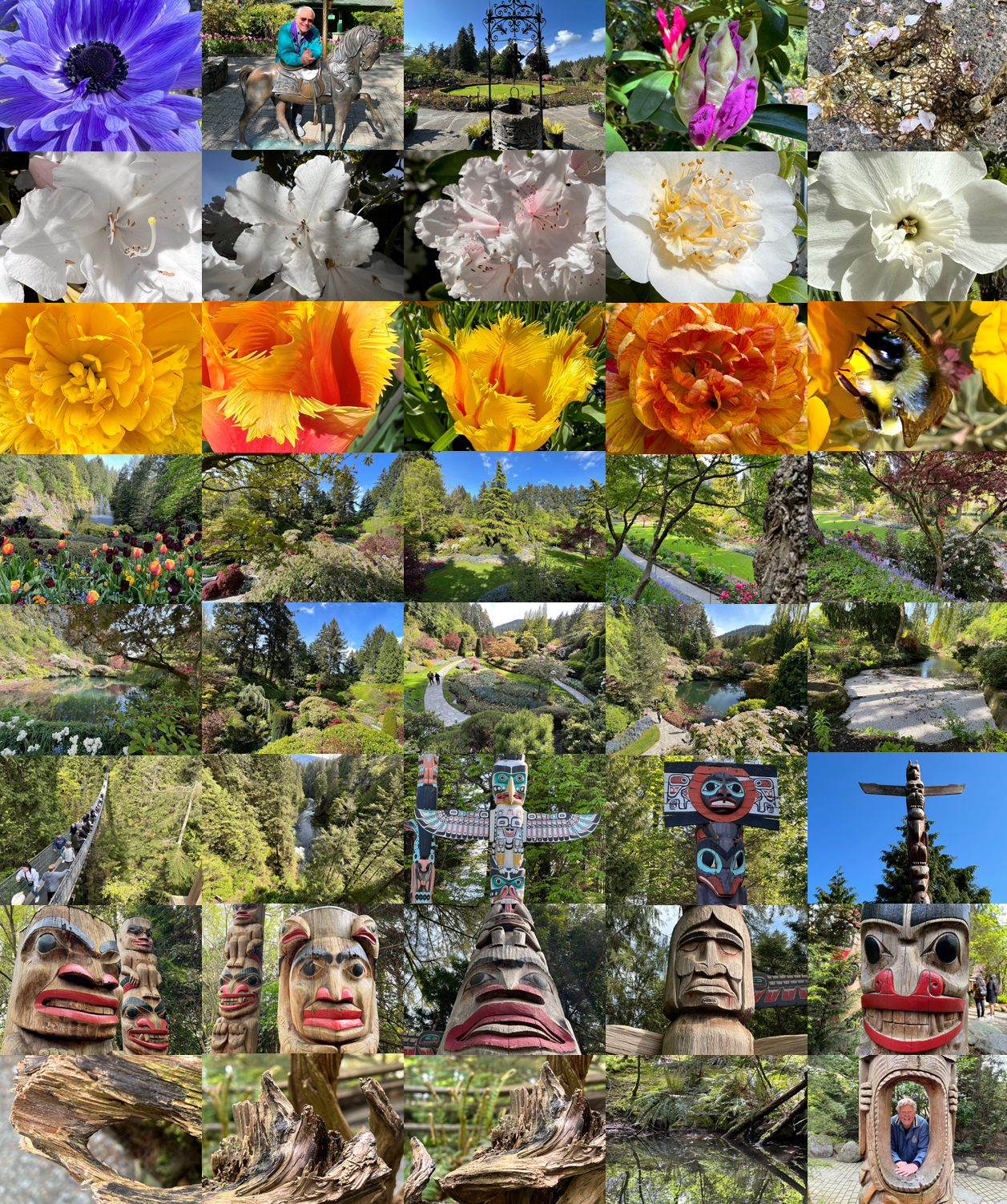
Butchart Gardens, Victoria, B.C., Canada
The 55-acre garden was a former limestone quarry which supplied a nearby Portland cement plant - consisting of the world-famous Sunken, Japanese, Rose, Italian and Mediterranean gardens, and is visited by nearly a million visitors annually.
The 100 year-old garden has been designated a National Historic Site of Canada. [www.butchartgardens.com]
Capilano Suspension Bridge in North Vancouver, British Columbia, Canada
"The World's greatest suspension footbridge"
The Capilano Suspension Bridge is a simple suspension bridge crossing the raging waters of the Capilano River in the District of North Vancouver, British Columbia, Canada.
The current bridge is 450 feet long and 230 feet above the Capilano River. It is part of a private facility and draws 1.2 million visitors per year.
The bridge was originally built in 1889. It was originally made of hemp ropes with a deck of cedar planks, and was replaced with a wire cable bridge in 1903. The (fourth and present) bridge was completely rebuilt in 1956. The bridge's pre-stressed, multi-strand steel cables embedded in 13 tons of concrete at either end, have a 123-ton breaking strength, (enough to hold two fully loaded Boeing 747's). The bridge has been featured in LIFE Magazine.
In May 2004, "Treetops Adventures" was opened, consisting of seven footbridges suspended between old-growth Douglas Fir trees on the west side of the canyon, forming a walkway up to 98 feet above the forest floor. In June 2011, a new attraction called "Cliff Walk" was added to the park.
The bridge has been featured as a setting in episodes of several television series, including: MacGyver, Sliders, The Crow: Stairway to Heaven, and Psych.
Interesting Information
"Aging Gracefully" ~ Some trees are more than 1,500 years old. Every year, a tree develops two rings of growth: a dark one for summer growth and a light one for winter growth. The outer layer of bark on a tree is strong and thick so that it can resist forest fires and bug infestations. The inner bark is the "pipeline" for nutrients traveling to the rest of the tree. The sapwood is the newest wood in the tree, and it transports water to the needles. The heartwood is the oldest and densest part of the tree; it keeps the tree upright.
"Skunk Cabbage" ~ With its big green leaves and bright yellow flowers, Skunk Cabbage is a plant found in the wet rainforests of the Pacific Northwest. It has a stinky smell which attracts flies, beetles, and gnats - which pollinate the plant. Bears eat the roots to clean out their system after hibernating, but it will severely burn your throat and stomach!
"Breathe In" ~ Rainforests are sometimes referred to as the "Earth's Lungs," and they are responsible for 28% of the world's oxygen turnover. Trees remove carbon dioxide from the air and give off oxygen, which we then breathe. Just one of these giant trees releases enough oxygen to support a family of four.
"Save A Tree" ~ The average North American uses over 700 pounds of paper per year. That's the equivalent of six trees worth of paper per person or two billion trees in total.
"Eagle Eye" ~ An eagle can spot a salmon in two feet of water from two miles away! Their vision is at least four times sharper than that of a human. They can fly at an altitude of 10,000 feet and dive up to 100 miles per hour. They have more than 7,000 feathers!
"Fish in the Trees?" ~ Salmon transport nitrogen from the ocean to the rivers when they return home to spawn. Bears then drag the salmon into the forest to feed on them. Birds and insects also feed on the remains, distributing nitrogen throughout the forest. In one year, a bear will typically bring 600-700 salmon carcasses into the forest.
"Trees are sanctuaries. Whoever knows how to speak to them, whoever knows how to listen to them, can learn the truth. They do not preach learning and precepts, they preach, undeterred by particulars, the ancient law of life."
Hermann Hesse