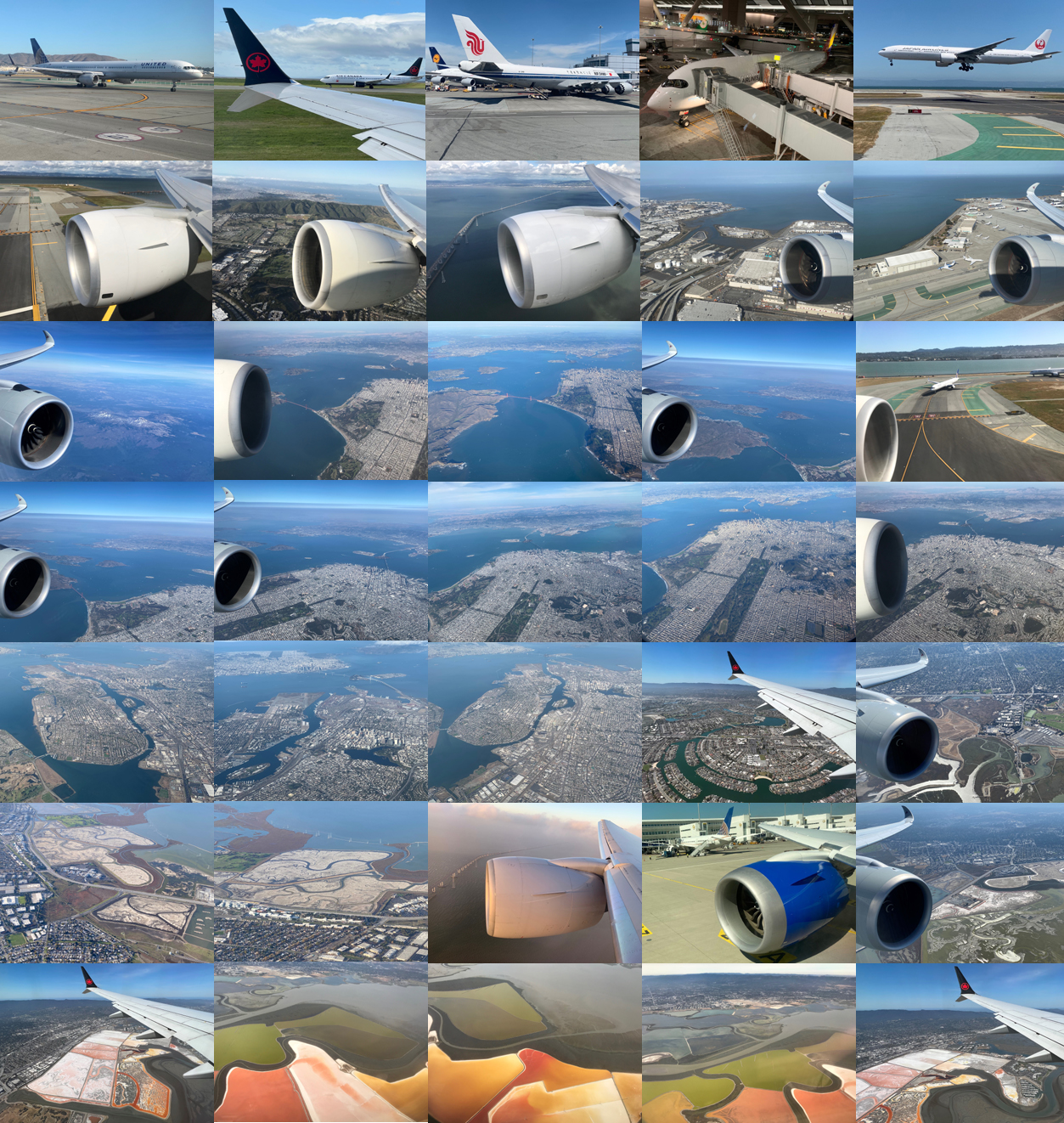
"SFO Ranked As Best Large Airport In U.S." ~ San Francisco Chronicle
Based on reliability, convenience and value, (out of the 50 largest airports in the United States), SFO ranked #1
SFO had the highest number of on-time arrivals (82%) and departures (84%)
SFO has "state-of-the-art" bag sorting, automated security lanes, museum, yoga rooms, and the "Quiet Airport" program - since 2018
5 million people are expected to travel through SFO between Thanksgiving, (2022), and New Year's Day
Leslie Salt Solar Evaporation (Crystalizing) Ponds in San Francisco Bay
The processing of salt dates back to 6,000 BC, when salt was such a valuable commodity, it was transported by boat across the Mediterranean Sea along specially built salt roads across the Sahara on camel caravans. Wars and taxes have been based on salt. The processing of salt dates back to 6,000 BC, when salt was such a valuable commodity, it was transported by boat across the Mediterranean Sea along specially built salt roads crossing the Sahara on camel caravans. Wars and taxes have been based on salt.
The word "salt" is meaningful: Salzburg translates to "salt castle" taking its name from the German word "salz." "Salary" comes from the Latin word for salt. Salt was used as a payment of debts. The word "salad" literally means "salted," and comes from the ancient Roman practice of salting leaf vegetables.
Salt mining in the Bay Area has been going on for longer than California has been a state. The Ohlone Indians pulled salt from the bay, and Gold Rush-era entrepreneurs built primitive dikes to create evaporation ponds and harvest the salt for the Comstock silver mines, which used it to process ore.
The California salt industry started in the 1850s, when the Indians, Spanish and Mexicans gathered salt out of natural tide pools in Alameda County. Today, the average American consumes as much as 250 pounds of salt per year!
Leslie Salt, the West's largest solar-evaporation producer, harvests salt: (sodium chloride NaCl), from the salt evaporation ponds in Redwood City. The giant salt mountain, was located near the Redwood City Marina and Highway 101. In 2006, Cargill ceased production at the Redwood City facility and removed the salt mountain, and the Bay Area lost a classic, glistening landmark.
By a system of levees, seawater is circulated through shallow ponds, some of them 800 acres in size. It takes approximately seven years to evaporate San Francisco Bay water into crystalized salt.
With production headquarters in Newark, California, Leslie Salt operates approximately 50,000 acres of concentrating ponds through which salt water from the ocean flows in a never-ending cycle. The function of these ponds, through evaporation, is to increase the salinity of the slowly-flowing brine to the point where salt will crystallize. At this point, the heavy, reddish brine is transferred to crystallizing ponds where the winds and heat of summer finish the evaporating job and deposit salt crystals in a five-inch layer.
The Pacific Ocean has about 1.2 ounces of solids per liter of sea water, a salinity of 3.5%.
By the 1940s, Leslie Salt under the dominant ownership of the Schilling Family had become the largest private landowner in the Bay Area. By 1959, they were producing more than one million tons of salt annually, on over 26,000 acres of bay salt ponds. They were purchased by Cargill in 1978.
From September through the Christmas season, ponds around Newark yield 700,000 tons of salt, and another 300,000 tons were harvested from the ponds between Redwood City and Alviso.
By the 2000s, the land used for salt harvesting had become so valuable that change was inevitable. Cargill maintained a harvesting facility in the East Bay but began to sell and donate large portions of its land and ponds along the bay. Large tracts would go to the Don Edwards San Francisco Bay National Wildlife Refuge while other areas were pegged for commercial or residential use.
Cargill agreed to sell a 15-acre parcel in Redwood City to pharmaceutical company Abbott Laboratories in the early 2000s. Food-grade salt accounts for only a small part of salt production in industrialized countries (7% in Europe), although worldwide, food uses account for 17.5% of total production.
In 2018, total world production of salt was 300 million tons, the top six producers being China (68 million), the United States (42 million), India (29 million), Germany (13 million), Canada (13 million) and Australia (12 million). Timbuktu became famous for its salt.
Until the 1800's, salt had a terrible-bitter taste as it could not have been over 99.63% pure sodium chloride. Today, it's 99.9% pure. In 1910, Leslie Salt improved the quality of its salt to 99.9% by use of the evaporative method of refinement, and their marketing strategy overwhelmed their competitors. By 1919 they were harvesting 25,000 tons yearly. Leslie Salt acquired more than 40,000 acres of tideland north and south of Redwood City and much of this area was used for the evaporation of salt processing 300,000 tons of salt a year and employing 300 workers. Ten years later Leslie was producing 450,000 tons of salt on 25,000 acres. Due to environmental concerns, silting of the Bay and population pressures, Cargill ceased production of unprocessed industrial salts in Redwood City
San Francisco Strain Brine Shrimp - A.K.A. "Sea Monkeys" are an important component to the salt-making process as natural-occurring algae prevents salt water from crystalizing. The introduction of brine shrimp - which feed on algae, adds redness to the color of the salt ponds allowing the salt to crystalize. Brine shrimp eggs float to the top of the water, where they can be skimmed, cleaned, dehydrated and sold as very expensive tropical fish food. The eggs are highly prized for their small size and high HUFA value. How small are the cysts, you may be wondering, 300,000 cysts per gram, which would yield over 265,000 nauplii per gram, with a hatch rate from 80% to 90% The dehydrated eggs are guaranteed to hatch for up to six years from the date they were canned.
(3 LETTER) AIRPORT & (TWO-DIGIT) AIRLINE CODES
Easy, Fun, and Odd airport codes and airline codes
For your reference: https://airportcodes.aero/iata/G
Airport coding first began in the 1930s, when airlines typically chose their own two-letter codes. By the late 1940s, there were too many airports, and the system shifted to the three-letter code. Los Angeles International Airport, for instance, was originally just "LA," but became "LAX" in 1947. Airport codes such as JFK, DEN, OAK, BOS, MIA and SEA are easy. You can fly nonstop from SIN to HEL if you like. Some airport codes are SAD while others are FAT. Those that are odd, usually involve little-known history.
ORD - Chicago O'Hare. Chicago's airfield started as Orchard Field Airport (OrchaRD) in 1945. In 1949 the airport was renamed Lt. Cmdr. Edward H. “Butch" O'Hare, a naval aviator who died in WWII.
MSY - New Orleans (New Orleans airport is called Louis Armstrong International. The code MSY has nothing to do with the jazz legend. The airport's name was Moisant Field, located in the Moisant Stock Yards or MSY).
MCO - Orlando (Originally a military airfield and known as McCoy Air Force Base)
IPC - Easter Island
IPC - refers simply to Isla de Pascua, the Chilean name for the island. It's Spanish for "Easter Island."
How many airport codes do you know?
After a baseball game, my DAD, MRS 'Kim' SUN, and Robert MAN thought it would be FUN to take my teammates: AMY, BOB, BUD, ELI, EVE, FAY, FLO, JAN, JED, JOE, NAT, ROB, ROY, SAL and myself, out for a HOT meal to EAT PIE, a delicious FAT HOG, and a TUB of ice cream. It really felt like a SIN and we were all going to DIE and go to HEL, unless we went to the GYM, where we could RUN a LAP or two, rather than just take the city BUS. But our AIM was to go to BED and sleep it off in a nice BOX spring mattress - and not TIE one on in a TUB of gin.
There are easy (IATA) two-digit airline codes such as AA, UA, DL and then there are those which make you wonder:
B6 - JetBlue
NH - All Nippon Airways (The code comes from the 1950'ds when the airline was Nippon Helicopter. The airline kept the name Nippon Helicopter after it introduced fixed-wing aircraft in the form of the DC-3 in 1955, but changed to its current name shortly after. The code, however, stuck.)
OK - Czech Airlines
FI - Icelandair (Icelandair began as Flugfelag Islands, or Flight Company of Iceland).
SU - Aeroflot (Soviet Union).
WN - Southwest Airlines Southwest tried for some time to get the code SW from Air Namibia, but ultimately failed because Air Namibia reportedly wanted an exorbitant sum to hand it over. But why does Air Namibia have SW? Because Air Namibia used to be called South West Africa and its airline was appropriately named South West Air Transport.
Tom Taffel
(415) 566-7673
www.TomsGroupCruises.com
Because some experiences in life are simply better when shared with others